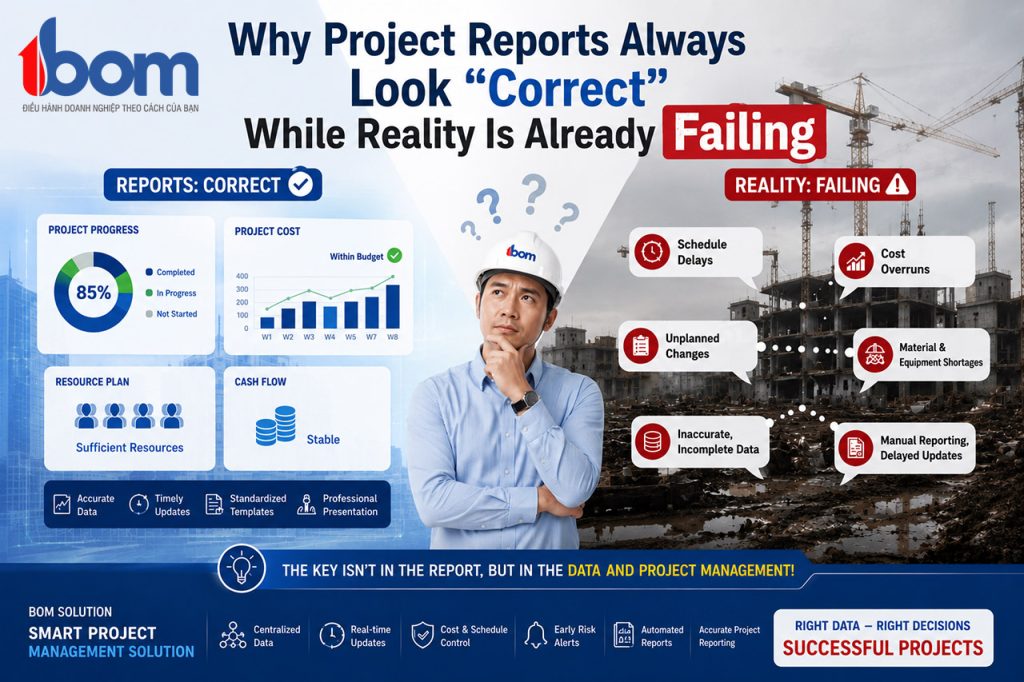

You Don’t Have a Project Problem. You Have a Control Problem.

Many construction companies believe their biggest challenge is project execution.
Delays, cost overruns, coordination issues—these are seen as operational problems.
So the focus is often placed on:
- Improving site management
- Strengthening project teams
- Fixing individual project issues
But after a while, the same problems return.
Across different projects.
Across different teams.
Across different time periods.
At that point, it becomes clear:
The issue is not execution.
It is control.
When Problems Repeat, They Are No Longer Operational

Every project faces challenges.
But when the same types of problems appear repeatedly, they are no longer isolated issues.
They are signals of a deeper structural problem.
For example:
- Cost overruns happening across multiple projects
- Delays occurring at similar project phases
- Resource conflicts repeating across teams
These are not project-level problems.
They are system-level patterns.
And patterns require system-level solutions.
The Illusion of Project-Level Fixes

Most companies respond to problems at the project level:
A delay occurs → the team investigates → a fix is applied.
This creates short-term improvement.
But it does not prevent recurrence.
Because the underlying system remains unchanged.
Fixing projects without fixing the system is like:
Solving symptoms without addressing the root cause.
What “Control” Really Means in Construction

Control is often misunderstood.
It is not about more reporting.
It is not about more meetings.
It is not about tighter supervision.
Real control means:
- The ability to see problems early
- The ability to understand patterns across projects
- The ability to intervene before issues escalate
This requires:
- Structured project data
- Consistent project frameworks
- System-level visibility
Without these, control is only an illusion.
Why Most Construction Companies Lack Control

Despite having experienced teams, many companies lack true control because:
- Data is fragmented across systems
- Projects are managed differently
- Reporting is delayed and inconsistent
- There is no unified view across the portfolio
As a result:
Leadership operates with partial visibility.
And decisions are often reactive.
From Execution Management to System Control
To move forward, construction companies must shift from:
Managing execution → Designing control systems
This means:
- Standardizing how projects are structured
- Integrating project data across the organization
- Building real-time visibility
- Managing at the portfolio level
Platforms like IBOM enable this shift by transforming fragmented project management into structured control systems.
The Leadership Question That Matters
The real question for construction leaders is not:
“How do we fix project problems?”
But:
“How do we build a system where project problems are prevented?”
Because in the long run:
Companies don’t fail because they cannot execute.
They fail because they cannot control.
Đỗ Hữu Binh
CEO, ISOFT
This article is part of a professional series analyzing construction project management and cost control strategies.
© 2026 Đỗ Hữu Binh. All rights reserved.
Any citation or reuse of this content must clearly state the source and author.
- Decision Infrastructure: The Next Competitive Advantage for Modern Organizations
- Construction Schedule Management: How to Plan, Update, and Control Project Schedules
- The Data Blind Spot in Construction Companies
- The Hidden Cost of Quantity Errors Most Construction Project Managers Never See
- Execution Data — The Missing Layer in Enterprise Management