
Why Many Construction Companies Grow Bigger but Become Harder to Control
Growth is often seen as the ultimate sign of success in construction.
More projects.
More revenue.
More teams.
More market presence.
But for many construction companies, growth comes with an uncomfortable reality:
The company becomes bigger, but not necessarily stronger.
Operations become harder to coordinate.
Project performance becomes less predictable.
Leadership becomes more overloaded.
Margins become harder to protect.
This is the scalability trap in construction.
It happens when a company grows faster than its management system can control.
1. Growth Exposes What Small Scale Can Hide
At a smaller scale, many construction companies operate successfully through experience, personal relationships, and direct leadership involvement.
The founder or CEO knows most projects.
Senior managers understand key risks.
Project teams communicate informally.
Problems are solved through personal effort.
This model can work well when the company manages a limited number of projects.
But growth changes everything.
As the number of projects increases, complexity multiplies:
- More project teams
- More subcontractors
- More cost centers
- More reporting layers
- More coordination points
- More decisions happening at the same time
What used to be manageable through experience becomes too complex to control manually.
Growth does not create all problems.
It exposes problems that were already hidden inside the operating model.
2. What Works at Five Projects Often Fails at Fifty
A construction company managing five projects can often rely on strong individuals.
A company managing fifty projects cannot.
At small scale, project managers can communicate directly.
Executives can follow details personally.
Reports can be reviewed manually.
Coordination can happen through meetings, phone calls, and spreadsheets.
But when the company grows, the same approach becomes fragile.
The organization starts to face questions that cannot be answered easily:
- Which projects are beginning to lose margin?
- Which teams are overloaded?
- Which delays are isolated, and which indicate a pattern?
- Which risks are repeating across multiple projects?
- Where should leadership intervene first?
Without a system, the company does not scale.
It only becomes larger.
And becoming larger without better control often creates operational instability.
3. The Hidden Cost of Scaling Without Systems

The scalability trap is dangerous because it does not appear immediately.
Revenue may still grow.
The company may still win projects.
Teams may still look busy.
But beneath the surface, several symptoms begin to appear.
Decision-making slows down
As more projects compete for attention, decisions take longer.
Issues move across departments.
Approvals wait for leadership.
Project teams lack clear escalation paths.
This delay creates cost.
In construction, a late decision rarely stays isolated. It affects procurement, subcontractors, site execution, cash flow, and project schedules.
Visibility decreases
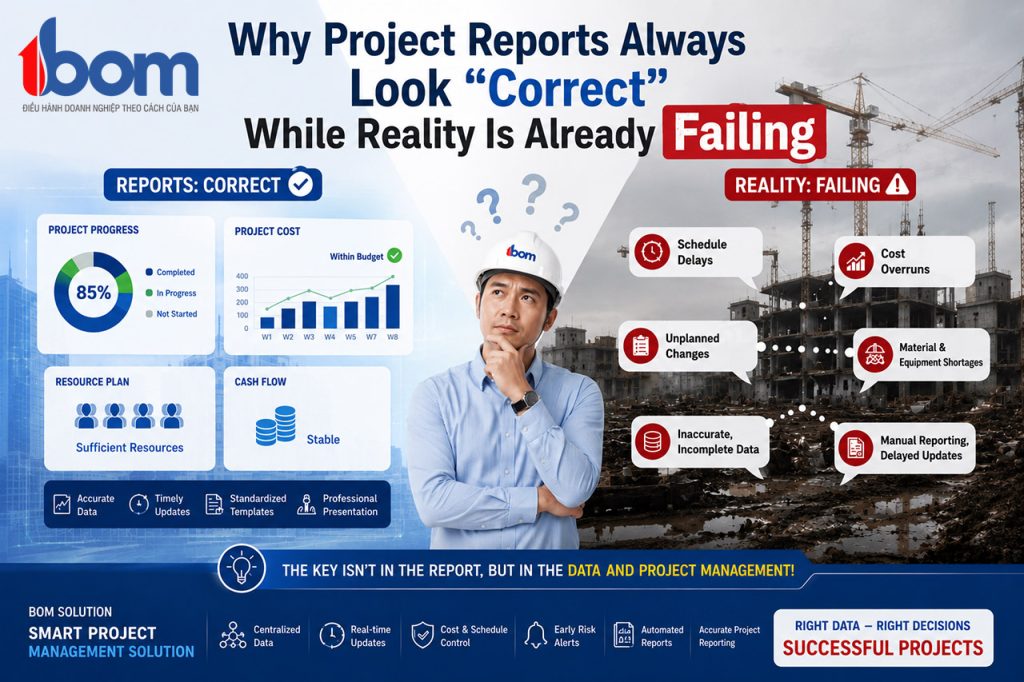
Ironically, larger companies often have more reports but less clarity.
Each project reports in its own format.
Each department tracks its own data.
Each team has its own version of the truth.
Leadership receives more information, but less insight.
Coordination becomes more fragile
As the number of stakeholders grows, coordination becomes harder.
Procurement may not align with site progress.
Finance may not see cost risks early enough.
Project teams may not share lessons across projects.
The company becomes busy, but not synchronized.
Margins become harder to protect
At scale, small inefficiencies become expensive.
A small delay repeated across multiple projects becomes a structural problem.
A small reporting gap repeated across teams becomes a governance problem.
A small cost variance repeated across projects becomes margin erosion.
This is why some construction companies grow revenue but fail to grow profit.
4. The Real Problem Is Not Growth — It Is Uncontrolled Growth

Growth itself is not the problem.
The problem is growing without the right management infrastructure.
Many construction companies assume that if they can execute individual projects well, they can scale the business.
But execution capability and scalability are not the same.
Execution depends on people.
Scalability depends on systems.
Execution answers:
“Can we deliver this project?”
Scalability asks:
“Can we deliver many projects consistently without losing control?”
That is a very different management challenge.
5. From Hero-Based Management to System-Based Management

Many construction companies grow through what can be called a hero-based model.
A few experienced people hold the organization together.
They remember project details.
They solve coordination issues.
They know which risks matter.
They connect information across departments.
This model can create short-term success.
But it creates long-term dependency.
When the company grows, leadership becomes overloaded because too much knowledge and control depend on too few people.
A scalable construction company needs to move from hero-based management to system-based management.
That means:
- Standardized project structures
- Clear roles and responsibilities
- Consistent reporting logic
- Integrated cost, schedule, and progress data
- Portfolio-level visibility
- Repeatable governance mechanisms
The goal is not to remove people from the system.
The goal is to give good people a better system to work within.
6. Why Digital Transformation Fails Without Scalability Thinking
Many construction companies adopt software when they begin to lose control.
But software alone does not solve the scalability trap.
If the organization lacks standardized processes, clear ownership, and structured project data, software may simply digitize the existing chaos.
True digital transformation must start with a scalability question:
“What system do we need so that projects can be controlled consistently as the company grows?”
Only then can technology create real value.
Modern platforms such as IBOM are most effective when they support a broader management shift:
From fragmented project management
to structured project governance.
From individual project control
to portfolio-level visibility.
From reactive execution
to scalable operational control.
7. The Future Competitive Advantage: Scalable Control
In the next phase of construction, competitive advantage will not come only from technical capability or the ability to win more projects.
It will come from the ability to scale without losing control.
The best construction companies will not simply be those that grow fastest.
They will be those that can grow while maintaining:
- Consistent project performance
- Reliable cost control
- Clear organizational accountability
- Real-time management visibility
- Repeatable project governance
The real question for construction leaders is no longer:
“How do we grow bigger?”
But:
“How do we build a company that can grow without becoming harder to control?”
Because in construction, growth without control does not create strength.
It creates risk.
Đỗ Hữu Binh
CEO, ISOFT
This article is part of a professional series analyzing construction project management and cost control strategies.
© 2026 Đỗ Hữu Binh. All rights reserved.
Any citation or reuse of this content must clearly state the source and author.