
Throughout the evolution of enterprises, every major technological shift has raised a fundamental question:
What will happen to the role of humans?
During the first industrial revolution, humans transitioned from manual labor to operating machines.
In the digital era, they evolved into knowledge workers, interacting with data and systems.
Today, with the rise of artificial intelligence, the question returns — but at a much deeper level:
When systems can analyze, learn, and even suggest decisions,
what role remains for humans?
The answer is not replacement.
It is something far more transformative:
👉 augmentation
The future organization will not be:
- purely human-driven
nor - purely AI-driven
It will be:
a system where human intelligence and artificial intelligence combine to create superior operational capability
This is the emergence of:
👉 AI-Augmented Organizations
1. From Automation to Augmentation

The early phase of digital transformation focused on automation.
The objective was clear:
- reduce cost
- increase speed
- eliminate repetitive tasks
However, AI introduces a fundamentally different paradigm.
It does not merely make processes faster.
👉 It makes them smarter
This distinction is critical:
| Automation | Augmentation |
| Replaces tasks | Enhances capability |
| Focuses on efficiency | Focuses on intelligence |
| Reduces human involvement | Elevates human value |
This marks a shift from:
optimizing work
to
optimizing decision-making capability
Autonomous Organization — When the System Starts to Run Itself
2. Organizations as Systems of Intelligence

Traditionally, organizations have been viewed as:
- hierarchical structures
- collections of roles
- chains of command
In the AI era, this perspective becomes insufficient.
Organizations must be understood as:
systems that continuously process information and make decisions
Within such systems:
- data serves as input
- AI provides analytical processing
- humans define direction and intent
- actions represent output
This transforms the organization into:
👉 a continuously operating intelligence system
3. The Three Levels of Augmentation

AI does not impact organizations uniformly.
It enhances capability across three distinct levels.
3.1 Individual Augmentation
At the individual level, AI expands human capability.
Professionals can:
- access information instantly
- interpret complex data more effectively
- make decisions with greater confidence
A project manager, for example, no longer relies solely on experience.
They can:
- anticipate delays before they occur
- understand cross-project dependencies
- evaluate decisions using real-time data
👉 The individual is no longer limited by personal cognitive capacity
3.2 Manager Augmentation
At the managerial level, the transformation is even more profound.
Managers no longer need to:
- manually consolidate reports
- monitor operations reactively
- resolve issues one by one
Instead:
- systems provide continuous visibility
- AI highlights anomalies and risks
- decisions are supported by structured insights
The role of managers evolves from:
👉 coordinators of activity
to
👉 designers of systems and decision frameworks
3.3 Organizational Augmentation
At the organizational level, augmentation creates a new form of enterprise capability.
The organization becomes:
- continuously learning
- dynamically adaptive
- capable of optimizing itself over time
This is the foundation of:
👉 organizational intelligence
4. Decision Augmentation — The Core Transformation

All levels of augmentation converge at a single point:
👉 decision-making
AI does not replace decisions.
👉 It enhances them.
This process includes:
- analyzing large-scale data
- identifying patterns
- generating recommendations
- simulating possible outcomes
Humans, in turn:
- interpret context
- define priorities
- make final judgments
This creates a new model:
👉 human-in-the-loop intelligence
Where:
- AI provides scale and speed
- humans provide judgment and direction
5. The Continuous Intelligence Loop
Traditional organizations operate in fragmented cycles:
- data is collected
- reports are generated
- decisions are made
- actions are executed
In AI-augmented organizations, this evolves into a continuous loop:
Execution → Data → AI → Insight → Decision → Action → New Data
This is not simply a process.
👉 It is a self-reinforcing learning system
The organization no longer reacts.
👉 It continuously evolves based on real-time feedback
6. The Evolving Role of Humans
AI does not diminish human importance.
It elevates it — but in a different direction.
Humans transition from:
- task execution → decision-making
- supervision → system thinking
- operations → architecture
Their primary responsibility becomes:
designing, governing, and improving intelligent systems
7. Common Misconceptions and Failure Modes
Organizations often fail in adopting AI for two reasons:
1. Attempting Full Replacement
Trying to remove humans entirely leads to:
- loss of control
- lack of accountability
- system fragility
2. Preserving Old Operating Models
Keeping traditional structures while adding AI results in:
- underutilized systems
- fragmented workflows
- minimal impact
👉 Success requires balance:
integrating human judgment with system intelligence
8. Competitive Advantage in the AI Era
In the future, competitive advantage will not come from:
- technology alone
- data alone
It will come from:
the ability to effectively combine human and artificial intelligence
Organizations that succeed will:
- make better decisions
- adapt faster
- operate more intelligently
Conclusion
AI does not replace humans.
👉 It redefines their role.
The most powerful organizations will not be fully automated
but those that can amplify human intelligence through systems
Đỗ Hữu Binh
CEO, ISOFT
This article is part of a professional series analyzing construction project management and cost control strategies.
© 2026 Đỗ Hữu Binh. All rights reserved.
Any citation or reuse of this content must clearly state the source and author.
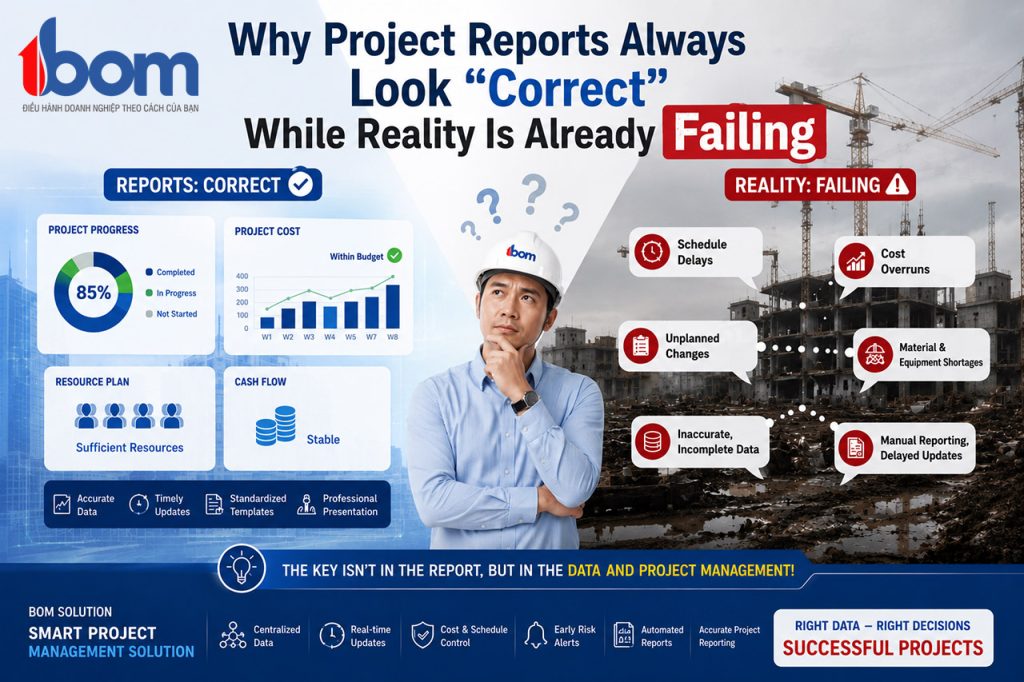
- Why Project Reports Always Look “Correct” While Reality Is Already Failing
- Most CEOs Don’t Have an Execution Problem — They Have an Accountability Problem
- Why Quantity Changes Break Down at Scale in Construction Projects
- Why Construction Companies Are Becoming Data Organizations
- From Data Visibility to Strategic Control: Governance in the Age of AI