
The Illusion of Digital Transformation

Over the last decade, enterprises have invested heavily in digital tools: ERP systems, CRM platforms, collaboration apps, BI dashboards, and cloud storage.
Most companies today have data everywhere.
Yet very few have control.
- Executives can see reports.
- Managers can track KPIs.
- Teams can update progress.
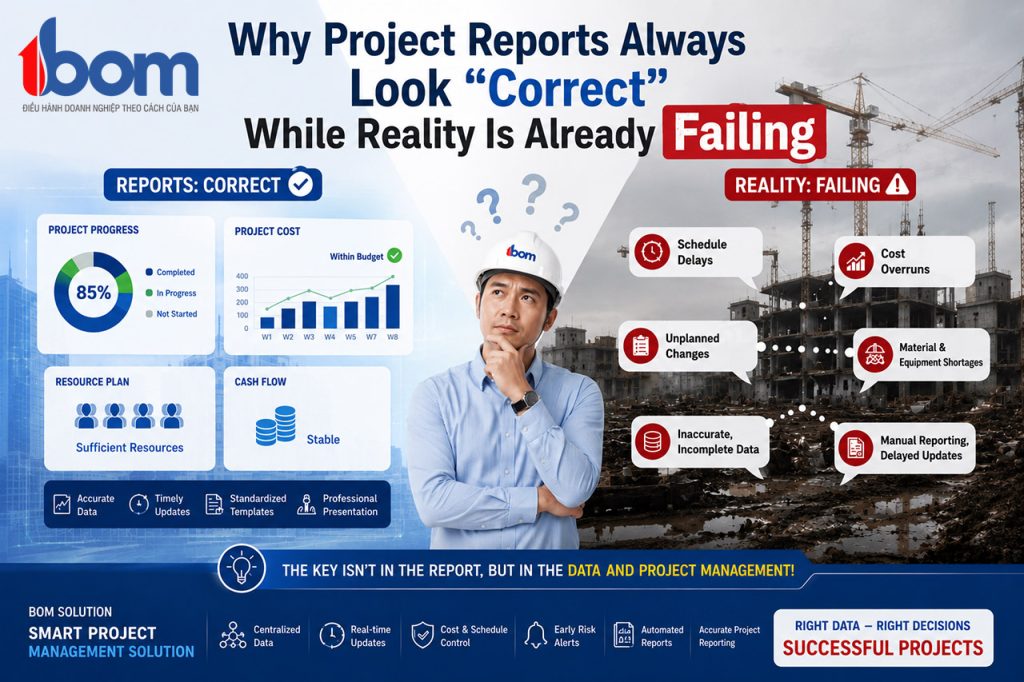
But when a crisis happens — revenue drops, cost overruns, compliance risk, delayed execution — leadership suddenly realizes something uncomfortable:
Visibility is not the same as governance.
In the age of AI, this gap becomes even more dangerous.
Governance in the Age of AI: Why It’s Different Now

AI changes the nature of risk and opportunity.
Before AI:
- Decisions were slower.
- Errors were localized.
- Data misuse had limited scale.
With AI:
- Decisions are automated.
- Errors scale instantly.
- Data quality directly impacts strategic outcomes.
- Algorithms can amplify blind spots.
If your organization lacks structured governance, AI will not make you smarter.
It will simply make you faster — at making mistakes.
Governance in the AI era must answer four critical questions:
- Who owns the data?
- Who defines the rules?
- Who is accountable for decisions?
- How do we ensure alignment from strategy to execution?
Without clear answers, AI becomes a risk multiplier.
From Data Visibility to Strategic Control

Most companies operate at Level 1 or 2 of digital maturity:
Level 1 – Data Collection
Data exists, but scattered across systems.
Level 2 – Data Visibility
Dashboards provide insights. Leaders can “see” what’s happening.
But real transformation happens at:
Level 3 – Strategic Control
Strategic Control means:
- Strategy is broken down into measurable objectives.
- KPIs are aligned from top management to operational teams.
- Every initiative is traceable to a strategic goal.
- Decision rights are clearly defined.
- Accountability is embedded into workflows.
- Risk signals are detected early, not after damage occurs.
This is governance — not just reporting.
The Core Pillars of AI-Ready Governance
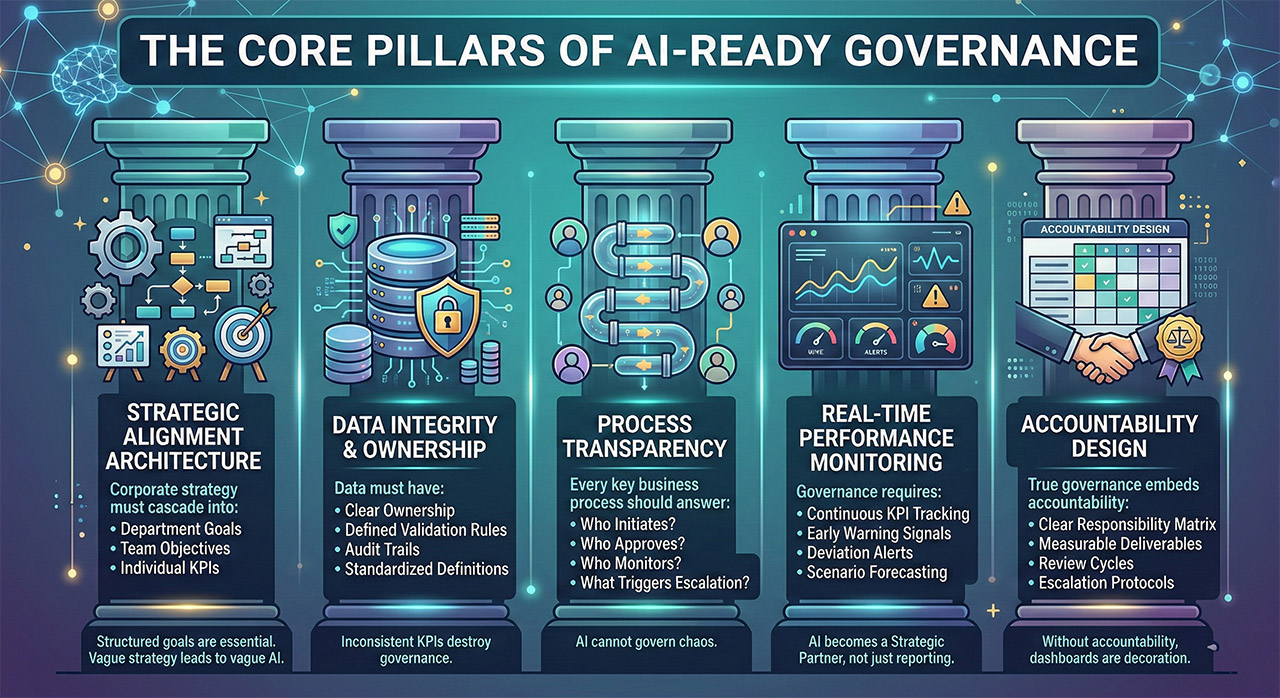
To move from visibility to control, enterprises need a structured governance framework built on five pillars:
1. Strategic Alignment Architecture
Corporate strategy must cascade into:
- Department goals
- Team objectives
- Individual KPIs
AI systems rely on structured goals.
If your strategy is vague, your AI outputs will be vague.
2. Data Integrity & Ownership
Data must have:
- Clear ownership
- Defined validation rules
- Audit trails
- Standardized definitions
Inconsistent KPI definitions across departments destroy governance.
3. Process Transparency
Every key business process should answer:
- Who initiates?
- Who approves?
- Who monitors?
- What triggers escalation?
AI cannot govern chaos.
4. Real-Time Performance Monitoring
Governance requires:
- Continuous KPI tracking
- Early warning signals
- Deviation alerts
- Scenario forecasting
This is where AI becomes a strategic partner — not just a reporting tool.
5. Accountability Design
True governance embeds accountability:
- Clear responsibility matrix
- Measurable deliverables
- Review cycles
- Escalation protocols
Without accountability, dashboards are decoration.
The Hidden Risk: AI Without Governance

Many organizations rush to implement AI tools:
- Predictive analytics
- Automated reporting
- Intelligent recommendations
- AI-driven decision support
But if:
- KPIs are inconsistent,
- Data is fragmented,
- Authority is unclear,
- Strategy is not cascaded,
AI will optimize the wrong things.
And when AI optimizes the wrong things, it does so extremely efficiently.
That is strategic danger.
Governance as a Competitive Advantage
Companies that master governance in the AI era gain:
- Faster but safer decision-making
- Transparent accountability
- Reduced operational risk
- Scalable execution
- Stronger investor confidence
- Higher resilience during crisis
Governance is no longer compliance-driven.
It becomes strategy-driven.
It shifts from “control mechanism” to “growth enabler.”
What Forward-Thinking Enterprises Are Doing
Leading enterprises are:
- Designing governance frameworks before deploying AI.
- Structuring KPIs across the entire organization.
- Integrating strategy management with operational execution.
- Ensuring board-level visibility over performance alignment.
- Building digital platforms that connect objectives, KPIs, initiatives, and results.
They understand:
AI without governance creates noise.
Governance with AI creates strategic power.
The Future: Strategic Control as the New Standard
In the next 5 years, enterprises will be divided into two groups:
- Those with dashboards.
- Those with strategic control.
The difference will not be technology investment.
It will be governance maturity.
And in a world where AI accelerates everything,
the only sustainable advantage is structured control.
Conclusion
Digital transformation was about visibility.
AI transformation is about control.
Enterprises that fail to upgrade their governance architecture will struggle with misalignment, inefficiency, and amplified risk.
Those that succeed will turn AI into a strategic accelerator.
The real question is no longer:
“Do we have data?”
But rather:
“Do we have control?”
Đỗ Hữu Binh
CEO, ISOFT
This article is part of a professional series analyzing construction project management and cost control strategies.
© 2026 Đỗ Hữu Binh. All rights reserved.
Any citation or reuse of this content must clearly state the source and author.