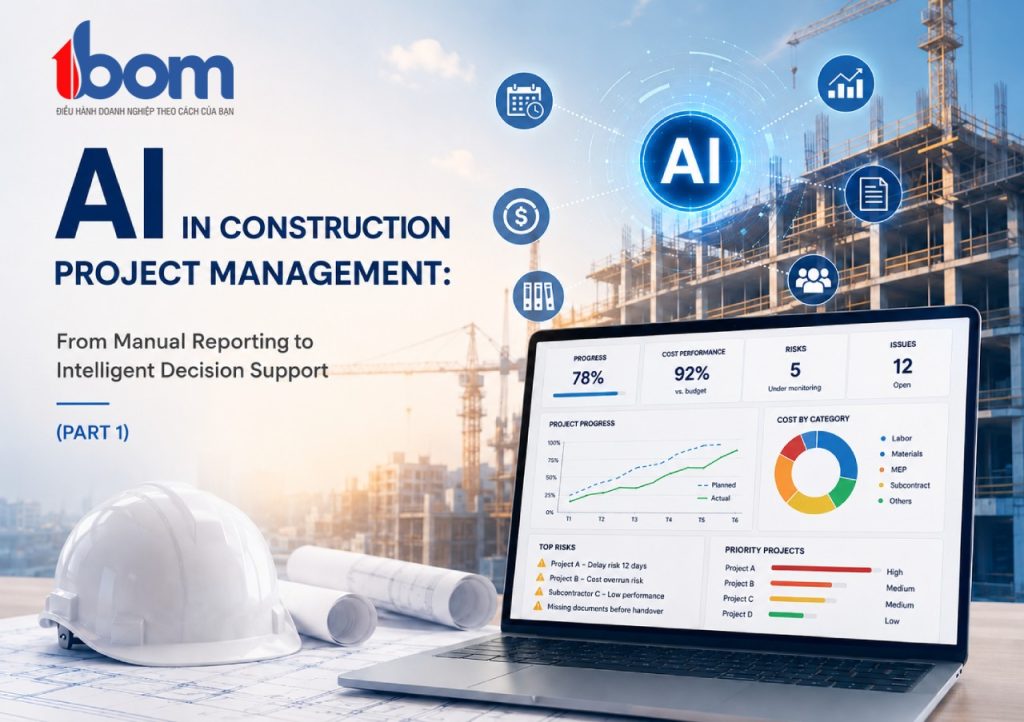

In many construction companies, project reporting is already highly structured.
Weekly progress reports are submitted.
Monthly cost reports are prepared.
Every department provides numbers.
Dashboards show green, yellow, and red indicators.
Every management meeting has summary files and charts.
On paper, everything appears to be under control.
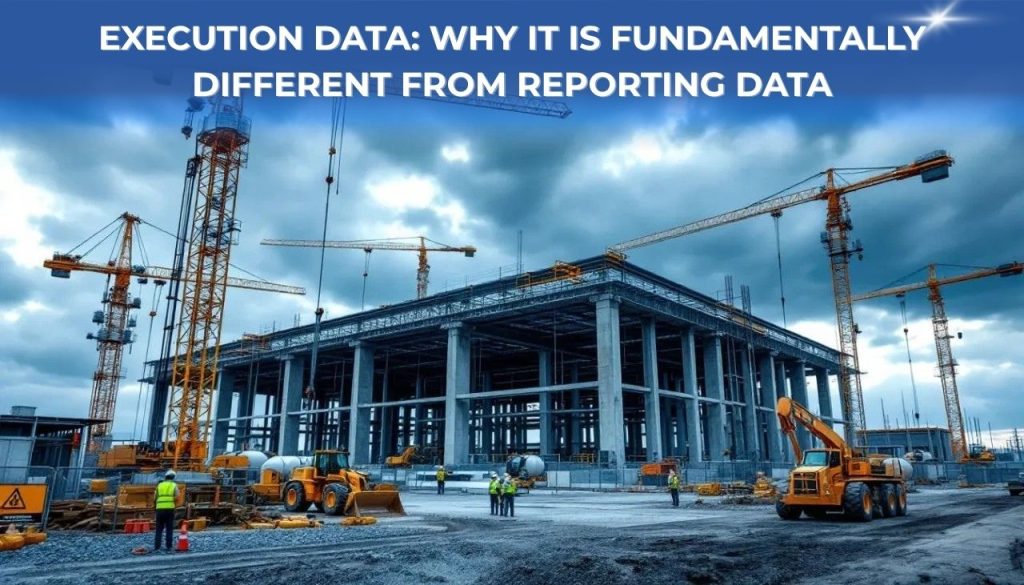
But on the construction site, reality is often very different.
A critical work package has already started slipping.
A subcontractor is running short on manpower.
Key materials have not arrived on time.
A design revision has not reached the site team yet.
Additional costs are already emerging but have not appeared in the consolidated reports.
And then one day, leadership suddenly realizes:
The reports were technically correct.
But the project had already gone wrong long before anyone noticed.
This is one of the biggest paradoxes in modern project management.
The problem is not the lack of reports.
The problem is that reports usually reflect the past, while projects evolve every hour.
1. Reports Are Often Correct — But Only for a Moment That Has Already Passed
A project report may be completely accurate at the time it is created.
The schedule numbers may be correct.
The cost figures may be correct.
The contract status may be correct.
The completed quantities may be correct.
But between the moment data is collected, consolidated, reviewed, approved, and delivered to leadership, reality on site may already have changed.
In construction, even a few days can completely alter the situation.
A one-day subcontractor delay can affect multiple downstream activities.
A late material delivery can stop an entire crew.
A delayed approval can interrupt the execution flow.
A design adjustment can create cascading impacts across several work packages.
This means reports can be numerically correct while still failing from a management perspective.
Because project management is not only about understanding what happened.
It is about understanding:
what is happening now,
what is likely to happen next,
and what action must be taken immediately.
When Does a Construction Project Actually Start Falling Behind?
2. Information Gets “Smoothed” Through Management Layers

Site information rarely reaches executives directly.
It usually travels through multiple layers:
- site engineers
- supervisors
- project management teams
- planning departments
- finance teams
- executive management
Every layer summarizes the information further.
Summarization itself is not wrong.
But during this process, many operational details disappear.
A serious field issue becomes “under control.”
A schedule delay becomes “recoverable.”
A procurement risk becomes “being coordinated.”
A technical conflict becomes “manageable.”
As information moves upward, reports become cleaner, shorter, and easier to present.
But they also become more disconnected from operational reality.
This is dangerous because:
The higher information travels, the more execution detail tends to disappear.
Yet those small operational details are exactly where risks begin.
3. Reports Focus on Results Instead of Causes
Most project reports focus on outcomes:
- percentage of completion
- budget consumption
- completed quantities
- payment status
- remaining work
These metrics are necessary.
But they are not enough.
Because leadership does not only need to know that a project is delayed.
Leadership needs to understand why.
Is the delay caused by manpower shortages?
Late materials?
Design changes?
Approval bottlenecks?
Poor subcontractor coordination?
Unrealistic planning assumptions?
Without understanding root causes, companies often make the wrong decisions.
For example:
A company sees delays and immediately increases manpower.
But the real issue is missing shop drawings.
A company sees rising costs and aggressively cuts spending.
But the actual problem is uncontrolled design changes.
A company penalizes subcontractors for slow progress.
But the real issue is poor coordination across the entire project.
Reports may correctly describe the symptoms while completely missing the underlying causes.
And decisions based on incomplete understanding often make problems worse.
4. Reports Show Static Conditions, Not Dynamic Trends

A report may show that a project is currently 65% complete.
But the more important question is:
At the current execution speed, will the project actually finish on time?
This is the difference between status and trajectory.
Status shows where the project is today.
Trajectory shows where the project is heading.
Many companies only look at status indicators and therefore believe everything is still manageable.
For example:
- current progress is acceptable
- costs are still within budget
- subcontractors are still working
- inventory levels still look sufficient
But when viewed as trends, the picture may look very different:
- productivity is declining
- cost escalation is accelerating
- material shortages are approaching
- unresolved issues are accumulating
- subcontractor responsiveness is weakening
Traditional reporting behaves like a static photograph.
But projects are moving systems.
If leadership only sees snapshots, they may completely miss the direction in which the project is actually moving.
5. Reports Separate Schedule, Cost, and Risk
Another major problem is that project information is often fragmented by department.
Planning teams report schedules.
Finance teams report costs.
Procurement teams report materials.
Contract teams report payments.
Project teams report field execution.
Each report may be individually correct.
But isolated reports rarely reflect the real operational picture.
In construction, schedule, cost, procurement, contracts, and risk are deeply interconnected.
A delayed material delivery affects schedule.
Schedule delays increase cost pressure.
Cost pressure impacts cash flow.
Cash flow issues weaken subcontractor performance.
Weak subcontractor performance creates further delays.
If reports remain disconnected, leadership cannot see these relationships.
They see many correct pieces.
But they fail to see that the overall system is already drifting out of control.
This is why many companies have extensive reporting systems yet still struggle to manage projects effectively.
The issue is not the lack of reports.
The issue is the lack of connected operational visibility.
6. Reports Usually Arrive After the Best Intervention Window Has Passed
In project management, timing matters as much as the problem itself.
A problem discovered early is often inexpensive to fix.
The same problem discovered late can become extremely expensive.
For example:
A work package shows early signs of delay in week one.
If detected immediately, the company can adjust manpower, materials, sequencing, or equipment allocation.
But if leadership only recognizes the issue three weeks later through reporting, the delay may already have propagated across multiple dependent activities.
At that point, the company may need to:
- add overtime
- increase manpower
- reallocate equipment
- accept additional costs
- renegotiate schedules
- accelerate procurement
The same issue becomes significantly more expensive simply because it was detected too late.
This is one of the biggest weaknesses of traditional reporting:
It often tells companies about problems after the optimal intervention window has already disappeared.
7. Reports Are Not Wrong — But They Are No Longer Enough
Reports are still necessary.
Companies still need reporting for:
- governance
- accountability
- tracking
- auditing
- strategic reviews
But reporting alone is no longer sufficient for modern project control.
Modern project management requires:
- real-time execution data
- operational visibility
- early warning systems
- cross-functional integration
- root cause traceability
- predictive analytics
- execution coordination
Reports answer the question:
What happened?
Modern execution management must also answer:
What is happening now?
What is likely to happen next?
Who needs to act?
Has the action already been executed?
What result did the action produce?
This is the difference between reporting and execution control.
8. From Reporting Mindset to Execution Visibility
Many companies still operate under a reporting mindset.
Meaning:
- wait for data collection
- wait for reports
- wait for meetings
- wait for decisions
- then finally act
This approach may still work in stable environments.
But modern construction projects operate in highly dynamic conditions where:
- schedules shift daily
- costs fluctuate continuously
- materials change
- manpower changes
- subcontractor conditions evolve
- field realities constantly move
In this environment, reporting alone is too slow.
Companies must move toward execution visibility.
Execution visibility means:
- data is captured where work actually happens
- problems are detected while they are still small
- leadership sees operational reality directly
- decisions are made based on live execution data
- actions are tracked and measured continuously
Reports do not disappear.
But reports become outputs of an operational intelligence system rather than the primary mechanism for understanding operations.
Conclusion
Project reports can be technically correct while projects are already operationally failing.
Because companies do not only need historical summaries.
They need the ability to see execution reality early enough to act.
In modern project management, the truth does not fully exist inside reports.
The truth exists where execution is happening:
- on the construction site
- inside material flows
- inside workforce productivity
- inside equipment conditions
- inside unresolved field issues
- inside emerging operational risks
Strong companies are not the ones with the most reports.
Strong companies are the ones capable of transforming execution data into visibility, decisions, coordination, and strategic control.
Reports help companies understand the past.
Execution visibility helps companies control the future.
Đỗ Hữu Binh
CEO, ISOFT
This article is part of a professional series analyzing construction project management and cost control strategies.
© 2026 Đỗ Hữu Binh. All rights reserved.
Any citation or reuse of this content must clearly state the source and author.