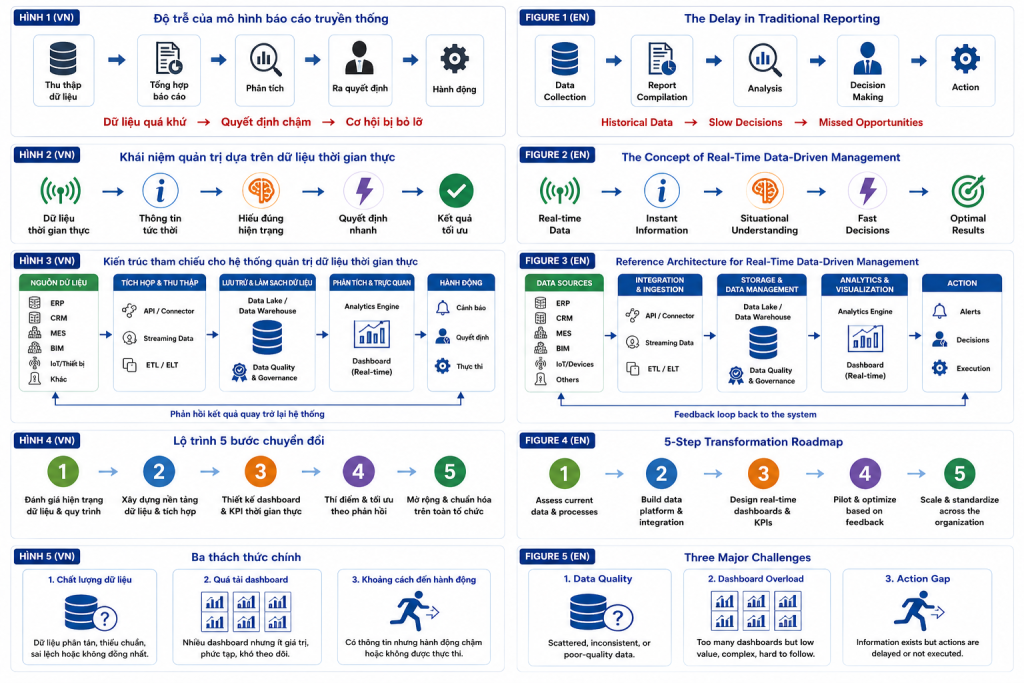

A production plan is not proof that a factory can execute it. The gap between intention and delivery emerges from capacity constraints, material flow, quality holds, interdependent operations and slow responses to change. This article explains how reliable operational data and disciplined decisions can narrow that gap.
1. Why manufacturing management must move beyond output reports
A factory can meet its daily output target and still miss customer deliveries. Production may be concentrated in the wrong product mix, upstream processes may exceed downstream capacity, and finished quantities may not match the orders that are due. Aggregating everything into one output figure conceals these imbalances without removing them. Modern operations management must therefore ask not only how much was produced, but which products, for which orders, at which operation, and whether they are ready for the next stage.
Real-time management does not require executives to watch machines every second. It means shortening the interval between a meaningful event, its reliable capture, and a decision. When a critical machine fails early in a shift but the issue is reviewed only at the end of the day, the organization loses the opportunity to reassign work, adjust material flows or protect delivery commitments. Timely, verified information changes the range of decisions that remains available.
A dashboard is valuable only when it reflects operational reality. Visualizing yesterday’s manual updates with attractive graphics does not create a responsive production system.
2. Customer orders are inputs, not executable production plans
An order establishes product requirements, quantity and delivery commitment. Turning that commitment into executable work requires a different set of decisions involving product structures, bills of materials, process routes, outsourced operations, equipment availability and quality-released inventory. A schedule that ignores these constraints is a statement of intent rather than a feasible plan.
Large orders may need to be split across batches because of setup time, storage limits or finite machine capacity. Combining similar orders can reduce changeovers, but it may delay an urgent customer requirement. Planning must reconcile delivery priorities with setup losses, intermediate inventory and the consequences for other customers. The appropriate rule depends on the production environment.
When a customer changes an order, the business must identify which work orders, material commitments and already-started operations are affected. Merely editing the promised date transfers the problem from sales to the shop floor.
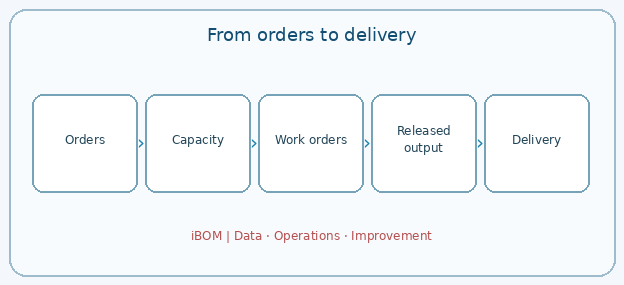
Figure 1. From orders to delivery
3. Planning with effective capacity instead of nominal machine ratings
Nominal capacity describes an idealized operating condition. Effective capacity is reduced by changeovers, maintenance, scrap, staffing and material availability. A machine scheduled for an eight-hour shift does not necessarily produce eight hours of acceptable output. Plans based solely on rated speed tend to appear feasible until actual production begins.
Capacity balancing must be performed at the relevant work center and shift, with particular attention to constrained operations. If one process can complete only 80 units per hour, feeding it 120 units per hour from upstream does not raise finished output. It raises work in process. The managerial priority is to protect the constraint from starvation and avoidable downtime rather than to maximize every machine’s utilization.
This distinction also helps separate a structural capacity shortage from temporary capacity loss. Additional capital equipment may be justified for a persistent bottleneck, while poor maintenance timing or unreliable material supply may be corrected through better coordination first.
4. Connecting planning horizons and controlling rescheduling
Monthly planning supports procurement and staffing decisions, while weekly, daily and shift-level scheduling assigns executable work to available resources. These horizons are related but serve different purposes. When they are managed independently, factories can have an apparently complete master plan and still spend every shift responding to emergencies.
A stable baseline is needed to measure deviations, together with explicit rules for rescheduling. A ten-minute interruption may be absorbed within the shift; a three-hour failure at a constrained machine may require multiple downstream orders to be replanned. Rescheduling every minor event is also costly because it destabilizes teams and material movements.
Operational governance must specify who may change priorities, which exceptions require escalation, when schedules are frozen and how revised instructions reach stores, maintenance, quality and production crews. The discipline of changing plans is as important as the planning algorithm.
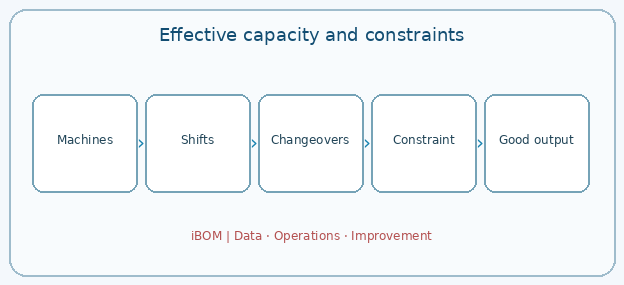
Figure 2. Effective capacity and constraints
5. Materials and work in process govern the flow of production
A work order is genuinely ready only when the correct materials, revisions and quantities have been released for use at the required location. Aggregate stock balances can be misleading: inventory may be under inspection, reserved for another order or physically distant from the line. Releasing orders before verifying readiness creates waiting, switching and partially completed work.
Work in process must be tracked by its operational status rather than as an undifferentiated quantity. Output from one process that has not passed its required checks may be unavailable to the next. If the system treats production completion as automatic downstream availability, the schedule overstates what can actually be assembled or shipped.
Effective flow management links material and lot identifiers to work orders, locations, operations and inspection outcomes. The goal is not universally minimal inventory; it is the right buffer at the right constraint without accumulating stock that does not contribute to customer delivery.
6. Capturing shop-floor events with the right context
Operational data may come from equipment signals, barcode scans, electronic forms or operator confirmations. Each source has limits. A sensor may establish that a machine is running without identifying the correct order; an operator may know the reason for downtime but enter it late; a warehouse transaction confirms issue rather than actual consumption. Reliable management combines these perspectives instead of treating one signal as complete truth.
Useful records distinguish event time from entry time and identify the machine, work order, person and verification status. This is essential when connectivity is interrupted or entries are backfilled. Otherwise a supposedly live dashboard can conceal hours of reporting delay.
Start with the events that change decisions: work-order starts and completions, downtime, changeovers, material shortages, accepted output, rejected output and handovers between operations. Capturing data that no one uses imposes cost and can weaken reporting discipline.
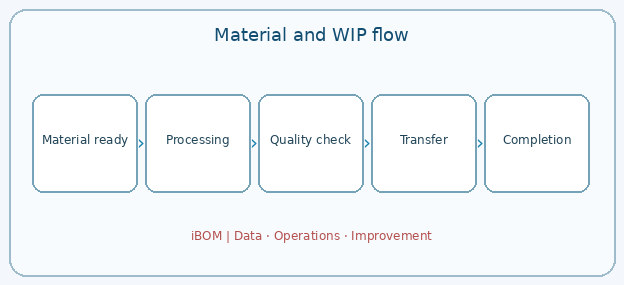
Figure 3. Material and WIP flow
7. Understanding lost performance rather than chasing output alone
Low output is an outcome, not a diagnosis. Managers need to understand whether time was lost to equipment failure, reduced running speed, long setups, late materials or rework. Two lines achieving the same percentage of plan may require entirely different interventions. A generic instruction to increase productivity does not identify the underlying constraint.
Overall Equipment Effectiveness (OEE) combines availability, performance and quality into a useful equipment-level diagnostic. It should not, however, be confused with factory-wide delivery performance. A machine can achieve high OEE while producing the wrong mix and increasing inventory; a deliberate stop to avoid overproduction may be economically sensible.
Equipment measures therefore need to be read alongside on-time delivery, work in process, cycle time, first-pass yield and schedule adherence. The purpose of measurement is to explain relationships and guide action, not to optimize isolated figures.
8. Making quality and maintenance part of daily execution
When a batch fails inspection, the consequence extends beyond the recorded scrap quantity. Managers need to know which lots are on hold, which orders depend on them and whether downstream work must be rescheduled. A disconnected quality system allows production planners to assume material is available until a shortage appears at assembly or shipping.
Maintenance must also be coordinated with demand. Deferring preventive work to meet an urgent order can create a longer outage later, while scheduling maintenance during low-load periods can protect delivery commitments. Decisions should consider equipment criticality, condition signals, repair duration and affected orders.
Quality, maintenance and scheduling must share a consistent picture of usable equipment and released product. A quarantined lot or unavailable machine changes the feasible plan immediately, not merely the next day’s report.
9. Managing by exception so that alerts lead to decisions
Managers cannot personally review every small variation across hundreds of machines and orders. A useful operations system distinguishes normal fluctuation from exceptions that threaten delivery, safety, quality or cost. An alert should identify the affected machine, order, downstream dependency, likely time impact and accountable owner, rather than simply announce that something stopped.
Alerts must arrive while corrective options still exist. A material shortage warning issued two hours before consumption is of little preventive value if replenishment takes two days. When expected repair time exceeds the schedule buffer, the appropriate response may be rerouting or customer communication rather than waiting for maintenance alone.
Decisions, owners, deadlines and results should be recorded. Without accountability, alerts become noise. With a feedback loop, the factory can learn which interventions actually improve performance.
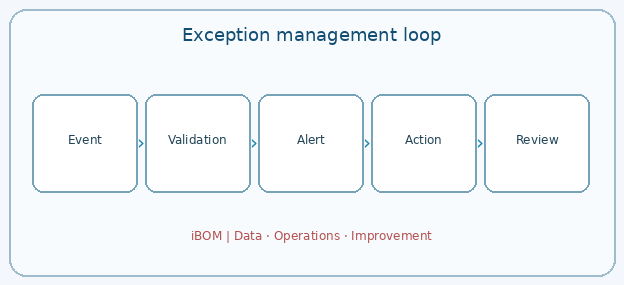
Figure 4. Exception management loop
10. Illustrative case: output targets met while deliveries slip
Consider a hypothetical factory with machining, surface treatment and assembly. The daily requirement is 800 finished units. Machining completes 1,000 components, exceeding its departmental target, but surface treatment releases only 650 acceptable sets because of repeated changeovers. Assembly receives insufficient inputs and completes just 620 units. These figures are illustrative and are not presented as observations from a real facility.
A management report focused on machining volume might suggest that production is ahead. In reality, 350 components are waiting for treatment and the 800-unit delivery commitment is missed. Asking machining to increase output by another ten percent would not resolve the constraint; it would add storage requirements and working capital tied up in unfinished goods.
An integrated system would show the treatment bottleneck, changeover pattern, inspection holds and affected orders. Managers could evaluate compatible batch grouping, targeted overtime, priority changes or alternative capacity. Success must be judged by released finished goods and actual delivery, not by machine hours alone.
11. Data architecture and the role of operational systems
Connecting plans to execution requires consistent identifiers for orders, products, bills of materials, process routes, work centers, work orders and operation results. Enterprise Resource Planning (ERP) typically manages commercial orders, purchasing, inventory and finance; Manufacturing Execution Systems (MES) generally support work orders, operations, equipment and shop-floor reporting. Actual boundaries vary by organization and implementation.
The objective is not to purchase every category of software. It is to establish trustworthy relationships among records. A work order should link to its customer demand; downtime should link to a machine and time interval; a defective lot should link to its operations and materials. Without these connections, separate departmental reports may look complete while the business cannot explain late delivery.
For iBOM, one potential direction is a coordination and work-management layer that links corrective tasks, milestones, accountability and operational data from existing systems. This is a proposed architecture, not a claim that iBOM already provides full MES, machine connectivity or finite-capacity scheduling. Deployment requires a capability assessment and clear ownership of source data.
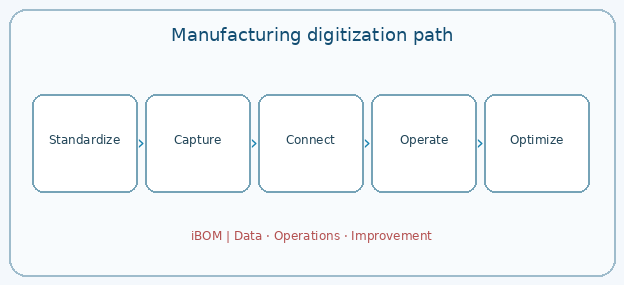
Figure 5. Manufacturing digitization path
12. A measurable implementation roadmap
Factories should avoid digitizing every workshop at once while item codes, standard times and output-confirmation rules remain inconsistent. A practical pilot is a repeatable product family with a relatively stable route and a visible delivery or work-in-process problem. The team should map material and information flows, identify the constraint, standardize work-order states and agree how to record downtime, accepted output and rejects.
Once baseline records are reliable, the factory can introduce shift-level operational views, planned-versus-actual monitoring, exception ownership and documented corrective action. Predictive models for late orders, sequence recommendations or algorithmic scheduling should follow only when sufficient consistent historical data exists. AI cannot compensate for weak operational definitions.
The pilot should be evaluated through on-time delivery, inter-operation waiting, work-in-process inventory, response time and operating cost, with adjustments for changes in product mix. Sustained improvement provides the basis for expansion to additional lines and plants.
Conclusion
Modern manufacturing management is neither a dashboard nor a scheduling algorithm. It begins with accurate customer demand, a realistic view of process capacity, reliable material and product states, and accountable responses to exceptions. When plans are continuously tested against trustworthy execution data and decisions are evaluated through delivery outcomes, real-time operations become a practical management capability. This foundation is also necessary before AI can credibly predict disruption or optimize production decisions.
Professional references and conceptual foundations
- ISO 22400-2:2014 – Automation systems and integration — Key performance indicators (KPIs) for manufacturing operations management — Part 2: Definitions and descriptions.
- IEC 62264 / ISA-95 – Enterprise-control system integration.
- APICS / ASCM – Production and inventory management, capacity planning and material requirements planning.