
In many construction companies, digital tools are already in place. Teams use software for drawings, spreadsheets for quantities, messaging apps for coordination, and accounting systems for finance.
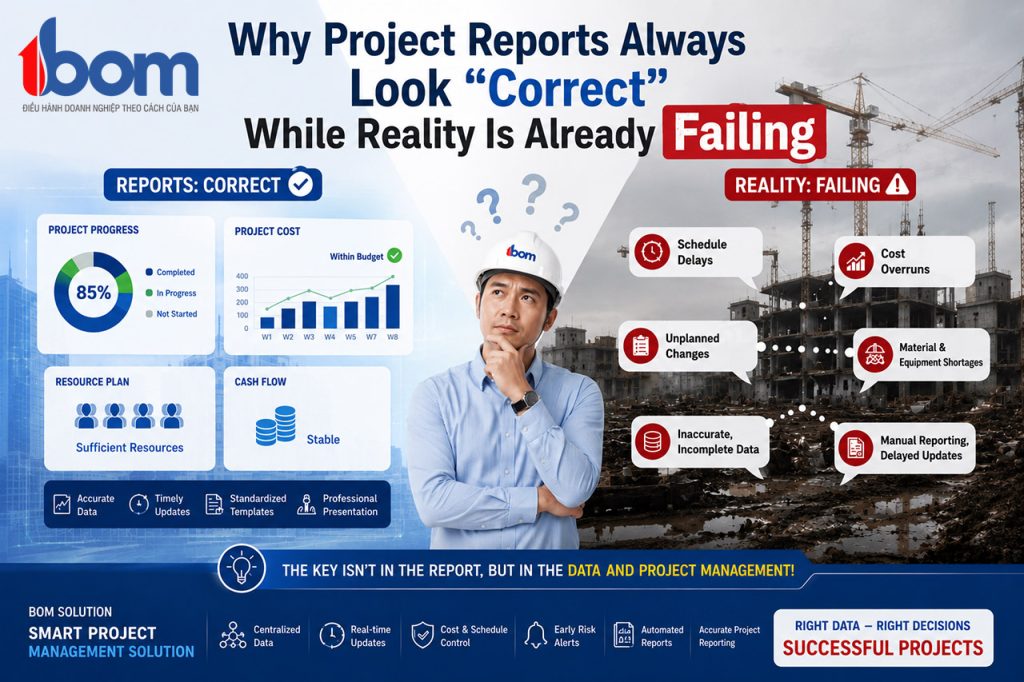
On the surface, everything seems “managed.”
But at the management level, leaders still ask the same questions:
- Why are costs rising even when progress looks on track?
- Which change orders are truly impacting profit?
- Where exactly are delays forming right now?
- Which projects are healthy — and which ones are only “looking fine” on reports?
The problem is not a lack of tools.
The problem is fragmentation.
Managing Work Is Not the Same as Operating a Project

Most systems help teams do their tasks.
Few systems help leaders operate the project as one living system.
Construction projects are not a collection of isolated activities. They are a network of:
- Quantities
- Costs
- Schedules
- Contracts
- Variations
- Payments
- Responsibilities
When these elements are not connected, management becomes reactive.
Leaders don’t see problems early — they only discover them after damage is done.
Operating a project means:
Not just knowing what has been done,
but understanding what is happening, what is changing, and what it means for cost, time, and risk.
The Shift: From Data Recording → Operational Control

Modern construction teams are moving toward a new approach:
| Old Way | New Way |
| * Record data after work happens | * See impact while work is happening |
| * Separate tools for each department | * One connected operational structure |
| * Manual consolidation for reports | * Real-time management view |
| * Problems detected late | * Risks visible early |
This shift turns digital tools into something bigger than software.
They become the operational layer of the project.
How IBOM Supports Project-Level Operation
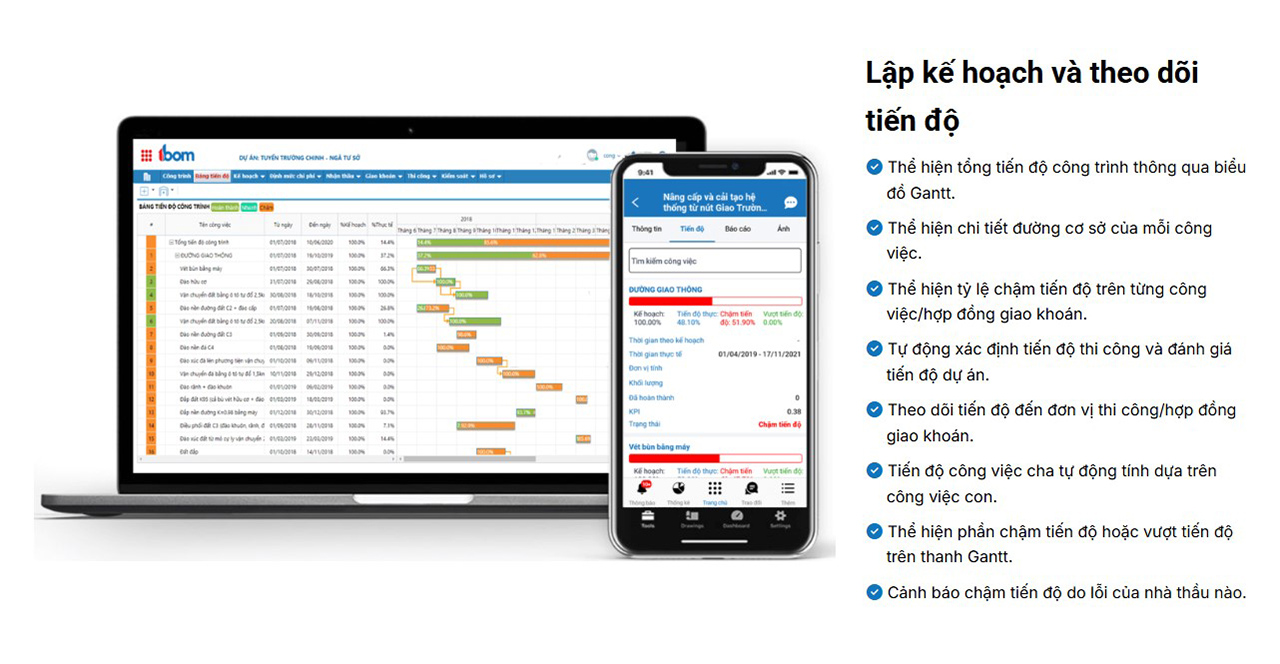
IBOM is designed not just as a task or document tool, but as a project operating environment where key elements are connected:
- Quantities link with cost and progress
- Changes connect to budget impact
- Site execution ties to contractual scope
- Financial control reflects operational reality
Instead of managers chasing data across departments, the system itself reflects how the project truly works.
This allows leaders to move from:
👉 “Collecting reports”
to
👉 “Operating the project based on live structure and data”
The Result: Less Chaos, More Control — Without More Complexity

The goal of digital transformation in construction is not to add more work.
It is to reduce uncertainty.
When projects are operated as systems:
- Decisions become faster
- Risks are seen earlier
- Variations are controlled, not just recorded
- Costs align better with reality
- Management time shifts from firefighting to steering
That is the real evolution — from digital tools to digital operations.
Đỗ Hữu Binh
CEO, ISOFT
This article is part of a professional series analyzing construction project management and cost control strategies.
© 2026 Đỗ Hữu Binh. All rights reserved.
Any citation or reuse of this content must clearly state the source and author.
- Why Future Construction Companies Need an Operating System
- How Modern Construction Teams Build Systematic Control Over Quantities, Costs, and Changes — Without Adding Complexity
- Báo cáo công nợ phải thu chính xác nhất bằng phần mềm IBOM.SCM 1
- AI Will Not Replace Managers — It Will Expose Them
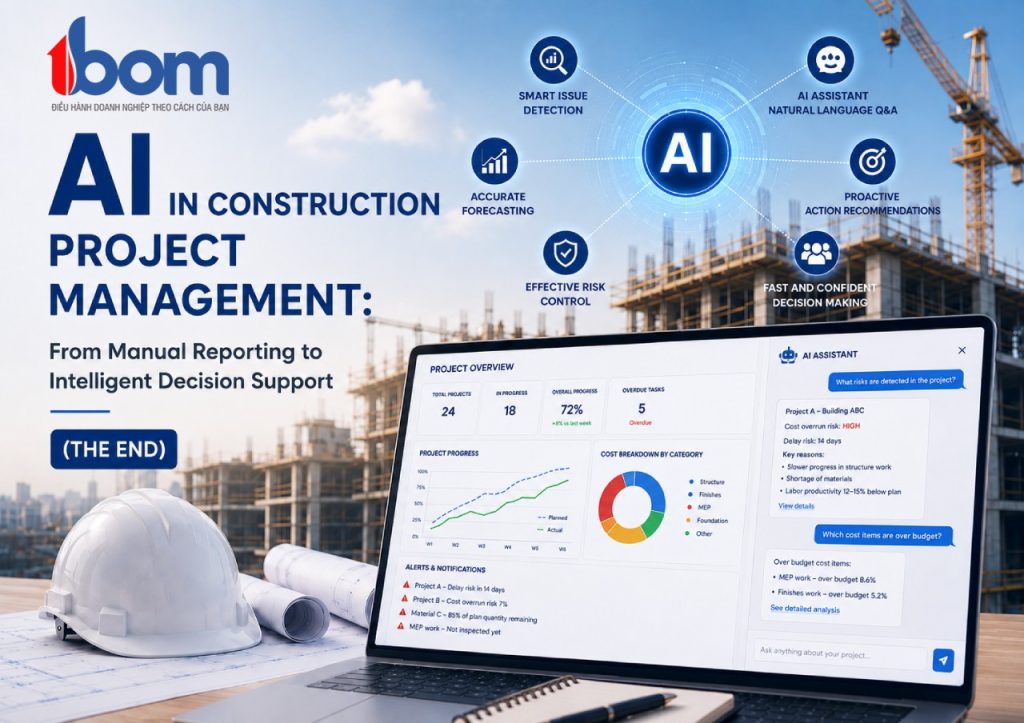
- AI in Construction Project Management: From Manual Reporting to Intelligent Decision Support (The end)