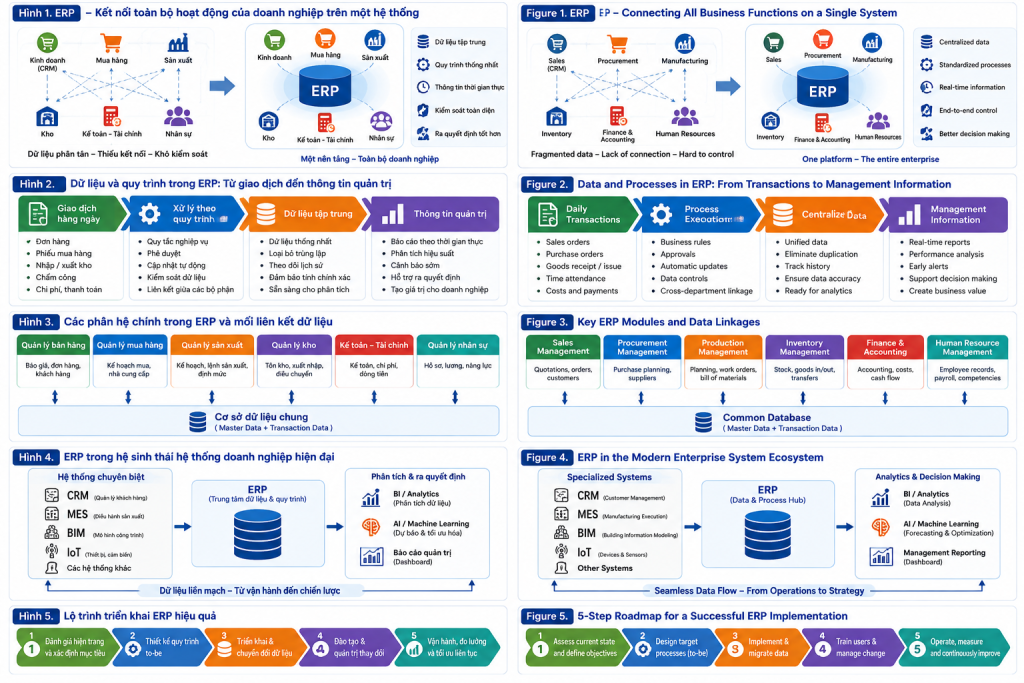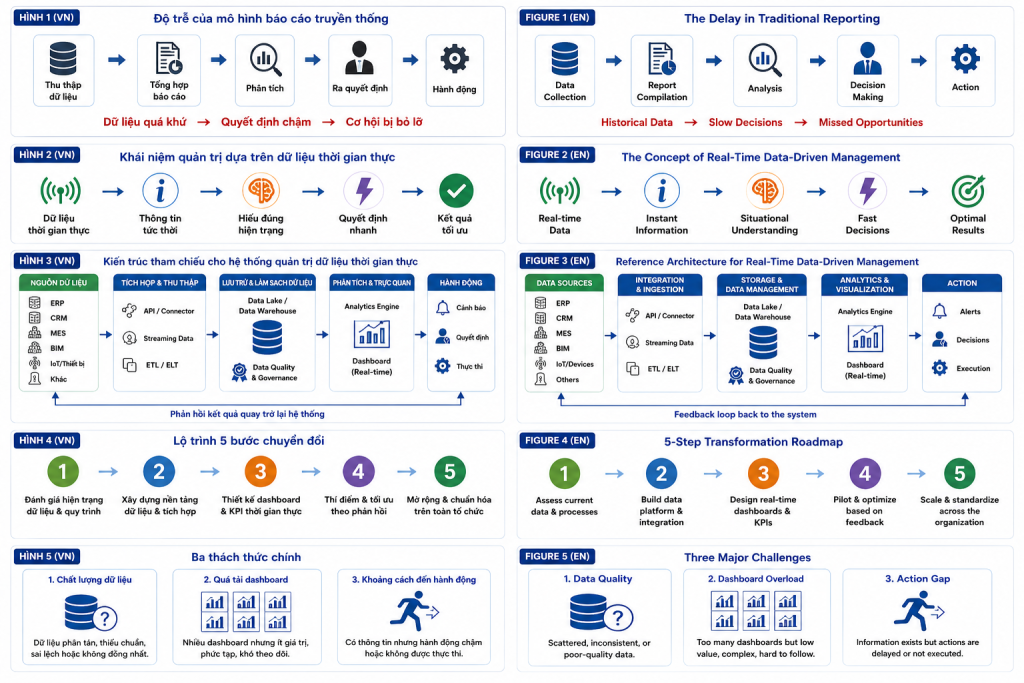

For years, enterprise digitization focused on recording more complete data and producing reports faster. ERP, BI and modern data platforms now allow managers to see revenue, cost, inventory, progress and performance with very low latency. Yet visibility does not automatically produce better decisions. A large gap still exists between a signal on a dashboard and an action that changes the business outcome.
The previous article examined five data layers required for enterprise management: master, transactional, execution, analytical and contextual data. Together, these layers allow the organization to understand not only what has happened but what is happening now and in what business context. The next step is to turn that foundation into a higher-order capability: decision capability.
This is where AI becomes strategically important. AI can detect signals across large data volumes, identify patterns that humans may miss, forecast scenarios, compare alternatives and recommend action. But another forecast or conversational interface is not the end of the value chain. Value emerges when insight becomes a decision, the decision becomes action, and the outcome feeds back into the system so it can improve.
1. The enterprise problem is increasingly the gap between data and action
An organization can operate hundreds of dashboards and still make decisions slowly. Dashboards generally stop at presentation. When an indicator turns red, people must still determine whether it matters, gather related evidence, ask other functions for context, diagnose causes, evaluate options and assign action. In complex processes, connecting these steps can consume more time than viewing the report itself.
Consider a potential material shortage. Current inventory alone is not enough to decide whether to buy. The enterprise also needs future demand, open purchase orders, supplier lead times, transferable stock, budget constraints, contract conditions and the operational impact of a late delivery. Human managers often assemble these pieces manually before making the decision.
AI can compress this gap by collecting signals, grounding them in context, analyzing relationships and generating alternatives. The key point, however, is that AI creates value not simply by analyzing faster, but by shortening the entire path from signal to action while making that path more consistent and governable.
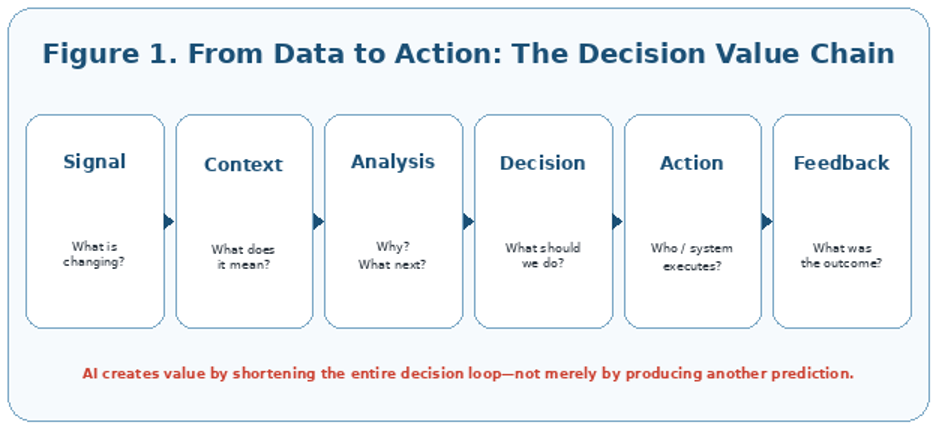
Figure 1. The decision value chain must extend from signal to feedback rather than stopping at reporting.
2. How AI changes each layer of enterprise decision-making
AI participation can be viewed in four progressively more active levels. The first is description and explanation: AI summarizes information, detects anomalies, answers questions and surfaces likely causes. It accelerates understanding while leaving decision authority with humans.
The second level is prediction. Historical patterns and current signals are used to estimate what may happen next: demand may decline, equipment may fail, a project may slip, a customer may churn or cash may become constrained. Prediction creates value by expanding the intervention window before an undesirable outcome becomes irreversible.
The third level is recommendation. This is fundamentally different from prediction. A 15% demand forecast does not specify the correct purchase quantity. Recommendation combines predictions with objectives and constraints such as service levels, working capital, storage capacity, lead time, minimum order quantities and risk tolerance. Mature decision support therefore requires not only AI models but business rules and optimization.
The fourth level is execution. For low-risk, bounded and verifiable decisions, an AI system or agent may create a requisition, adjust a schedule, trigger a workflow, send an alert, assign a task or update a system. AI then becomes part of the operating process rather than an external advisory tool.
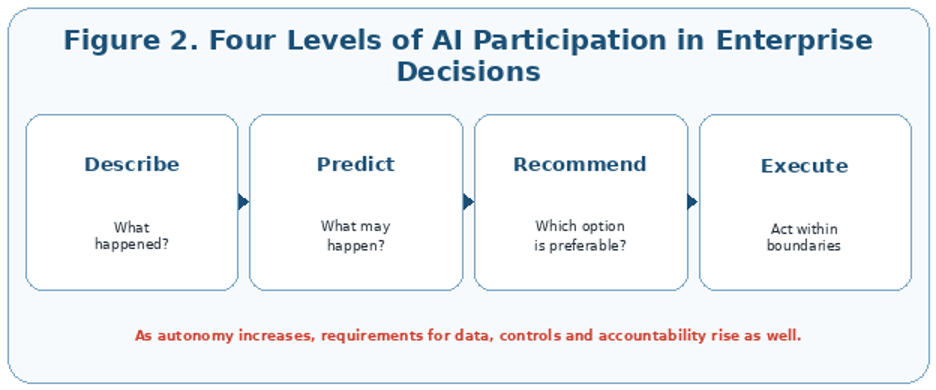
Figure 2. Four levels of AI participation, from description to bounded execution.
3. From prediction to decision: the missing middle
A common misconception is that a better predictive model automatically produces a better decision. Prediction is only an input. A model may estimate a 70% probability of equipment failure within seven days, but a maintenance shutdown still depends on downtime cost, production commitments, equipment criticality, spare-parts availability and maintenance capacity.
The same applies to project delay. Predicting a twelve-day slip does not determine the response. Managers need to know which activity is driving the delay, whether it lies on the critical path, the cost of acceleration, alternative sequencing options and contractual implications. Prediction becomes management action only when these factors enter a decision logic.
Enterprise decisions therefore combine multiple forms of intelligence. Data provides operational facts. AI models provide patterns and probabilities. Business rules encode policy, authority and limits. Optimization balances objectives against constraints. Humans contribute judgment in novel, ambiguous, sensitive or high-impact situations.
Decision Intelligence is useful precisely because it shifts attention from how intelligent an individual model is to how well the decision system is designed. One decision may combine machine learning, optimization, business rules, unstructured information and human approval. The unit to optimize is the final decision, not a single algorithm.
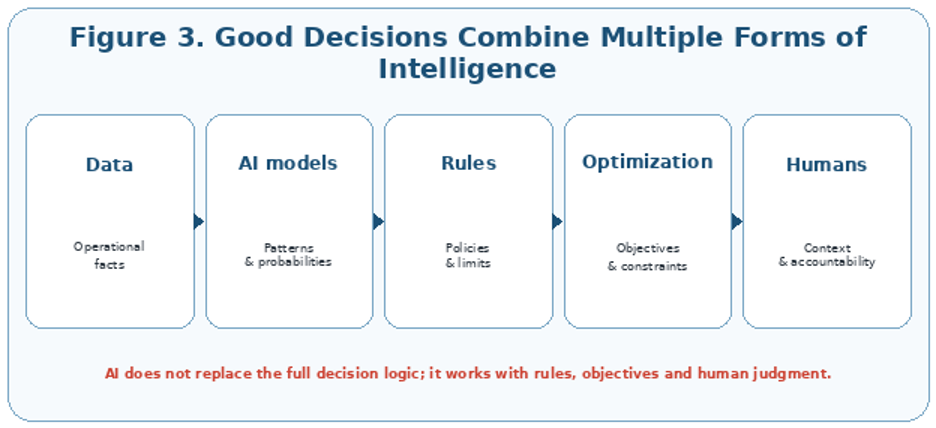
Figure 3. Strong enterprise decisions combine several forms of intelligence.
4. Context is what turns data into a meaningful decision
The previous article emphasized contextual data because the same number can have different meanings depending on demand, lead time, contractual terms, relationships and operating conditions. In decision systems, context becomes even more important.
An AI system may detect overdue receivables and recommend blocking a shipment. Yet the customer may be strategic, the invoice may be under reconciliation, contractual grace may apply, or the shipment may fulfill a special commitment. A mechanically correct rule can still create a poor business outcome when context is incomplete.
Decision systems therefore need a semantic layer that allows AI to understand entities, relationships, policy and current state. Context includes history, authority, business definitions, objectives, constraints and relationships among business objects. This is why enterprise AI architectures increasingly emphasize contextual intelligence rather than raw data access alone.
A powerful general-purpose model does not automatically know an enterprise’s safety stock, approval thresholds, contract terms, actual production capacity or strategic priorities. Decision capability emerges from combining model intelligence with the organization’s own operational intelligence.
5. AI agents turn recommendations into actions—but authority must be designed
When AI agents can use tools and interact with ERP, CRM, MES and workflow systems, the gap between analysis and execution shrinks dramatically. An agent can receive a shortage signal, inspect open purchase orders, compare demand, identify approved suppliers, evaluate alternatives and create a purchase requisition. Work that previously required multiple handoffs can become one coordinated flow.
Action changes the risk profile. An incorrect chatbot answer may be ignored; an incorrect ERP action may create a purchase order, alter a production schedule or affect a customer. Enterprises should therefore assign authority according to risk rather than according to what the technology is technically capable of doing.
Low-risk, frequent and reversible decisions may be executed automatically. Medium-risk decisions can operate within thresholds or require approval beyond a boundary. High-impact financial, legal, safety, workforce or reputational decisions should typically keep humans in the final approval role. Exceptions require explicit stop and escalation mechanisms.
These boundaries must be implemented in the system, not merely written in policy documents. Agents need explicit tool permissions, data access rules, transaction limits, approval gates and stop conditions. Logs should make it possible to trace inputs, recommendations, decisions, tool calls and outcomes.
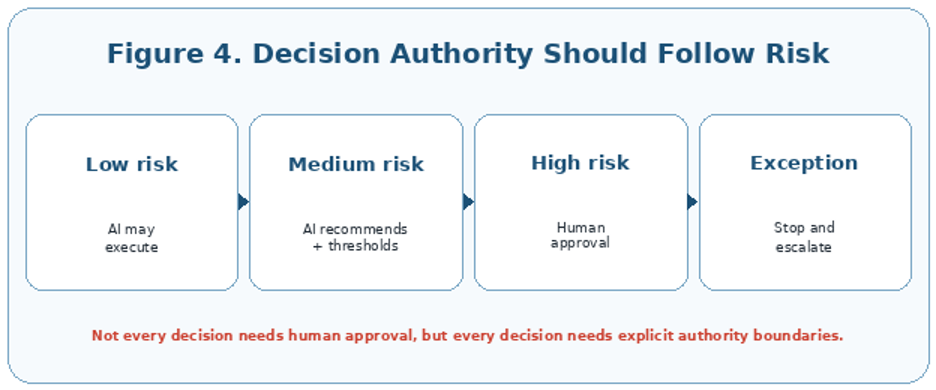
Figure 4. AI autonomy should increase with evidence and decrease as decision risk rises.
6. Better decisions must be measurable, not merely faster
Once AI participates in decisions, organizations need a definition of decision quality. Optimizing only for speed can increase cost or risk. Measuring only model accuracy can also mislead: a forecast may be statistically strong but ignored by users, or followed without improving the business outcome.
Decision quality should be measured at several layers. Model metrics assess predictive stability and accuracy. Decision metrics assess policy compliance, objective optimization and exception handling. Operational metrics assess whether action occurred in time. Outcome metrics assess whether shortages, downtime, delivery failures, cost or cash-flow performance actually improved.
Human override rates and override reasons are particularly informative. If managers repeatedly reject AI recommendations because a specific context variable is missing, the problem may be the data design rather than user resistance. Conversely, if human overrides consistently produce poorer outcomes, the organization has evidence for expanding bounded automation.
This turns AI deployment into evidence-based learning. Autonomy is not a one-time configuration; it can expand or contract according to observed performance, risk and trust.
7. Feedback turns prediction into a learning decision system
A mature decision system records more than inputs and selected actions. It records what happened afterward. If AI recommends increasing inventory, did the business avoid a shortage? What happened to carrying cost? If AI recommends a schedule adjustment, did the project recover? What was the effect on cost and quality?
Outcome feedback allows the enterprise to distinguish different failure modes. A model can be accurate while the decision is poor because the objective function is incomplete. The model can fail because input relationships changed. The decision can be correct but executed too late. Without separating these causes, improvement becomes guesswork.
Feedback also helps detect drift. Model drift matters, but decision systems face broader drift: business rules, risk thresholds, costs, capacity and strategic objectives all change. The complete decision logic must therefore be managed as a living asset.
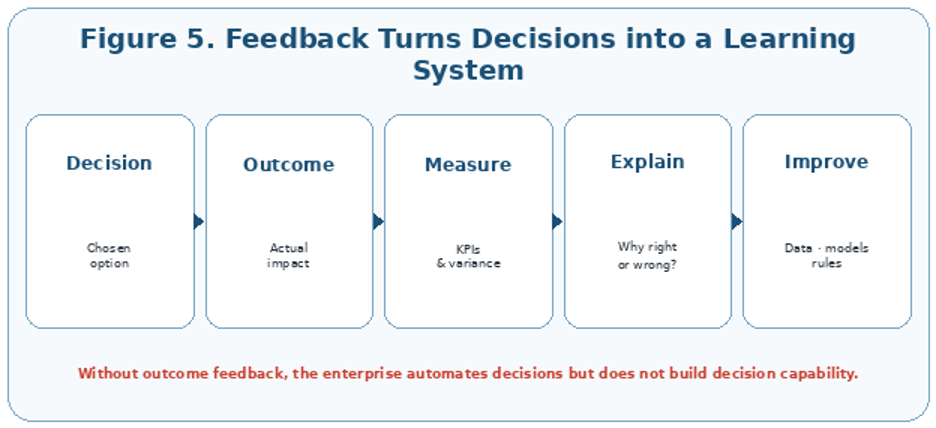
Figure 5. Actual outcomes must feed back into data, models and decision logic.
8. A data-to-decision architecture: the layers enterprises need
A practical architecture begins with source systems such as ERP, CRM, MES, BIM, IoT and document platforms. Their data is integrated into governed data and context layers. AI models then detect anomalies, forecast or reason; business rules define policy and authority; optimization models balance objectives and constraints.
A decision-orchestration layer combines predictions, rules, optimization and approvals into an actionable choice. Workflow systems or AI agents then execute against operational applications. Every step should be observable, logged and connected to outcome feedback.
The key architectural boundary is between what AI proposes and what the enterprise authorizes. Models may generate options, but policy controls determine which options can be executed. This separation allows models to evolve without weakening governance and makes decisions explainable through data, model output and explicit rules.
9. Implementation roadmap: start with a valuable decision, not an AI model
The strongest starting question is rarely “Which model should we use?” It is “Which decision currently creates the most avoidable cost, delay or risk?” Good initial candidates are frequent enough to matter, supported by reasonably available data, measurable in outcome, clearly owned and bounded in risk.
Initially, AI can analyze and recommend while the organization records the actual human decision. This creates a comparison set between AI recommendations and management choices. Once performance is demonstrated, simple cases can be automated within thresholds while exceptions continue to escalate.
The scope can then expand from one decision to a connected chain—for example, from shortage prediction to procurement recommendation, supplier selection, plan adjustment and delivery monitoring. This is where AI agents become more valuable, but also where governance, observability and stop mechanisms become more important.
The goal is not to automate the maximum number of decisions. The goal is a system in which each decision uses appropriate data and context, follows transparent logic, receives authority proportional to risk and produces measurable feedback. That is the foundation of an increasingly intelligent enterprise.
Conclusion
AI is changing enterprise management not because it produces more information, but because it can shorten the distance from data to action. When data, context, predictive models, rules, optimization and workflows are connected, enterprises can move from reacting after problems occur to detecting signals early, evaluating alternatives and acting while outcomes can still be changed.
Speed, however, cannot be separated from control. The closer AI moves to action, the more explicitly organizations must define authority, risk, accountability, explainability and feedback. A good decision system is not one in which AI always decides; it is one that knows which decisions can be automated, which require humans and what evidence should change that boundary over time.
If data is the foundation of the intelligent enterprise, decision capability is where that foundation becomes operational value. In the AI era, advantage will not belong simply to organizations with more data, but to those that can turn data into better, faster and governable decisions.
References
- IBM (2026), What it takes to build an AI-ready data foundation: Insights from Think 2026.
- IBM Decision Intelligence (2026), product and decision-service guidance.
- IBM (2026), The evolving role of data intelligence in the age of autonomous AI agents.
- Microsoft (2026), Decision-ready: Accelerating clarity and action with business intelligence.
- Microsoft (2026), Enterprise intelligence and context-layer guidance for AI and agents.
- NIST, Artificial Intelligence Risk Management Framework (AI RMF) and related resources.