
Process automation is not new. Enterprises have long used software to route cases, apply rules, send notifications and execute deterministic steps. Traditional automation is highly effective when inputs are structured and conditions can be expressed explicitly.
AI extends this boundary. Language models can read and interpret documents, while AI agents can use tools, retrieve data and coordinate multi-step work. Tasks that once required people to read, classify and reconcile information can therefore be automated more deeply.
The critical management question, however, is not how much work AI can technically perform. It is how much authority the enterprise should grant, under what controls, and where human accountability must remain explicit.
1. From rule-based automation to reasoning-enabled automation
Traditional automation is strongest when conditions can be expressed explicitly: if a value exceeds a threshold, route to a higher approver; if required data is missing, return the case. This behavior is predictable and controllable but depends on structured inputs and predefined situations.
AI adds the ability to handle cognitive work between deterministic steps. It can interpret emails, contracts and free-form requests, extract meaning, compare evidence and identify likely exceptions. This makes it possible to automate work that previously required a person to read and interpret before the workflow could continue.
The strongest design is often a combination rather than a replacement. Rules and workflows define authority and control; AI handles variability and interpretation. This preserves predictable governance while expanding the range of tasks that can be automated.
This is why process standardization remains essential. AI needs to know the purpose of the current step, relevant data, permitted actions and stop conditions. Without process context, flexibility can become uncontrolled behavior.
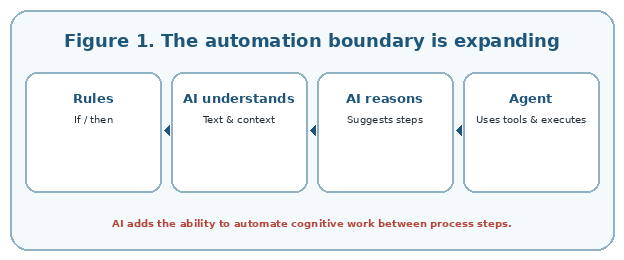
Figure 1. AI expands automation from rule execution toward contextual and cognitive work.
2. Five levels of AI participation in enterprise processes
At level one, AI assists users with search, summaries and drafting while people perform the process. At level two, AI recommends a classification or next action, but a person remains the decision-maker.
At level three, AI can execute a bounded task such as updating a field, routing a case or creating a transaction draft. At level four, an AI agent coordinates multiple tools and completes several steps while stopping at defined approval gates.
At level five, selected low-risk transaction classes may operate autonomously within explicit policies, budgets or supplier boundaries. This does not mean every process should evolve to level five.
The correct target is process-specific. Automation should increase only when performance and control improve together; technical autonomy without accountable governance is not process maturity.
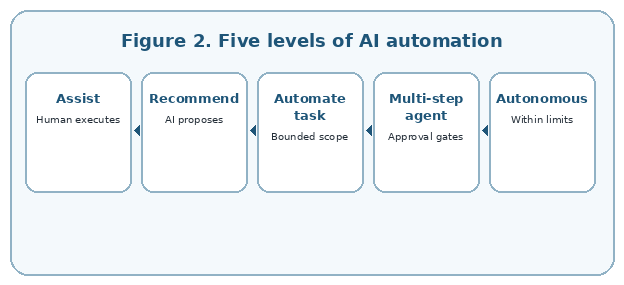
Figure 2. Five levels of AI participation, from assistance to bounded autonomous execution.
3. Where should enterprises automate first?
Strong starting points are frequent tasks with reasonably available data, verifiable outcomes and bounded downside. Document reading, extraction, completeness checking, classification and case preparation often meet these criteria.
AI can reconcile invoices, review purchase requests, prepare HR cases or summarize project records. These activities remove repetitive cognitive effort before material decisions occur.
Verifiability matters. Extracted invoice values can be compared with the source document, and classification decisions can be corrected by users. Clear feedback loops create evidence for model evaluation and improvement.
Enterprises should prioritize measurable process bottlenecks rather than the most visually impressive agent concept. The best first use cases often remove waiting and rework without requiring broad execution authority.
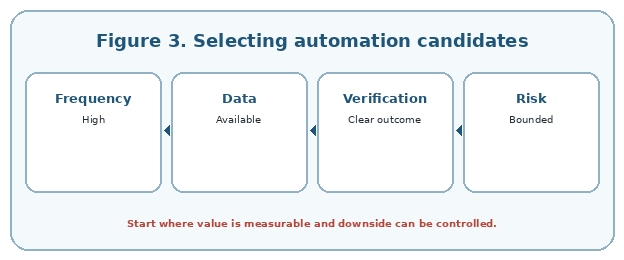
Figure 3. Prioritize frequent, verifiable tasks with bounded risk.
4. What should not be fully automated?
Automation should decrease as the consequences of error increase. Major financial, legal, safety, people and reputational decisions usually require a human final authority even if AI performs substantial analysis and preparation.
Another constraint is incomplete context. A supplier choice or contractual exception may depend on strategic and legal information that is not fully represented in enterprise data. Automated consistency is not the same as strategic correctness.
The answer is not to make humans inspect every AI action. Instead, enterprises should design mandatory stop points based on transaction value, anomaly level, model confidence or data category.
Human-in-the-loop design is most valuable when people are positioned at high-consequence or high-ambiguity points, allowing stronger automation in lower-risk regions without losing accountability.
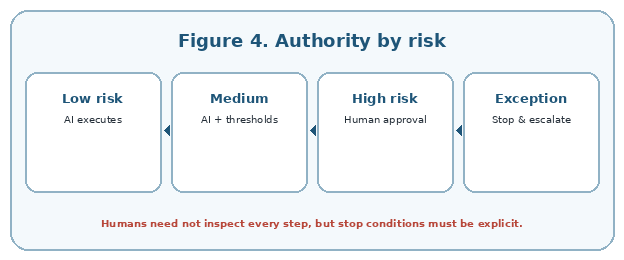
Figure 4. As risk rises, human approval and intervention points become more important.
5. How do AI agents change workflow design?
Traditional workflows describe fixed paths. AI agents can choose tools, gather additional evidence and adapt intermediate plans in order to achieve an approved goal. This can reduce the enormous branching logic required for exception-heavy work.
An agent preparing a procurement request, for example, may inspect production plans, inventory, open orders, lead times and framework agreements. If a source is incomplete, it can seek additional evidence before continuing.
This flexibility creates governance requirements. Every agent needs an identity, explicit permissions, allowed tools, transaction limits and escalation conditions. Broad access should not be granted simply because an AI system is expected to complete a task.
Agents therefore do not eliminate workflow. They shift workflow design from enumerating every action toward defining goals, policies, boundaries and approval gates.
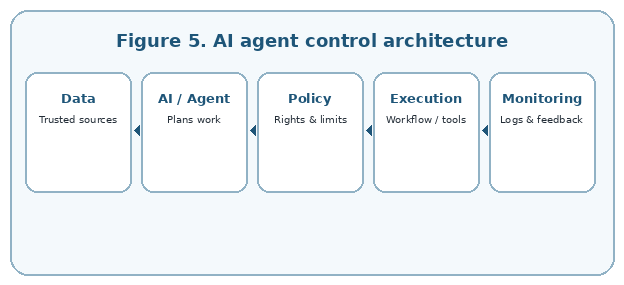
Figure 5. AI agent control architecture requires authority, logs, monitoring and feedback.
6. Control architecture: preventing AI automation from becoming a black box
Once AI can update data or call enterprise tools, traceability becomes essential. Management needs to know what information was used, which tools were called, what policy applied and who authorized a material action.
A practical control architecture separates trusted data sources, the AI or agent layer, policy and authority, execution services and monitoring. Important actions should flow through controlled interfaces rather than unrestricted access to core systems.
Logs should capture key inputs, recommendations, actions, approvals, exceptions and outcomes. This evidence supports auditability and makes it possible to determine whether errors originate in data, model behavior, policy design or tool execution.
Failure handling is part of the architecture. When confidence is insufficient, data conflicts or tools fail, the system should stop safely and escalate. Manual fallback is a core resilience feature, not an admission that automation is incomplete.
7. Measure process outcomes, not the number of AI tasks
Automating thousands of actions creates little value if employees recheck every output or cycle time remains unchanged. Metrics should focus on process outcomes: lead time, first-time-right rate, rework, cost per transaction, compliance and output quality.
Human-AI interaction also requires measurement. Acceptance rates, overrides and override reasons reveal where recommendations are useful and where context is missing. These are more meaningful governance signals than model-call volume.
For executing agents, enterprises should monitor successful autonomous actions, stops, exceptions and recovery behavior. If autonomy expands while human intervention rises, authority may be growing faster than reliability.
Finally, automation must connect to business results. Procurement automation should improve service levels or administrative cost; customer-service automation should improve response time and quality. Outcome measurement prevents AI deployment from becoming a technology-counting exercise.
8. A staged roadmap toward more autonomous processes
Begin with a relatively standardized process and classify each step by structure and risk. Determine where AI should observe, recommend, execute a bounded task or require approval.
Keep AI in an assistive role first to validate data, accuracy and user interaction. Then grant low-risk execution rights such as drafting, updating or routing. Multi-step agents should come only after these components are demonstrably stable.
Every increase in authority should have entry criteria: required quality, stability period, acceptable exception rate, recovery design and fallback controls. Autonomy should grow through evidence rather than through technical ambition.
The endpoint does not need to be a human-free process. In many workflows the optimal model combines AI scale, workflow control and human judgment. The enterprise should optimize the entire human-process-AI system rather than maximize autonomy in isolation.
Conclusion
AI can automate process work much more deeply than earlier rule-based tools, especially where work requires reading, interpretation and coordination across systems. Technical capability, however, should never be confused with authority.
Most enterprises will progress from assistance to recommendations, bounded task execution and multi-step agents with approval gates. Low-risk, stable transaction classes may become autonomous within limits, while material decisions remain human-accountable.
The future is therefore not the disappearance of workflow. Workflow becomes the policy and control layer, AI handles more variable cognitive work, and people retain authority where consequences are material. Enterprises that standardize processes, design explicit authority and measure human-AI outcomes will be better positioned for increasingly autonomous operations.
References
- NIST, Artificial Intelligence Risk Management Framework (AI RMF) 1.0 and AI RMF Playbook.
- NIST AI Resource Center, Human-AI Interaction and oversight guidance.
- IBM, enterprise AI orchestration and agent governance resources.
- ISO/IEC 42001:2023, Artificial intelligence management system requirements.
- Why Project Reports Always Look “Correct” While Reality Is Already Failing
- Most CEOs Don’t Have an Execution Problem — They Have an Accountability Problem
- From Data to Action: How AI Turns Enterprise Data into Decisions
- How Far Can AI Automate Enterprise Processes?
- Why Construction Companies Are Becoming Data Organizations