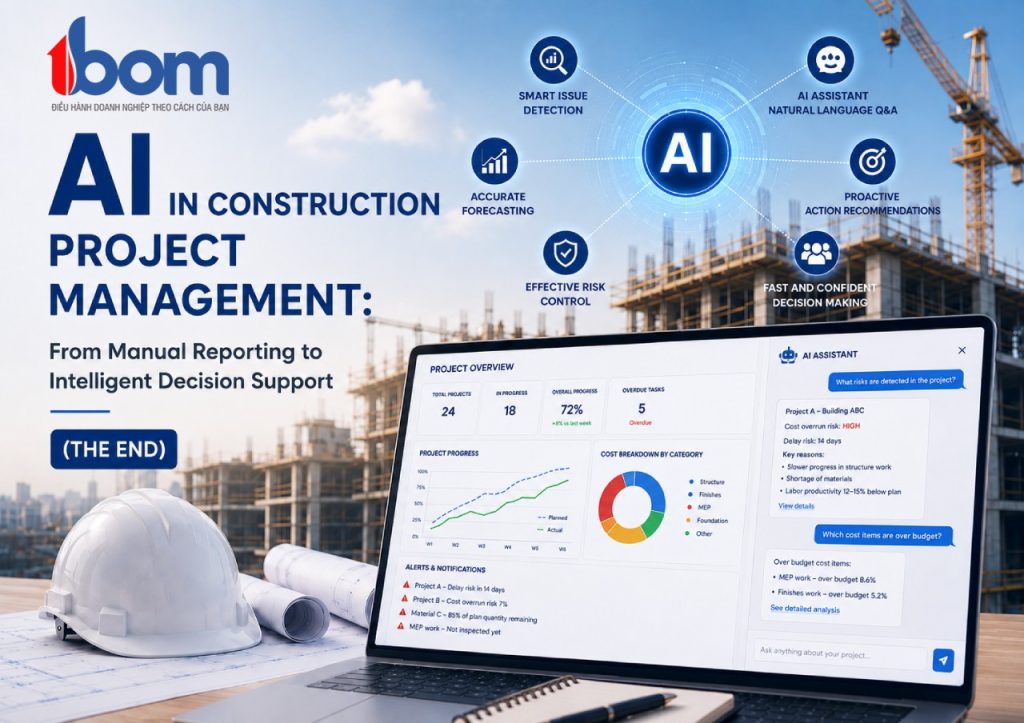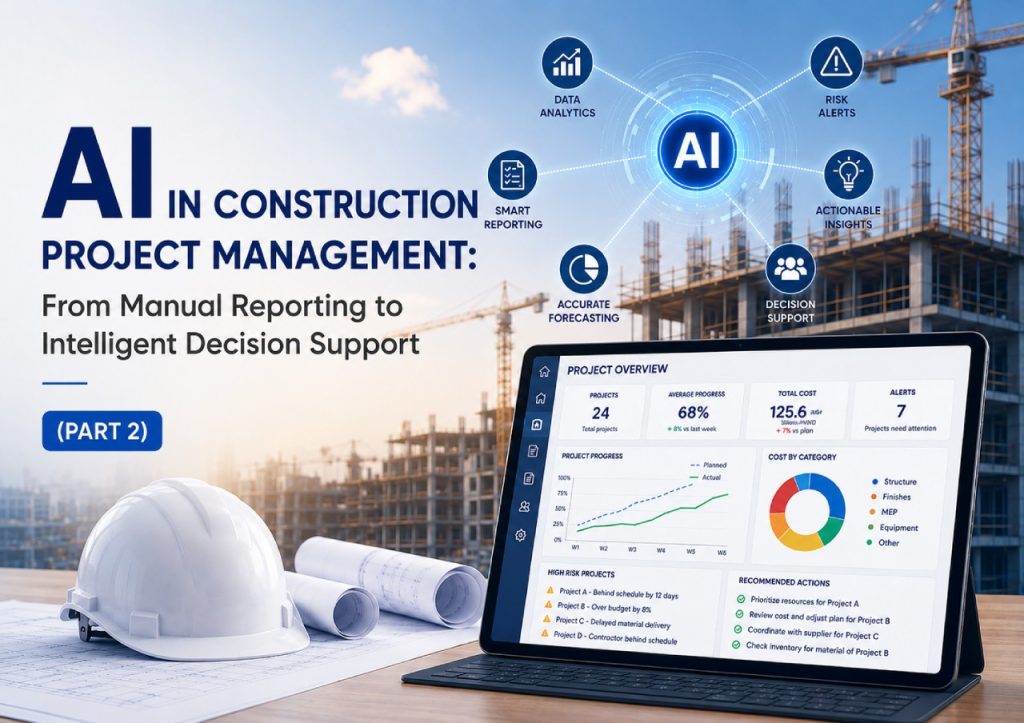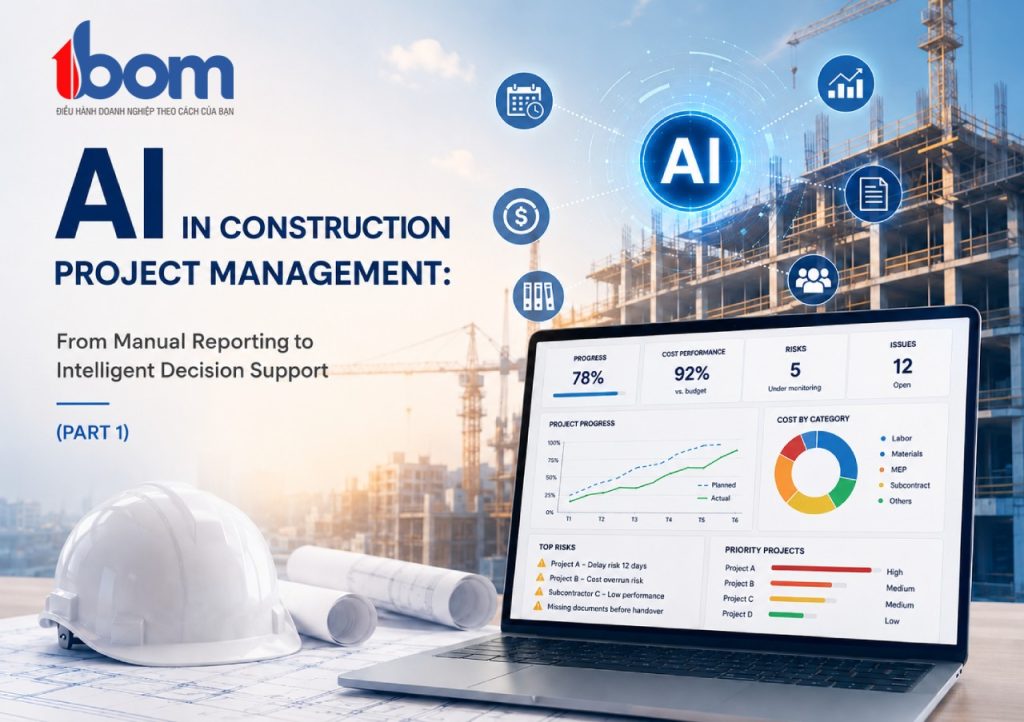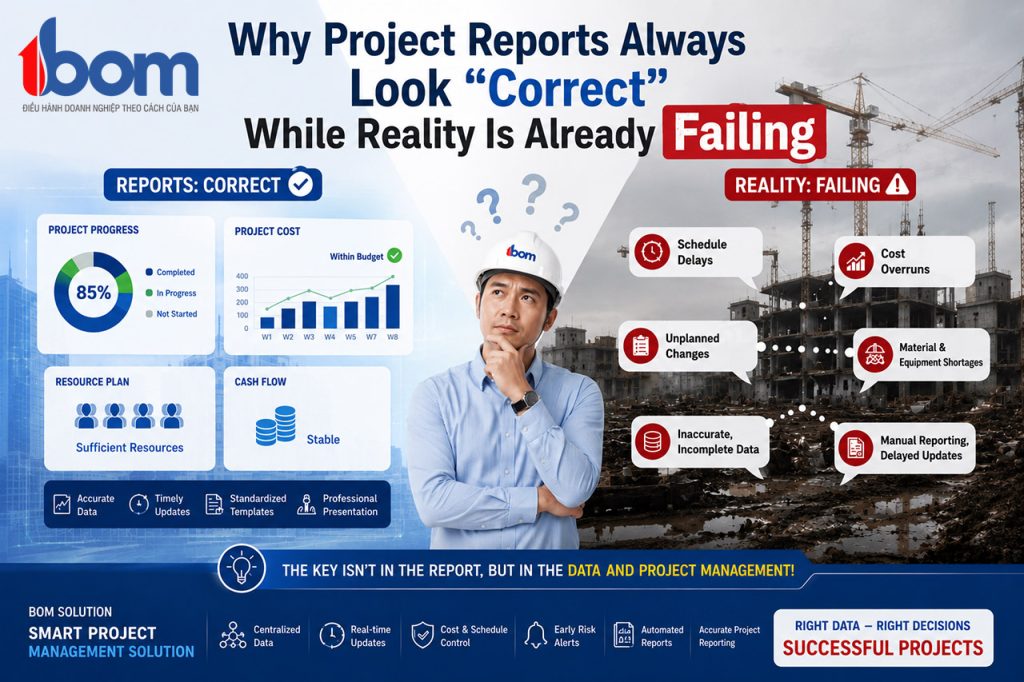

For decades, construction companies have managed projects primarily through reports.
Progress reports.
Cost reports.
Procurement reports.
Resource reports.
Weekly reports.
Monthly reports.
Executive summaries.
On the surface, everything appears well organized.
There are spreadsheets, dashboards, KPIs, and regular management meetings.
Yet one question continues to challenge many organizations:
Why do projects still fall behind even when every report appears to be under control?
The answer lies in the nature of the data being used.
Traditional reports describe what has already happened.
Modern project management requires something entirely different:
It requires understanding what is happening right now.
This is where the concept of Execution Data becomes essential.
Execution Data is not simply another category of information.
It represents a new way of managing projects.
While reporting data looks backward, execution data allows organizations to see the present and act before problems become crises.
What Is Reporting Data?

Reporting data is information collected after work has been completed.
Typical examples include:
- Percentage of project completion
- Budget consumed
- Materials delivered
- Workforce utilization
- Approved quantities
- Completed activities
- Delayed work packages
These reports are usually generated daily, weekly, or monthly.
Their purpose is clear:
- summarize project status
- support management reviews
- document performance
- satisfy contractual requirements
- provide executive reporting
Reporting data is valuable.
However, it has one significant limitation.
It always represents the past.
By the time leadership reviews a report, project reality may already have changed.
A report can be perfectly accurate at the moment it is produced, yet already be outdated when decisions are made.
Execution Infrastructure — The Missing Foundation of Modern Enterprise Execution
What Is Execution Data?

Execution Data is generated while work is actively taking place.
Instead of describing completed results, it reflects the live operational state of a project.
For example:
- Which teams are currently working
- Which activities are waiting
- Which materials have not arrived
- Which approvals are pending
- Which issues remain unresolved
- Which subcontractors are losing productivity
- Which tasks are beginning to slip
- Who owns each unresolved issue
- How long a problem has existed
- What downstream activities may be affected
Execution Data answers questions before reports do.
A report may say:
“The activity is delayed.”
Execution Data says:
“The activity is beginning to fall behind and will affect three critical downstream tasks unless action is taken today.”
This difference changes how organizations manage projects.
Managing Results Versus Managing Execution

Every project outcome is the consequence of thousands of operational activities.
A delayed milestone rarely appears without warning.
Before the delay, there are usually many smaller signals:
- Material shortages
- Design clarification requests
- Labor constraints
- Equipment downtime
- Approval bottlenecks
- Coordination issues
Reporting data tells organizations that the milestone has already slipped.
Execution Data reveals the chain of events that is causing the delay.
Modern project management is no longer about measuring results alone.
It is about understanding how those results are being created.
Organizations that manage only outcomes react after problems appear.
Organizations that manage execution can intervene while problems are still manageable.
Timing Is Everything

In construction, the value of information depends heavily on when it becomes available.
The earlier a problem is detected, the lower the cost of resolving it.
Consider a simple example.
A subcontractor begins falling behind on Monday.
If project leadership recognizes the issue immediately, they may adjust manpower, resequence work, or allocate additional resources.
If the problem only appears in Friday’s report, several days of productivity have already been lost.
Recovery may now require:
- overtime
- additional crews
- equipment relocation
- revised schedules
- increased costs
The later the information arrives, the more expensive every decision becomes.
Execution Data Connects the Entire Project
Most organizations manage data by department.
Planning manages schedules.
Procurement manages materials.
Finance manages costs.
Engineering manages drawings.
Construction manages site activities.
Each department owns valuable information.
However, projects do not operate as isolated departments.
Projects operate as connected systems.
Material delays affect schedules.
Schedules affect costs.
Costs affect cash flow.
Cash flow affects subcontractors.
Subcontractors affect productivity.
Execution Data connects these relationships into one operational picture.
Instead of isolated reports, leadership gains visibility into how the entire project is functioning.
Reporting Data Answers “What Happened?”
Execution Data Answers “What Is Happening?”
This distinction is fundamental.
Reporting Data answers:
- Has the activity been completed?
- Has the budget been exceeded?
- Has payment been approved?
- Has the milestone been achieved?
Execution Data answers:
- Which activity is currently blocked?
- Which issue has remained unresolved for seven days?
- Which approval is delaying progress?
- Which subcontractor is becoming a risk?
- Which decisions require executive attention today?
One measures status.
The other measures movement.
Construction projects are living systems.
Managing movement is far more valuable than observing static results.
Execution Data Creates Early Warning Capability
One of the greatest strengths of Execution Data is early detection.
Projects rarely collapse because of one catastrophic event.
They deteriorate through hundreds of small operational signals:
- Longer approval cycles
- Increasing unresolved issues
- Repeated material delays
- Declining productivity
- Growing coordination conflicts
Individually, these signals appear insignificant.
Together, they indicate that the project is losing operational stability.
Execution Data allows organizations to recognize these patterns before they become visible in traditional reports.
This transforms project management from reactive to proactive.
Why AI Depends on Execution Data
Today, many organizations discuss Artificial Intelligence.
AI for forecasting.
AI for risk prediction.
AI for decision support.
AI for project analytics.
However, AI is only as effective as the data it learns from.
If AI receives only historical reporting data, it can identify past outcomes.
It cannot fully understand the operational causes behind those outcomes.
Execution Data provides AI with the operational context required to generate meaningful insights.
It allows AI to understand not only what happened, but why it happened and what is likely to happen next.
For this reason, the foundation of AI-powered construction management is not algorithms.
It is high-quality Execution Data.
The Future of Enterprise Management
Future construction companies will not compete based on who produces the most reports.
They will compete based on who understands project execution most clearly.
Leadership will increasingly require visibility into:
- Workflows
- Decisions
- Resources
- Issues
- Dependencies
- Operational risks
Execution Data enables this visibility.
It transforms enterprise management from reviewing history to managing reality.
This is not simply a technological evolution.
It is a new management philosophy.
Conclusion
Reporting Data and Execution Data serve different purposes.
Reporting Data explains what has already happened.
Execution Data reveals what is happening now.
Reporting Data supports analysis.
Execution Data supports action.
Reporting Data summarizes performance.
Execution Data drives operational control.
In the AI era, organizations that rely solely on reports will always be reacting to yesterday.
Organizations that build their management systems around Execution Data will be prepared to shape tomorrow.
Because in modern construction management:
Those who can see execution earliest are the ones who control projects most effectively.
Đỗ Hữu Binh
CEO, ISOFT
This article is part of a professional series analyzing construction project management and cost control strategies.
© 2026 Đỗ Hữu Binh. All rights reserved.
Any citation or reuse of this content must clearly state the source and author.
- What Is ERP? The Role of ERP in Modern Enterprise Management
- Why Quantity Control Is the First Line of Margin Protection in Construction Projects
- In the AI Era, Management Power Lies in Execution Data
- AI in Construction Project Management: From Manual Reporting to Intelligent Decision Support (Part 1)
- AI in Construction Project Management: From Manual Reporting to Intelligent Decision Support (The end)