
Article “How Can AI Predict Construction Project Cost Overruns?” established the operating foundation for construction cost control: managers need a connected view of approved budget, commitments, actual cost, Estimate to Complete (ETC) and Estimate at Completion (EAC). More importantly, cost control creates value only when it exposes developing pressure early enough for management to retain choices.
AI extends that early-warning capability. Rather than waiting for an accounting variance to cross a threshold, a model can combine weaker signals such as falling productivity, increasing change exposure, procurement price pressure, rapid contingency consumption, schedule extension and repeated upward revisions to ETC. Individually, these signals may be ambiguous. Together, they may reveal a cost trajectory weeks or months before the overrun becomes obvious in formal reporting.
AI-based overrun prediction should not be treated as a black box that converts a few project numbers into a perfectly accurate answer. The practical challenge is broader: define the decision question, construct time-correct data, avoid future-information leakage, quantify uncertainty, explain the drivers, and embed warnings into a management process that can still change the outcome.
1. Cost overrun is the final outcome of a signal chain that develops earlier
Traditional reporting often declares a problem when actual cost exceeds budget or when EAC rises materially. By then, the underlying mechanisms may have been developing for weeks: lower labor productivity, extended equipment use, design-driven quantity growth, delayed approvals, emergency procurement, market escalation or repeated ETC increases.
AI can search for combinations of these weak signals. It does not need to wait for EAC to exceed budget. If historical data show that a particular pattern of productivity decline, change exposure, contingency drawdown and schedule extension frequently precedes an overrun, the model can raise risk when the pattern begins to reappear.
The business objective is therefore early warning, not prediction for its own sake. A moderately accurate warning with meaningful lead time can be more valuable than a highly accurate forecast delivered when the outcome is already locked in.
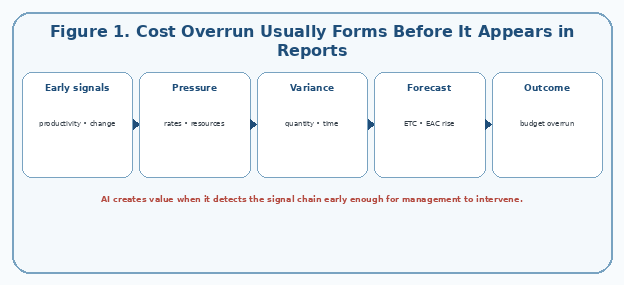
Figure 1. Cost Overrun Usually Forms Before It Appears in Reports
2. Define what the model is predicting before choosing the algorithm
‘Cost overrun prediction’ can mean several different tasks: probability of exceeding budget by more than five percent, expected overrun ratio, future EAC, or ranking work packages by financial risk. Each requires a different target, dataset and evaluation method.
A classification model may return the probability of crossing a threshold. A regression model may estimate EAC or overrun magnitude. A portfolio model may be judged mainly by whether it ranks the right packages for management attention.
The prediction point also matters. A warning at 20% completion may be less accurate than one at 80%, yet much more actionable. The target must therefore be defined around the management decision that follows.
3. AI needs more than accounting data
Accounting actuals are lagging evidence. An effective model should combine the layers described in Article “How Can AI Predict Construction Project Cost Overruns?“: original and current budget, contingency, commitments, purchase orders, approved and pending changes, actual and accrued cost, quantities, schedule, productivity, resources, procurement and contextual risk.
The critical requirement is linkage. Contracts, schedule activities, quantities and ledger entries need common or mapped identifiers. Putting disconnected datasets into one data lake does not automatically create the economic relationships that the model needs.
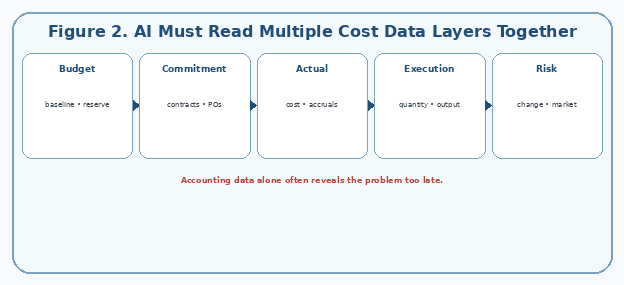
Figure 2. AI Must Read Multiple Cost Data Layers Together
4. Models learn patterns from data; they do not understand the project like a manager
Most machine-learning models identify statistical relationships between inputs and observed outcomes. They may reveal that certain patterns are associated with cost overrun, but association is not automatically causation.
Potential signals include commitment-to-budget ratio, contingency consumption, cost-performance trends, pending-change exposure, productivity variance, procurement delay, percent complete and period-to-period ETC movement. Algorithms such as regression, decision trees, random forests, gradient boosting and neural networks can capture different forms of relationship.
Recent studies show that machine-learning methods can improve EAC forecasting or cost-risk classification in particular datasets. The result is highly dependent on data quality, project phase and validation design; there is no universally superior algorithm.
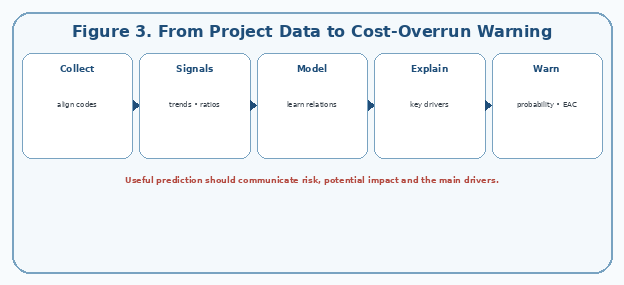
Figure 3. From Project Data to Cost-Overrun Warning
5. AI-based EAC forecasting is a natural extension of cost control
Traditional EAC formulas provide transparent baselines but often extrapolate from a limited set of performance relationships. Machine learning can incorporate a larger set of variables and nonlinear interactions.
A 2025 study proposed an automated machine-learning pipeline for project cost and duration forecasting and compared 30 machine-learning methods with Earned Value and Earned Schedule approaches. In the study dataset, several ML methods—particularly indirect-regression approaches—produced more accurate, precise and timely forecasts.
This does not imply replacing EVM. A practical architecture can retain EVM as an interpretable benchmark while AI generates an independent forecast. Large divergence between the two becomes a management question rather than something to hide.
6. Forecasting must be lifecycle-aware
Early in a project, actual data are limited but management flexibility is high. Late in a project, data are richer and forecasts can be more accurate, but commitments are locked and the room to intervene is small.
Models should therefore be evaluated separately at meaningful completion points such as 10%, 30%, 50% and 70%. Early phases may depend more on scope maturity, design, procurement strategy and risk; execution phases can rely increasingly on productivity, commitments, progress and ETC trends.
Late-stage accuracy alone is not evidence of business value. Lead time is part of forecast quality.
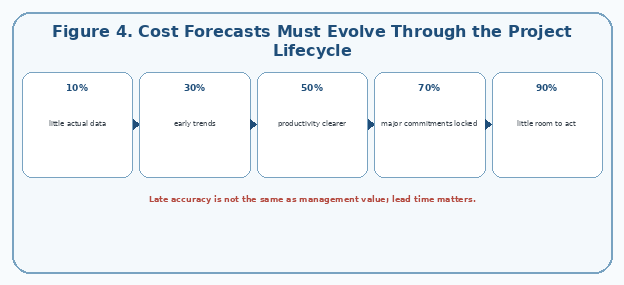
Figure 4. Cost Forecasts Must Evolve Through the Project Lifecycle
7. Time-correct data is essential; otherwise the model may accidentally know the future
A common modeling error is using information that was not available at the prediction date—for example, an August-approved variation to predict May risk. The model can look excellent in testing and fail completely in operation.
Every record should represent only what management could know at the data date. Change events need timestamps, ETC needs historical versions, and schedule and cost updates need preserved snapshots rather than overwritten current values.
Validation should also respect time. Training on earlier periods and testing on later projects or periods is harder than random splitting, but it better answers the real question: can a model built from history predict the future?
8. Accuracy alone is not enough
When overruns are relatively rare, a model can achieve high headline accuracy by predicting the majority class. Evaluation should therefore consider detection of risky cases, false-alert rate, probability calibration and, for continuous forecasts, absolute and percentage error.
Management also needs lead time. A correct warning two days before the outcome may be useless; a somewhat less precise warning six weeks earlier may support procurement renegotiation, resource changes or scope intervention.
The model should ultimately be evaluated by whether it improves decisions and reduces avoidable financial exposure.
9. AI must explain why risk is rising
A dashboard that says ‘78% probability of overrun’ is not enough. Managers need to know which package and which drivers are pushing the forecast.
Recent construction-cost research has combined machine learning with explainable-AI methods such as SHAP to expose influential variables. Other work has added calibrated uncertainty so the system does not present a single deterministic answer.
In an enterprise interface, technical explanations should be translated into management language: declining MEP productivity, unresolved design changes and procurement prices above estimate are more actionable than anonymous feature codes.
10. Forecasts should express uncertainty
Construction outcomes remain uncertain because quantities, prices, productivity, schedule and change continue to evolve. A point forecast of 125 billion VND should not be interpreted as certainty.
Probabilistic models or uncertainty-estimation methods can provide a range around the forecast. A 2026 Scientific Reports study proposed a hybrid framework combining predictive performance, calibrated uncertainty and SHAP-based interpretability for construction cost prediction.
Uncertainty changes the decision. A forecast only two percent above budget with a wide upper tail creates a different risk posture from the same central forecast with a narrow interval.
11. AI complements change control, EVM and professional judgment
AI is strong at combining signals and recognizing patterns. It does not decide whether a design change is technically necessary, whether a claim is contractually justified, or whether spending more to protect a milestone is commercially rational.
The strongest architecture keeps established controls in place. EVM provides transparent performance indicators, change control provides causality and accountability, package-owner ETC captures field knowledge, and AI adds an independent analytical layer.
Agreement among these views increases confidence. Disagreement should trigger investigation rather than be averaged away.
12. Prediction creates value only when it leads to action
Every warning should connect to a work package, accountable owner, key drivers, expected impact, response deadline and possible actions.
Material-price risk may lead to price locking, supplier negotiation or substitution. Productivity risk may require method, crew, access or sequence changes. Design-change exposure may require accelerated decisions and tighter scope control.
After intervention, the outcome should return to the system. This feedback loop allows the organization to learn which actions actually reduce cost risk.
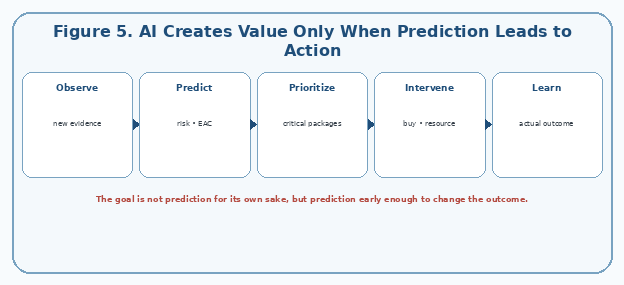
Figure 5. AI Creates Value Only When Prediction Leads to Action
13. Example: an MEP package shows risk before actual cost exceeds budget
Consider an MEP package with a 100-billion-VND budget. At 45% completion, actual cost is 43 billion, so conventional reporting does not yet show a clear overrun. However, installation productivity has been 12% below plan for six weeks, three pending design changes are estimated at five billion, two major equipment purchases are eight percent above estimate, schedule extension is increasing site overhead, and package ETC has risen for two consecutive periods.
The AI model combines these signals and raises overrun probability from 31% to 74%, with a central EAC forecast of 111 billion. The explanation identifies productivity, design change and procurement price as the largest drivers.
Management can intervene immediately. If four weeks later EAC falls to 105 billion and risk probability to 42%, the value of the model was not the original 74% number; it was the time created for action.
14. Models degrade when the project environment changes
A model trained on older projects may weaken when material markets, contract types, approval processes or construction methods change. Relationships in project data are not permanently stable.
Organizations should monitor input drift, false-alert rates, calibration and changes in feature importance. Retraining or threshold adjustment may be necessary.
Model governance is therefore continuous, much like estimate governance. A deployed model is not a static asset that can run indefinitely without challenge.
15. A practical implementation roadmap
Start with a narrow decision question—for example, predicting the probability that major construction packages will exceed budget by more than five percent between 30% and 70% completion.
Standardize the Article “How Can AI Predict Construction Project Cost Overruns?” data foundation: budget, cost codes, commitments, actuals, ETC, EAC, changes and contingency. Add schedule, quantities and productivity, and preserve historical snapshots by data date.
Build a simple benchmark first and compare it with EVM and current package forecasts. Run the model in shadow mode before embedding warnings into cost-review meetings. Measure lead time, false alerts, explanation quality and management response.
Once the foundation is proven, extend toward scenario simulation, portfolio risk, document intelligence, BIM and procurement integration, and AI agents that can prepare response options. Financial approval authority should remain governed explicitly.
Conclusion
AI can move construction cost control from reactive reporting toward earlier warning. Its main value is not replacing estimates or producing a more impressive number; it is combining fragmented signals into a risk view while management still has options.
That requires a disciplined data foundation, time-correct validation, explicit uncertainty and understandable explanations. Budget, commitments, actuals, ETC, EAC, changes, progress, quantities and productivity need to form one connected history.
Prediction creates value only inside a closed management loop: observe, predict, prioritize, act, measure and learn. The goal is not for AI to announce that the project will exceed budget. The goal is to identify the risk early enough to change the result.
References
- Yalçın, G., Bayram, S. & Çıtakoğlu, H. (2024). Evaluation of Earned Value Management-Based Cost Estimation via Machine Learning. Buildings, 14(12), 3772.
- Ottaviani, F. M., Ballesteros-Pérez, P. & Narbaev, T. (2025). Automated machine learning pipeline for robust project cost and duration forecasting. Automation in Construction, 178, 106426.
- Mostofi, F., Tokdemir, O. B. & Toğan, V. (2025). Bidirectional spatio-temporal networks for predicting cost performance in construction using deep learning extension of earned value management. Automation in Construction.
- Chen, L. et al. (2025). Transparent and reliable construction cost prediction using advanced machine learning and explainable AI. Engineering Science and Technology, an International Journal, 70, 102159.
- Chen, L. et al. (2026). Uncertainty aware and explainable construction cost prediction using a hybrid probabilistic learning model. Scientific Reports, 16, 10973.
- Machine learning prediction of estimate at completion for infrastructure projects in Nusantara Indonesia (2026). Discover Applied Sciences, 8, 921.
- Execution Data: Why It Is Fundamentally Different from Reporting Data
- The Biggest Blind Spot in Construction Management That 90% of Companies Never See
- Why Future Construction Companies Need an Operating System
- How Does a Construction Project Really Operate from A to Z
- AI in Construction Project Management: From Manual Reporting to Intelligent Decision Support (The end)