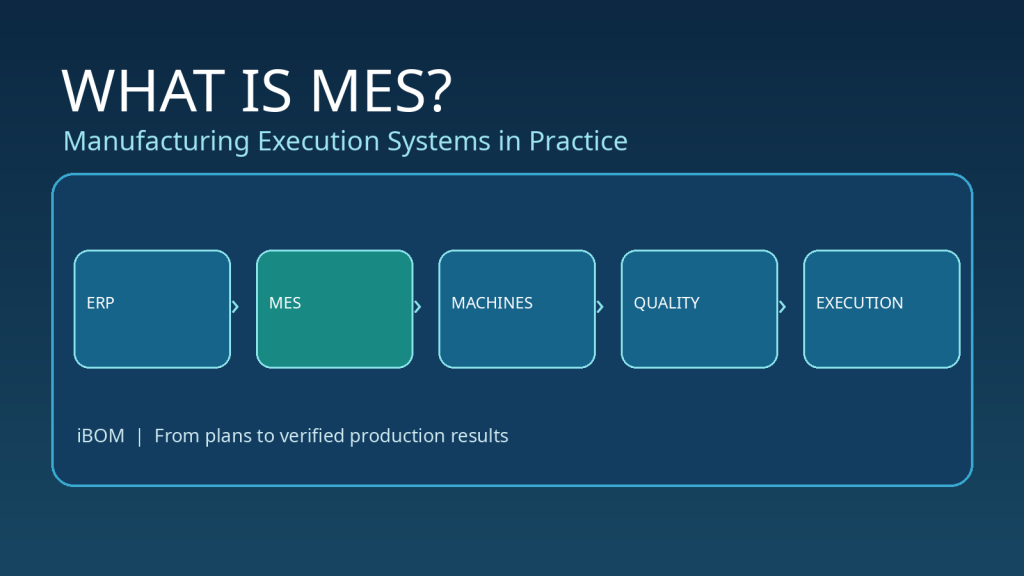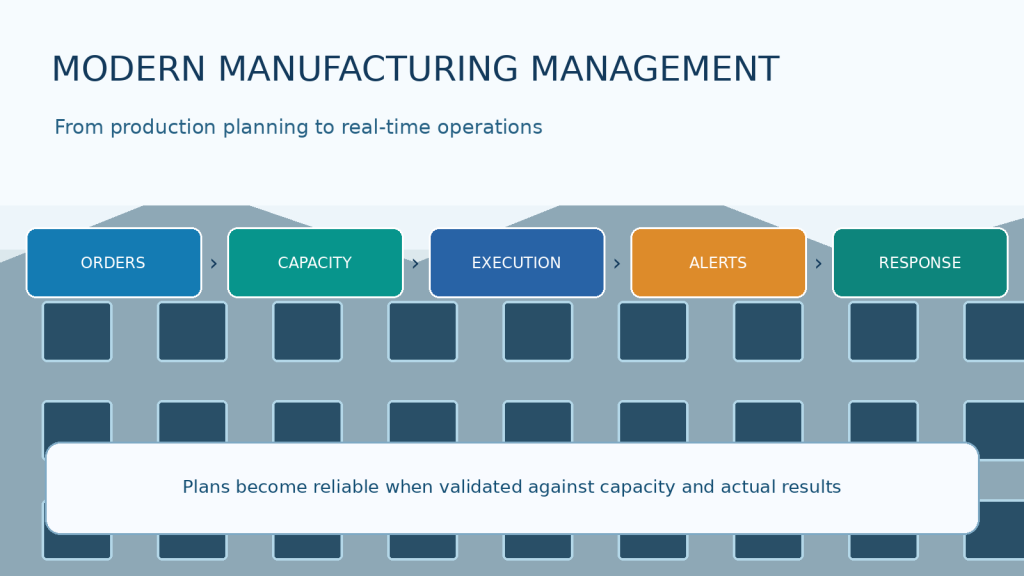

MES establishes what is happening on the shop floor. AI adds value when that evidence supports forecasts, feasible decisions and verified outcomes. This article examines the practical architecture, operational limits and governance of MES–AI–iBOM integration.
1. MES records the present; AI helps anticipate what comes next
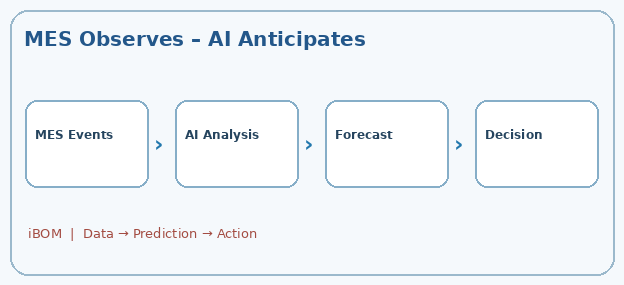
A manufacturing execution system records where each order stands, which machine is running, how much output has passed inspection and where work has stopped. This is essential operational evidence, yet a live dashboard does not necessarily reveal whether tomorrow’s shift will meet its delivery commitments. Monitoring what has already happened and anticipating what is about to happen are different management capabilities.
When AI analyzes time-stamped MES events, it can detect patterns that precede disruption. A machine may still be marked as running while cycle times gradually increase, minor stops become more frequent and rework rises. Each signal alone may appear manageable; together they may suggest an emerging production risk that conventional status reporting misses.
It is useful to distinguish monitoring, rule-based alerting, prediction and decision support. Monitoring describes current conditions; alerts identify known threshold violations; prediction estimates possible future states; decision support compares feasible responses. Calling a dashboard intelligent does not automatically create the latter two capabilities.
The business objective is to shorten the interval between the first meaningful warning and a controlled response. A useful deployment begins with a specific decision a supervisor must make, not with a search for an impressive algorithm. Its value is measured by fewer avoidable disruptions and more reliable commitments.
2. Connected, time-correct production data is the foundation
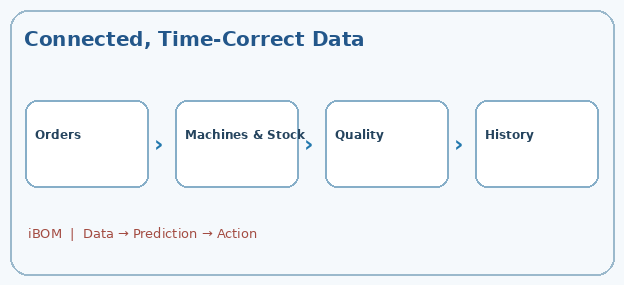
MES data typically include work orders, routing, start and finish times, good and rejected quantities, downtime reasons and operator records. AI becomes more useful when these records connect to order priorities, bills of materials, material availability, maintenance histories and inspection results. Without consistent identifiers, apparently rich data can describe disconnected pieces of the factory.
Timestamps require particular discipline. The time an event occurred, the time it entered the system and the time someone corrected the record may differ. A model trained using end-of-shift inspection results to predict a beginning-of-shift problem is effectively learning from the future, producing inflated test performance that will not survive live deployment.
More data are not automatically better data. Machine signals may arrive every second, while production plans change hourly and inventory updates occur at transaction time. A dependable data layer must reconcile these frequencies, retain historical revisions, distinguish missing information from normal conditions and preserve event provenance.
A shared data dictionary across MES, ERP, machine systems and coordination workflows is therefore an operational asset. Managers should be able to trace a warning to the underlying order, work center, data timestamp and source revision. Explainability begins with reliable records, not merely a visualization of model features.
3. Predicting order delays and bottlenecks before they become visible
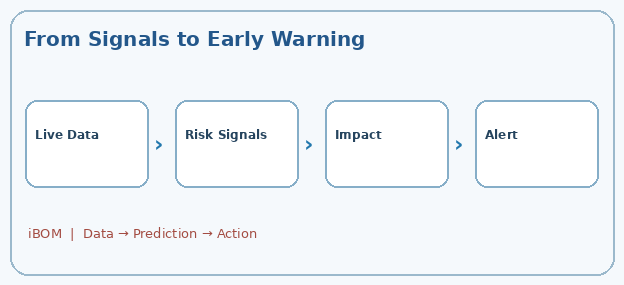
A work order can remain officially on schedule while its likelihood of finishing on time is deteriorating. Slower output, growing work-in-process queues, an upcoming machine outage and materials awaiting acceptance can collectively move the completion date. When these signals sit in separate departmental reports, intervention may begin too late.
AI can estimate remaining completion time from observed throughput, available capacity, queue length, changeover requirements and historical variability. Forecasts should show scenarios or ranges rather than pretend that one completion date is certain. The same order may be on time if equipment remains stable and late if rework continues to rise.
Bottleneck analysis must follow the production flow. A machine operating at full utilization is not automatically the right place to increase output when the downstream process is already saturated. Conversely, idle equipment may be waiting because upstream output is held for quality review. Local utilization is not a substitute for end-to-end throughput.
Actionable warnings identify the affected orders and feasible responses: moving eligible work to an alternative machine, changing sequence, adding an approved shift or resolving blocked materials. Each option must respect tooling, operator skills, changeover time, quality approval and the effect on other orders. AI informs the choice; accountable people authorize the change.
4. Predictive maintenance and quality analytics must lead to action
MES provides downtime history and order impact, while maintenance and sensor systems may add vibration, temperature, current draw and repair records. Together, these signals can support estimates of near-term failure risk. A probability warning is not a diagnosis and should never be treated as proof that equipment will fail.
Maintenance priority depends on the consequence of failure, spare-part readiness, available maintenance windows and delivery exposure. The same anomaly on a backup machine and on the only machine capable of a critical operation requires different responses. A model score without operational context is a poor basis for intervention.
Quality analytics can identify rising defect rates associated with particular machines, shifts, materials or process conditions. However, statistical association does not establish technical causation. Engineers still need to review specifications, machine settings, measurement methods and approved changes before blaming a supplier or stopping a line.
The strongest implementation links each validated warning to inspection, maintenance or corrective-action work and records the outcome. Updated downtime, good output and quality results then provide evidence for evaluating the prediction. Without this feedback loop, AI simply creates another stream of notifications.
5. Optimization requires explicit trade-offs and constraints
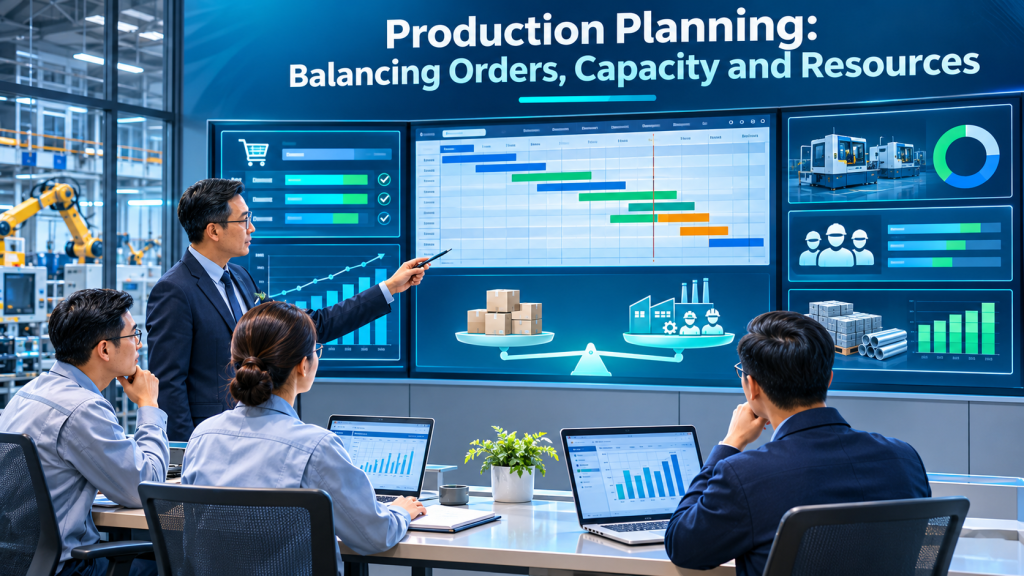
Factory objectives often conflict. Expediting a priority order can delay another customer; minimizing work in process can starve a machine; preventive maintenance reduces risk but consumes capacity today. Optimization must therefore reflect the enterprise’s actual objectives rather than maximize a single operating metric.
AI may forecast cycle times, demand changes or failure exposure, while an optimization engine evaluates feasible schedules under hard constraints. Those constraints include eligible equipment, qualified operators, approved materials, operation precedence, delivery dates and overtime limits. Forecasting and constrained optimization are complementary, not interchangeable.
Alternative plans should be compared through business outcomes: on-time delivery, overtime expense, queue length, changeover losses, rework costs and residual risk. A schedule that uses fewer machine hours may still be commercially inferior if it misses a contractual milestone.
Intelligent control also requires schedule stability. Reordering every job whenever a new data point arrives can disrupt crews and raise setup costs. Frozen planning windows, explicit rescheduling triggers and approval responsibilities keep the technology aligned with disciplined execution.
6. Illustrative case: avoiding disruption in a three-stage factory
Consider a hypothetical factory with machining, painting and assembly operations. A priority order requires 1,000 units in five days. After two days, MES reports 480 machined units but only 300 painted units; another 90 units await quality review, and short stops on the primary paint line have increased. These figures illustrate the method rather than measured industry performance.
A machining report alone looks reassuring. Connecting events across operations reveals a growing queue ahead of painting and a plausible delivery risk if interruptions persist. Any AI forecast must state its assumptions about remaining shift capacity, rework and the availability of a secondary paint line.
Management can compare rapid maintenance on the primary line, moving eligible units to an approved secondary line, and controlled overtime. Transferring production requires validated process equivalence and quality authorization; overtime requires available qualified staff and a cost assessment. AI can estimate consequences but cannot waive those conditions.
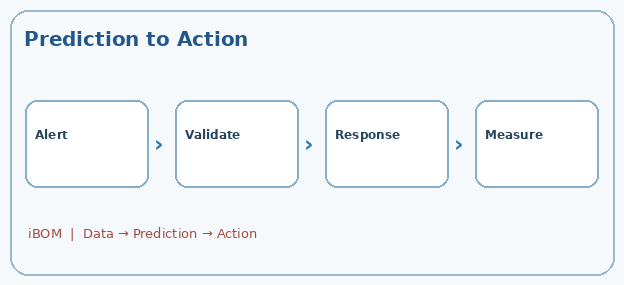
Once a decision is approved, maintenance, production and quality receive accountable tasks. MES captures the revised status, shift output and inspection results, while planning updates the delivery forecast. Success is not a precise initial probability; it is sufficient lead time to prevent an avoidable outcome.
7. Defining a practical MES–AI–iBOM architecture
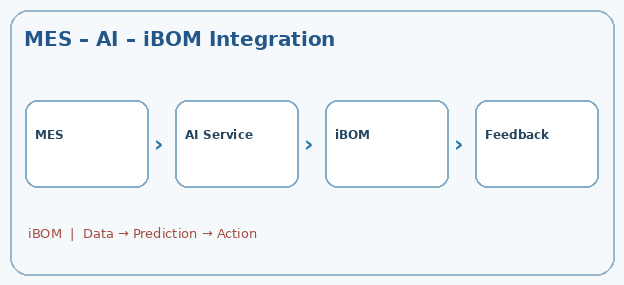
MES should remain the system of record for production execution: orders, operations, machine time, quantities, inspection and traceability. ERP governs enterprise orders, purchasing, finance and resources, while equipment and SCADA systems provide machine-level signals where appropriate. An AI service should consume governed data without silently rewriting the original operational records.
A practical architecture includes data ingestion and normalization, event history, forecasting services, a constraint-validation layer and a decision-support interface. Each warning should carry the work-order identifier, work center, data timestamp, confidence or uncertainty, principal drivers and proposed responses. Safety, quality and material financial decisions require explicit authorization.
For iBOM, a reasonable integration role is cross-functional coordination: receive validated warnings, create accountable work, assign deadlines, preserve decision records and measure corrective outcomes. This is a proposed integration architecture, not a claim that iBOM already includes every specialized MES or AI function.
Clear system boundaries prevent overlapping investment. MES should not be replaced by generic task forms, and iBOM should not directly control industrial equipment without a dedicated safety architecture. The integration creates value when shop-floor evidence becomes a traceable management decision and a completed action.
8. Implementation roadmap and credible value measurement
A pilot should begin with one production line that has reasonably reliable MES records and one consequential business problem, such as delayed orders caused by equipment stops or recurring rework. Before training a model, verify order identifiers, event timestamps, downtime causes and inspection outcomes. Poor records are a process problem that AI cannot repair by itself.
Build a transparent baseline using existing rules or simple statistical methods, then run AI predictions in parallel with current operations. Assess early-warning lead time, false alarms, stability and the clarity of explanations. Aggregate accuracy alone can be misleading when warnings arrive after the last practical opportunity to act.
Once alerts demonstrate value, connect them to approval and task workflows. Track response time, avoided downtime, on-time delivery, rework expense and operator acceptance. Compare results with an appropriate baseline while accounting for changes in volume and product mix, rather than attributing every improvement to AI.
Expand only after the pilot has shown repeatable operational benefits. Multi-line deployment requires model versioning, access controls, cybersecurity, drift monitoring and a fallback procedure when AI is unavailable. The long-term goal is a sustainable management capability, not a technology demonstration.
Conclusion
MES and AI do not replace management accountability. They become a durable competitive capability only when reliable data, verifiable forecasts and governed decisions lead to measurable action.
Professional references and conceptual foundations
- ISA-95 / IEC 62264 — Enterprise-control system integration .
- ISO 22400 — Key performance indicators for manufacturing operations management.
- NIST AI Risk Management Framework (AI RMF 1.0) .
- Why Excel Is Still Causing Cost Overruns in Construction Projects
- From Managing Tasks to Operating the Entire Project
- AI & Power: Whoever Controls the Algorithm Controls the Advantage
- How Far Can AI Automate Enterprise Processes?
- What Is MES? The Role of Manufacturing Execution Systems in Modern Factories