
Articles “Production Planning: Balancing Orders, Machine Capacity and Resources” and “How AI Optimizes Production Scheduling as Orders and Capacity Keep Changing” explored production planning and rescheduling under changing conditions. The next question is how a factory verifies execution: which orders are actually running, which output is compliant and which events can support timely decisions. MES connects enterprise plans to shop-floor reality, but only when implemented around the actual production process.
1. MES is an execution system, not another reporting dashboard
A factory may have approved production plans, reliable order records and detailed inventory in its enterprise system, yet supervisors still struggle to identify which order is waiting at a machine, which operation has stopped and which output is awaiting inspection. This gap lies between enterprise-level commitments and events on the shop floor. A Manufacturing Execution System (MES) addresses that gap by connecting production intentions with observable execution rather than merely replacing end-of-shift spreadsheets.
An MES translates production plans into trackable work: which operation runs on which equipment, using which process revision, material lot and responsible team. Instead of representing a manufacturing order as one aggregate quantity, the system records a sequence of time-stamped events and transitions. That history provides the context necessary to understand whether the factory is progressing toward customer-ready output.
A report showing 1,000 units produced is incomplete unless management can distinguish processed units from inspected, accepted and released units. Material awaiting inspection or requiring rework is not equivalent to output ready for the next operation. MES must preserve these distinctions because downstream planning depends on usable quantities, not optimistic totals.
The real business benefit is timely intervention. A dashboard refreshed the following morning can support historical analysis, but it may not help a supervisor prevent an interruption during the current shift. MES creates value when verified shop-floor events reach accountable decision-makers early enough to change the outcome.
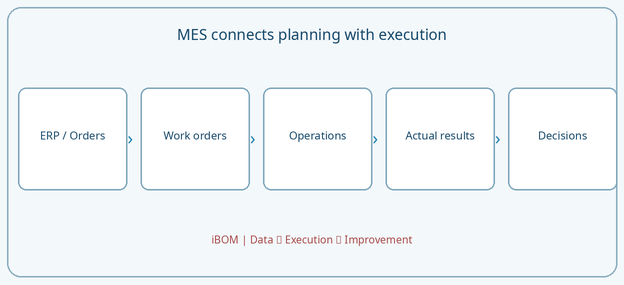
Figure 1. MES connects planning with execution
2. How MES differs from ERP, SCADA and work-management platforms
Enterprise Resource Planning (ERP) manages enterprise commitments and resources: sales orders, purchasing, inventory, financial records and aggregate planning. MES manages the execution of those commitments within the plant. ERP may establish that 5,000 units are required by Friday; MES shows which batches have passed each operation and which are ready to ship. Neither system should be expected to replace the other.
Supervisory Control and Data Acquisition (SCADA) and industrial controllers capture equipment signals and operating parameters. MES may consume those signals but adds manufacturing context: which order was running, which product was affected, why the machine stopped and who owns the response. Connecting a machine to a network does not, by itself, create an integrated manufacturing execution process.
A project or work-management platform such as iBOM could, within a proposed integration architecture, coordinate cross-functional corrective tasks, escalation, responsibilities and improvement projects. It should not automatically be described as a substitute for specialist MES functions such as operation-level tracking, lot genealogy or process enforcement. Explicit boundaries prevent duplicate investment and unrealistic product expectations.
The practical architecture requires clear ownership of each data object. ERP supplies demand and enterprise constraints; MES governs execution transactions and returns actual results; industrial systems supply machine evidence; work-management tools coordinate exceptions requiring people. Shared identifiers and reconciliation rules are essential to avoid contradictory production figures.
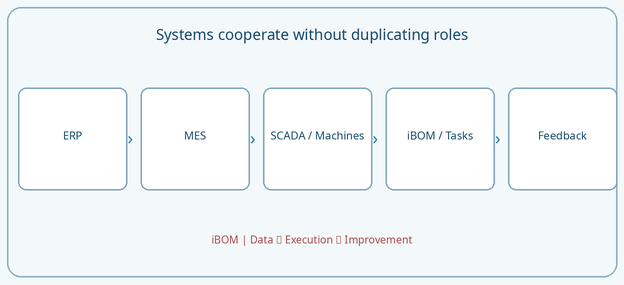
Figure 2. Systems cooperate without duplicating roles
3. Converting orders into executable manufacturing work
A weekly production plan becomes executable only when it is translated into shifts, machines, crews and batches. Materials must be released, equipment must be ready, approved instructions must exist and predecessor operations must be complete. A system that simply imports a list of orders without checking these conditions digitizes scheduling but does not establish operational readiness.
Each released order should reference a product identity, bill-of-materials revision, approved routing, quantity, due date and required quality controls. Revision history matters. If a process specification changes halfway through production, the plant must still know which units were made under the earlier version rather than overwriting the past with the latest master record.
Production often splits and merges lots. A 2,000-unit order may run in several batches on different machines, with only part of the output accepted for assembly. MES needs relationships between parent orders, sublots, accepted quantities, rejects and work in progress. Without these links, downstream schedules can mistakenly assume that all reported output is available.
Exception handling is as important as the normal workflow. Material shortages, unavailable equipment, unapproved instructions and priority changes must trigger visible states and assigned decisions. Critical quality or safety conditions should not be bypassed merely to make the schedule appear complete.
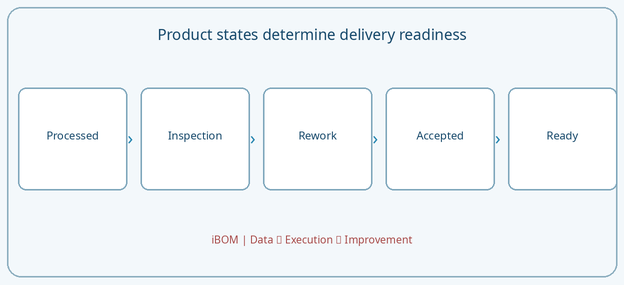
Figure 3. Product states determine delivery readiness
4. Shop-floor data must be timely, contextual and auditable
Factory data may come from sensors, controllers, barcodes, handheld devices or operator entries. These sources do not represent the same type of evidence. A running-machine signal does not prove accepted production, while a barcode scan may confirm a lot movement without measuring processing time. MES must distinguish automatic measurement, operator declaration and verified acceptance.
A useful event identifies what happened, when and where, which order it relates to and how the operational state changed. Eighteen minutes of machine downtime without a reason code or associated order may help maintenance analysis but cannot reliably quantify delivery exposure. Common identifiers and synchronized event times matter as much as the number of connected sensors.
Real factories face intermittent networks, legacy equipment and uneven reporting discipline. Offline capture, reliable synchronization, duplicate-event detection and an audit trail for corrections are therefore practical requirements. Otherwise, one network interruption can force paper recording and retrospective entry, undermining near-real-time visibility.
Data governance must also make it safe to record undesirable events. If workers are penalized for accurately reporting downtime or scrap, the system may collect convenient explanations instead of facts. Reliable execution data requires sound workflows, training and incentives, not just better devices.
5. Controlling progress, work in process and bottlenecks
End-of-shift production totals reveal output volume but not necessarily whether customer orders will ship on time. MES should relate each order to operation-level progress and accepted output. When upstream production exceeds downstream capacity, work in process accumulates even as local machine utilization looks strong. This is a flow problem rather than evidence of overall improvement.
Work in process must be tracked by location and condition. A batch awaiting inspection is not available to assembly, and a lot moved physically but not recorded can create false shortages. Reliable flow records help supervisors distinguish actual constraints from reporting errors and focus attention on the operation that limits completion.
Cycle times, queue times, first-pass yield and plan-versus-actual progress can all support decisions, but no single metric should dominate. Maximizing upstream throughput may increase queues without improving shipments; reducing waiting at a noncritical machine may consume resources needed elsewhere. Performance must be interpreted against the complete routing.
MES does not create extra machine capacity. It makes constraints visible so management can consider maintenance priority, workforce transfers, sequence changes or earlier inspection. The value lies in evidence-based intervention, not simply in constantly updating charts.
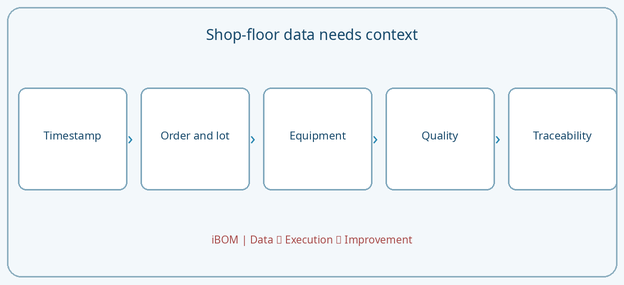
Figure 4. Shop-floor data needs context
6. Embedding quality and traceability in execution
Units should not automatically proceed merely because processing has finished. MES must connect inspection requirements and approved process parameters to each routing step and lot state. At critical gates, release can be prevented until valid test results or authorized approval exist. Quality then becomes an operational condition rather than paperwork completed after the fact.
Traceability may connect input lots, equipment, shifts, operators, process settings, test outcomes and finished goods. When a material batch is found defective, precise genealogy allows targeted containment instead of a broad recall caused by missing records. The necessary granularity should follow product risk and sector requirements rather than collecting unlimited data.
A nonconforming lot needs recorded quarantine, disposition, rework, scrap and retest results. Simply changing the accepted quantity while erasing defect history corrupts both quality and productivity analysis. Event history can support root-cause investigation, although statistical association alone does not prove why a defect occurred.
Quality problems also consume capacity and working capital. Rework occupies equipment, requires additional materials and may delay other customer orders. Linking quality events to orders and costs reveals the wider operational consequences and supports better prioritization of preventive improvements.
7. Illustrative case: high output but a late customer order
Consider a machining plant with an order for 1,000 assemblies due at the end of the week. The machining department reports 1,050 processed units and appears ahead of plan. Inspection records, however, show 120 awaiting dimensional checks, 80 requiring rework and only 850 accepted for assembly. These figures are illustrative, not industry survey results.
If assembly scheduling uses the 1,050-unit headline, it will release work that cannot be completed because only 850 compliant units are ready. MES must distinguish processed, pending inspection, rework and accepted quantities by lot. The resulting 150-unit shortfall becomes visible before the customer delivery deadline.
Suppose rework requires 12 additional machine-hours and retesting requires four labor-hours, while the machine is already allocated to another order. The system can expose the competing commitments, remaining shift capacity and approvals needed to change priorities. Overtime and resequencing still require managerial judgment about cost, safety, quality and other customers.
After the intervention, the plant should preserve the defect cause, recovery time, accepted final quantity and delivery impact. Repeated problems associated with a machine or process revision can then inform improvement. MES does not magically increase output; it prevents management from relying on quantities that are not actually ready.
8. Implementation roadmap and a realistic role for iBOM
A sensible MES rollout begins with one production line or product family with a clear routing and measurable problems. The team should define orders, operations, lot states, quality gates and event-capture points before selecting interfaces. Baseline data on waiting time, accepted output, defects and on-time delivery are necessary to judge whether the pilot works.
Full machine connectivity is not a prerequisite on day one. Barcode scanning, shift-level reporting and selected automatic signals can provide useful visibility if records are reliable. Once the event flow is validated, integration can expand to ERP, stores, maintenance and industrial control systems. Each integration must specify data ownership and reconciliation behavior.
Within a proposed architecture, iBOM could serve as the cross-functional coordination layer for machine stoppage responses, corrective actions, change control and improvement initiatives. A specialist MES would remain responsible for order-, lot-, operation- and equipment-level execution transactions. This is an integration concept to be validated against actual product capabilities, not a claim that iBOM already provides complete MES functionality.
When execution data becomes dependable, AI can be introduced for completion-time forecasting, anomaly detection and scheduling assistance. But AI cannot compensate for incorrect identifiers, missing event times or bypassed quality controls. A sound investment sequence establishes accountability and clean execution data first, validates MES operations next and only then expands toward prediction and optimization.
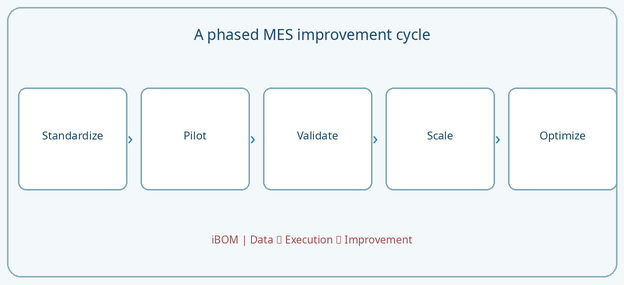
Figure 5. A phased MES improvement cycle
Conclusion
MES does not replace planning, ERP or shop-floor expertise. It establishes a reliable execution layer between enterprise commitments and actual output. When orders, operations, lots, quality states and exceptions are recorded correctly, factories can manage delivery, trace problems and improve through evidence. That is also the necessary foundation for the next article on MES combined with AI.
Professional references and conceptual foundations
- ISA-95 / IEC 62264 – Enterprise-control system integration (functional and information-model concepts).
- MESA International – Manufacturing Execution Systems and manufacturing operations management concepts.
- ISO 22400 – Key performance indicators for manufacturing operations management.
- A Day in the Life of a Construction Site Manager: What Do They Really Do?
- Why Construction Projects Always Run Late
- Construction Material Management: Controlling Demand, Supply, Inventory and Consumption
- Computer Vision in Construction: AI for Defect Detection and Site Quality Monitoring
- AI in Construction Project Management: From Manual Reporting to Intelligent Decision Support (Part 1)