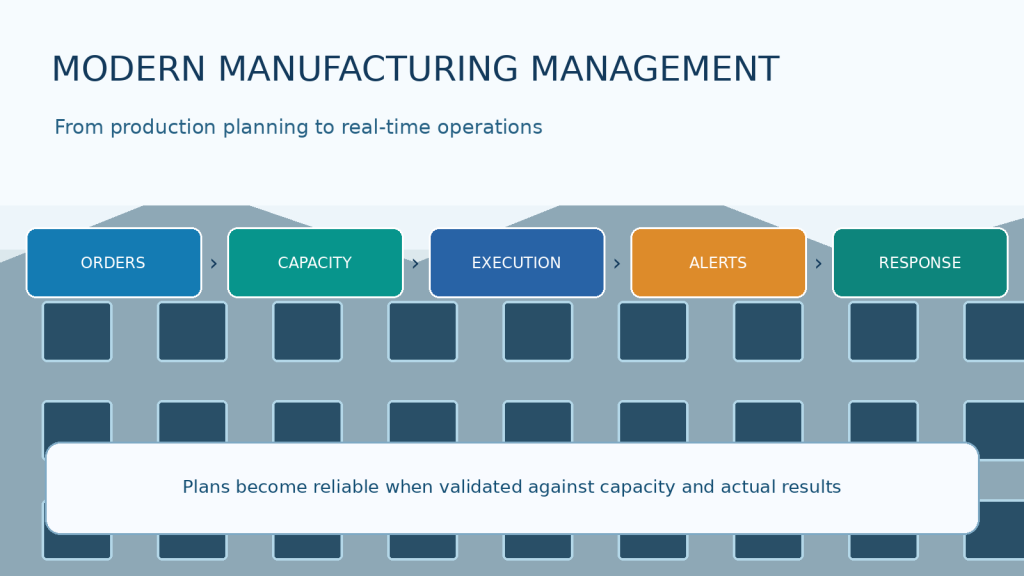

Article “Production Planning: Balancing Orders, Machine Capacity and Resources” established that production planning must reconcile customer orders with finite capacity and resources. Even a carefully designed plan becomes obsolete when urgent orders arrive, machines stop or materials are delayed. This article examines data-driven, AI-assisted rescheduling, constrained optimization and the governance required to turn better schedules into better operational decisions.
1. Why an approved production schedule immediately starts to change
In make-to-order manufacturing, an approved schedule is a conditional commitment rather than an immutable allocation of jobs. It assumes particular material arrivals, machine availability, staffing, changeover durations and order priorities. When any assumption changes, the feasibility of the remaining sequence changes with it. A schedule that was sound on Monday morning may therefore contain serious conflicts by Tuesday afternoon.
Rush orders attract immediate attention, but quieter disturbances can be more damaging. An unexpected coating-line outage, a rejected material batch or ten additional processing minutes per unit may create growing queues and push promised dates backward. Updating aggregate output targets without revising the dependencies between operations can leave a schedule that looks plausible in a report but cannot be executed on the shop floor.
Every intervention has consequences elsewhere. Inserting a rush order at the bottleneck may delay three existing customers. Moving a job to an alternative machine may increase setup time or scrap. Overtime may protect this week’s delivery while increasing cost and fatigue exposure. Rescheduling is therefore a constrained, multi-objective decision problem, not simply rearranging bars on a Gantt chart.
AI can help identify disturbances, estimate realistic processing times and compare alternative schedules. But the model must know which restrictions are inviolable, which customer commitments can be negotiated and which actions require management authorization. Computational speed matters only when the optimization problem represents the factory that actually exists.
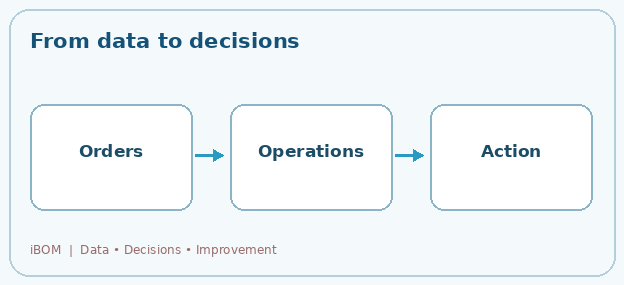
Figure 1. Disturbances change the schedule
2. From static schedules to state-aware rescheduling
Initial scheduling assigns jobs to resources and time windows. Rescheduling asks a harder question: given work already in process, material already staged, machines already running and commitments already locked, what can be changed without destabilizing everything else? The current operational state is therefore more important than a pristine copy of the original plan.
For each production order, the system needs completed operations, remaining quantities, priorities, due dates, available materials and mandatory successors. For each machine, it needs usable calendars, sequence-dependent setup times, technical capabilities, maintenance restrictions and existing allocations. Two machines are not interchangeable merely because they belong to the same equipment category; tolerances, tooling and qualification may differ.
A frozen scheduling window is equally important. Jobs about to start, installed tooling and material already released to the line should not be moved casually. A mathematically attractive solution might reshuffle dozens of tasks in one shift, but repeated changes can undermine operator confidence and actual throughput. Schedule disruption must therefore be represented explicitly as a constraint or penalty.
A practical operating model preserves stability in the immediate horizon while allowing more flexibility further ahead. When a significant disturbance occurs, the system refreshes the operational state, estimates the impact and proposes changes to the affected portion of the schedule. This is controlled, proactive rescheduling rather than a sequence of disconnected local reactions.
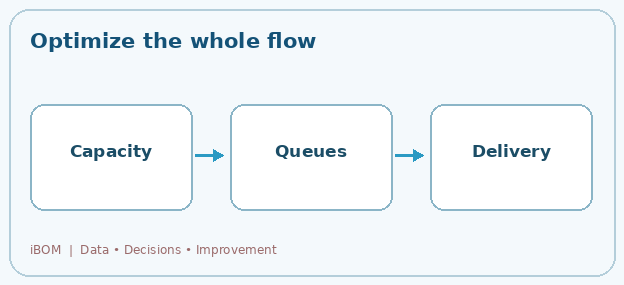
Figure 2. Scheduling needs real state
3. The constraints that determine schedule feasibility
An algorithm can produce an elegant but meaningless timetable if it considers machine hours alone. Feasibility also depends on qualified operators, tooling, inspected materials, cleaning time, testing capacity, intermediate storage and transport between operations. In high-mix manufacturing, changeover duration is often sequence-dependent: alternating paint colors or molds can consume substantial productive capacity.
Precedence relationships form a network of mandatory dependencies. A component cannot proceed to final inspection before required heat treatment, and a rejected batch cannot be treated as available work in process. If the schedule starts a downstream operation before the predecessor is complete and released, the problem is not suboptimality but an incorrect model. Hard technical constraints must be enforced before alternatives are ranked.
Nominal capacity must also be distinguished from usable capacity. A machine staffed for sixteen hours does not necessarily provide sixteen productive hours after planned maintenance, breaks and tooling changes. Actual cycle-time variation and rework rates further affect capacity. Applying one generic efficiency factor to every machine can conceal the resource that truly constrains delivery.
Constraints are not merely mathematical restrictions; they identify management interventions. If every feasible alternative is late because of one curing chamber, the answer may be an additional shift, limited outsourcing or a renegotiated due date rather than more optimizer runtime. A credible system explains why all commitments cannot be met simultaneously and which condition must change to restore feasibility.
4. AI estimates uncertainty; optimization chooses feasible alternatives
The phrase “AI-optimized production scheduling” can imply that a single model performs every task. In practice, a robust architecture separates prediction from optimization. Predictive models estimate cycle times, equipment interruption risk, material arrival uncertainty and possible lateness using historical and current data. An optimization solver then uses those estimates alongside hard constraints to generate feasible sequences.
Dispatching can begin with transparent rules such as earliest due date or shortest processing time. More complex, multi-stage factories may require constraint programming, mixed-integer optimization or heuristic search. No algorithm dominates every setting: scheduling dozens of jobs overnight is a different computational problem from revising thousands of operations within seconds.
Training data must be time-correct. A model that predicts an operation’s duration using information recorded after completion may appear excellent in testing and fail in deployment. Historical relationships also change after new equipment, supplier changes or process redesign. Forecasting models require time-aware validation, drift monitoring and comparison against the factory’s existing scheduling baseline.
Managers should not receive only one supposedly optimal schedule. The system can show a customer-priority scenario, a lower-overtime scenario and a stability-focused scenario, together with expected late orders, total tardiness, additional cost and number of changed assignments. Prediction and optimization then become explainable decision support rather than a black box that silently rewrites customer commitments.
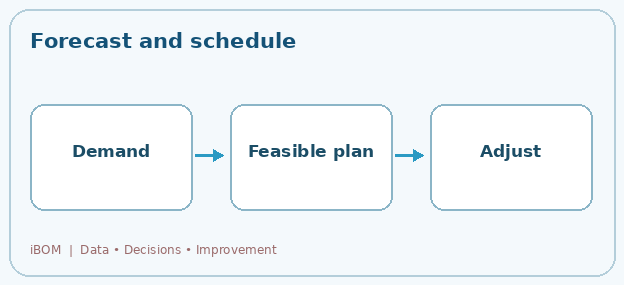
Figure 3. Prediction plus optimization
5. Multi-objective trade-offs and the cost of schedule changes
Maximizing machine utilization alone may favor large batches and fewer changeovers, improving capacity dashboards while pushing urgent small orders to the back of the queue. Maximizing on-time delivery alone may require frequent setups and expensive overtime. Scheduling therefore needs explicit business priorities rather than optimization of one isolated indicator.
Common objectives include delivery reliability, total tardiness, changeover frequency, overtime, work in process, subcontracting cost and schedule stability. They should not all disappear into an unexplained composite score. Safety, quality and technical capability remain hard constraints; other objectives can be traded off only within authorized management limits.
Consider a revised sequence that protects a high-value order but changes eighteen jobs already released to crews. The commercial benefit may be meaningful, yet additional tooling changes, material movement and execution errors must also be considered. If the optimizer ignores these costs, the numerically superior schedule may perform worse on the shop floor.
A responsible decision framework sets priority rules by customer commitment, contractual penalties, order value and data confidence. When a significant conflict arises, the system should show who benefits, which orders are disadvantaged and who can approve the trade-off. Optimization does not remove managerial judgment; it makes the consequences of that judgment visible.
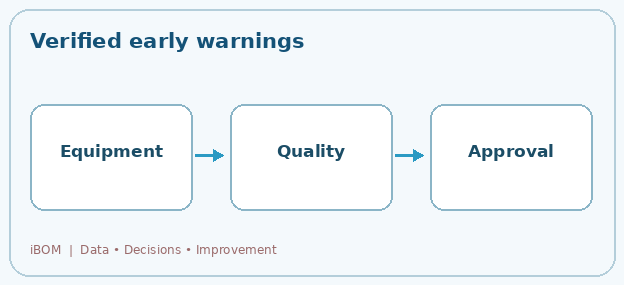
Figure 4. Balance competing objectives
6. Illustrative case: a rush order overloads the coating bottleneck
Consider a metal-fabrication plant whose coating line is the bottleneck, with 160 usable hours available next week. Confirmed orders require 148 coating hours, and several batches are already waiting after machining. A strategic customer introduces a rush order requiring another 24 hours by Friday. Nominal demand rises to 172 hours, twelve above capacity, before accounting for sequence-dependent color changes and cleaning.
A manual response might place the rush order first and push other batches backward. That could protect the new customer while delaying two existing orders, increasing color-change time and starving final assembly of work in process. The scheduler must evaluate individual due dates, buffer inventory, downstream capacity and material readiness; coating hours alone are not a sufficient decision basis.
For discussion, imagine three candidate scenarios. The first preserves regular shifts and renegotiates a lower-priority delivery. The second adds twelve overtime hours, subject to staffing and safety checks. The third groups similar colors to reduce changeovers, but must establish whether the time saved is sufficient and whether all due dates remain feasible. These are illustrative alternatives, not solver outputs from measured factory data.
AI adds value by refreshing processing-time expectations and identifying when a scenario is becoming unreliable. Optimization adds value by constructing alternatives consistent with constraints. Management adds value by authorizing overtime, customer negotiation or resequencing and then monitoring the result. All three must operate together before schedule optimization improves business performance.
7. Measure delivery outcomes and operational stability
An optimization system should not be judged solely by its ability to generate a timetable in seconds. Feasibility comes first: no machine conflicts, no violated operation precedence, no unapproved material use and no allocation beyond authorized calendars. Without these conditions, improvements in simulated delivery indicators have little practical meaning.
Once feasibility is established, organizations should track on-time delivery, average tardiness, overtime, post-release schedule changes, bottleneck waiting time and work-in-process levels. Comparisons must control for order mix and operating conditions. A month with simpler orders may look better even if the scheduling method has not improved.
Forecast quality and decision quality are also different. More accurate processing-time estimates may not help if priority rules cause constant reshuffling. Fewer late orders may be offset by costly overtime and expanding intermediate inventory. Performance evaluation should examine customer service, total cost and schedule stability together.
During a pilot, proposed schedules can run alongside actual dispatching decisions and be evaluated against recorded disturbances. Each run should preserve the information available at that moment to avoid hindsight bias. After deployment, every managerial override provides useful evidence about missing constraints, questionable assumptions and opportunities to improve the decision process.
8. An implementation pathway for intelligent scheduling with iBOM
For a work-management platform such as iBOM, the sensible starting point is not to replace a specialized manufacturing execution system immediately. First identify the business entities that must be linked: customer orders, production orders, operations, machines, shifts, people, materials, quality states and disruption events. These may originate in ERP, MES, equipment systems or field records. iBOM can be evaluated as a coordination and exception-management layer over a connected operational dataset.
A pilot should begin at a clearly constrained process such as coating, heat treatment or packaging. The team must agree on job identifiers, machine calendars, setup times, operation-release rules and delivery criteria. Before introducing AI, a transparent rule-based scheduler and conflict alerts can establish a benchmark. This creates measurable operational value without depending on claims about complex models.
The next phase adds processing-time and disruption forecasts, then connects an optimization solver to generate alternatives. iBOM could receive lateness alerts, assign investigation tasks, route overtime or resequencing proposals for approval and capture the outcome. Role-based access, audit trails, approval workflows and rollback to the last accepted schedule are essential when recommendations affect real production commitments.
Expansion across operations and plants should follow evidence of improved delivery reliability and schedule stability. The architecture must distinguish source systems, forecasting services, optimization engines and iBOM’s execution-coordination layer. This is a proposed product-development direction, not a claim that AI scheduling functions already exist in iBOM. The ultimate objective is a closed operational loop: detect change, assess impact, choose an intervention, assign work, measure results and improve.
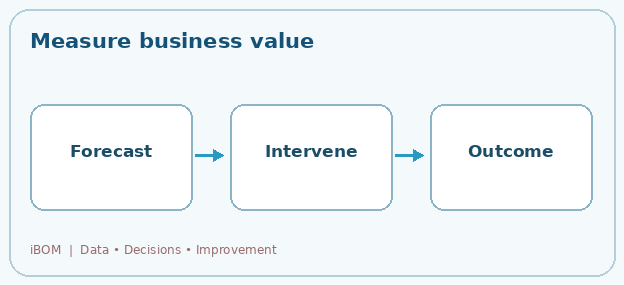
Figure 5. Closed-loop scheduling
Conclusion
AI creates scheduling value only when supported by trustworthy operational data, explicit technical constraints and accountable decisions. The goal is not to change schedules constantly or maximize the utilization of every machine. It is to protect delivery commitments with acceptable cost and disruption. Prediction makes uncertainty visible, optimization compares feasible options, and managers authorize and execute the selected response.
References and professional foundations
- Pinedo, M. L. (2022). Scheduling: Theory, Algorithms, and Systems, 6th ed. Springer. Foundations of scheduling objectives, algorithms and constraints.
- International Organization for Standardization. ISO 22400-2:2014, Automation systems and integration — Key performance indicators for manufacturing operations management — Part 2: Definitions and descriptions.
- Why Construction Companies Will Compete on Decision Speed, Not Execution Speed
- The Hidden Cost of Construction Projects: It’s Not What You Think
- Most CEOs Don’t Have an Execution Problem — They Have an Accountability Problem
- Why Do Growing Enterprises Need Standardized Management Processes?
- How AI Optimizes Production Scheduling as Orders and Capacity Keep Changing