
A production plan creates value only when delivery commitments become an executable schedule grounded in real capacity and resource availability. This article examines the underlying planning mechanisms, managerial trade-offs and data practices required for dependable operations.
1. Production planning starts with delivery commitments, not nameplate capacity
A manufacturer may accept orders with different delivery dates, but those orders cannot simply be inserted into the production calendar. A credible plan translates commercial commitments into dated output requirements and tests whether the production system can actually deliver them. Dividing total order volume by nominal plant capacity ignores product mix, setup time and process routing.
The same line can achieve high output in a long single-product run yet lose substantial capacity when tooling, cleaning or materials must change. Planning must distinguish theoretical capacity, schedulable time and productive capacity after known losses. These figures should be validated against operating records rather than equipment specifications alone.
A large order with a flexible due date may fit into available capacity windows. A small urgent order can instead consume scarce time at the bottleneck and delay several other customers. Order acceptance should therefore reflect end-to-end routing feasibility, not the superficial observation that some machines are idle.
From a management perspective, a plan is not a guarantee that events will unfold exactly as expected. It is a transparent statement of which commitments are supported, which depend on uncertain assumptions and what trade-offs accompany priority changes. Shared assumptions allow sales and operations to negotiate delivery promises on a common factual basis.
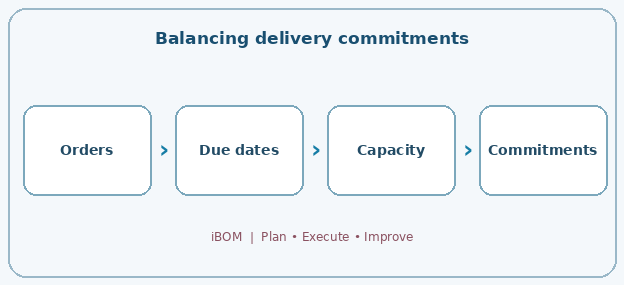
Figure 1. Commitment balance
2. Translate orders into operation-level requirements
Customer orders specify finished goods, while factories execute individual operations. A workable plan connects finished-product identifiers to bills of materials, consumption standards, routings, setup times and processing times. Without this connection, aggregate volume may look balanced even though one operation is severely overloaded.
Standards are not immutable. A product may run on alternative machines at different speeds, scrap rates may vary with materials or operator experience, and outsourced operations depend on supplier schedules. Versioned routings and standards, coupled with actual-versus-standard comparisons, keep planning assumptions relevant.
An order for 1,000 assemblies does not merely require 1,000 final assembly slots. Expected repainting may increase upstream component demand, while a test station operating on one shift can delay finished-goods release. Operation-level requirements reveal constraints hidden by a single finished-output target.
Once requirements are decomposed, planners can schedule backward from the due date and forward from available materials and capacity. The gap between those two calculations exposes the need to revise priorities, expand capacity, change routing or renegotiate delivery commitments.
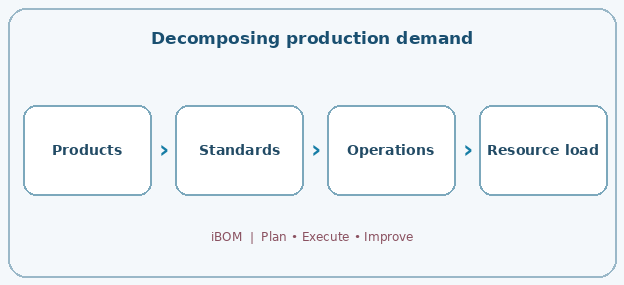
Figure 2. Demand decomposition
3. Finite-capacity planning and bottleneck identification
A common mistake is loading multiple work orders into the same period without checking machine, labor and auxiliary-equipment availability. The resulting schedule may look orderly in a spreadsheet but cannot be executed. Finite-capacity planning assigns operations to real resource time slots and prevents impossible overlaps.
The bottleneck is not necessarily the slowest machine. It is the resource whose required workload exceeds available capacity over the relevant planning horizon. As the product mix changes, the constraint can shift from machining to surface treatment, testing or packing. Load must therefore be assessed by period, shift and product family.
When an operation is overloaded, accelerating upstream production often merely creates work-in-process inventory. Working capital, storage space and handling effort rise without improving deliveries. A sound plan regulates work release around the constraint, protects its productive time and avoids unnecessary jobs that displace priority orders.
Overtime or new equipment should follow a diagnosis of the overload. Some constraints represent genuine capacity shortages; others result from excessive changeovers, material waiting or unrecorded downtime. Recovering lost productive time may release capacity at far lower cost than capital expansion.
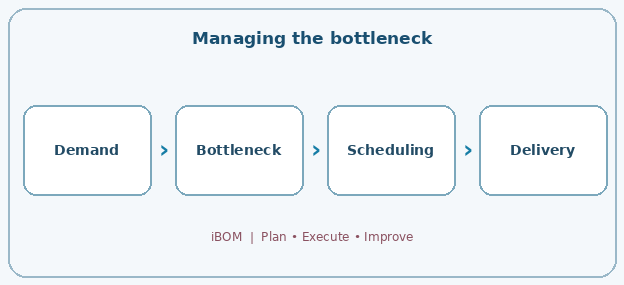
Figure 3. Bottleneck
4. Synchronizing materials, labor and tooling
A scheduled work order is not necessarily ready to start. Unreleased materials, tooling under maintenance or unavailable qualified operators can invalidate the schedule at execution time. Feasibility must therefore be checked across multiple resource classes, not merely against an open machine slot.
For materials, book inventory differs from stock genuinely available to a particular order at a particular time. Some quantities are reserved, quarantined or inaccessible. Requirements must be dated and adjusted for purchasing, transit, inspection and supplier uncertainty.
Headcount is not equivalent to interchangeable capability. Certified tasks, machine programming and specialist inspection require specific competencies. The plan should reflect shifts, leave, training and labor constraints without treating safety safeguards as expendable capacity.
Effective coordination brings materials, people, machines and tools together at the right operation and time. When departments optimize in isolation, stores issue too early, maintenance interrupts peak production and staffing fails to match material arrivals. A shared schedule exposes these conflicts before they become waiting time.
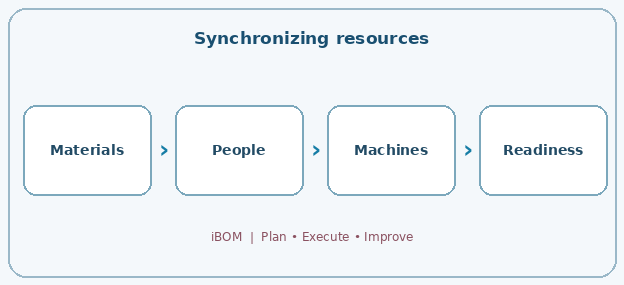
Figure 4. Resources
5. Planning horizons and controlled replanning
Production planning requires several horizons because decisions have different degrees of flexibility. Over months, managers can adjust staffing, long-lead procurement or outsourcing. Within a week, options narrow to shifts, sequencing and maintenance windows. During a shift, supervisors mainly respond to disturbances and reallocate ready work.
The master plan needs enough stability for departments to prepare, while detailed scheduling needs room to respond to reality. Constantly reshuffling jobs for every urgent order increases changeovers, disrupts material staging and erodes trust. Refusing to revise after equipment failure or order cancellation is equally damaging.
A practical approach uses a near-term frozen zone, a controlled adjustment zone and a longer scenario-planning horizon. Every rush-order request should expose effects on other commitments, overtime cost and quality risk. Authorized decision-makers should see these trade-offs before approving a change.
Update frequency should match operating volatility. Continuous production may require hourly deviation monitoring, while make-to-order operations may need replanning when materials or drawings change. What matters is defining which events trigger replanning and who authorizes the revised schedule.
6. Illustrative case: sufficient aggregate capacity, late deliveries
Consider a hypothetical plant with three order families due over four weeks. Aggregate reports show roughly 15% more available machine hours than planned processing hours, suggesting feasibility. Yet the coating line has only 160 productive hours against 195 required, while machining has spare time. This example is illustrative, not measured plant performance.
If machining is pushed to hit local output targets, work-in-process accumulates ahead of coating. Storage becomes congested, sorting and handling consume time, and urgent orders remain unfinished. Machining can report excellent performance while plant-level delivery deteriorates.
One response is to group compatible coating jobs, reduce changeovers, add a safe shift where justified and prioritize near-due orders. Overtime is not automatically optimal: maintenance, fatigue-related quality exposure and downstream packing capacity also matter. If the gap remains, selective outsourcing or delivery renegotiation may be necessary.
Finite-capacity replanning makes it clear which orders remain feasible, which require rescheduling and what each alternative costs. The value of planning software is not a fully populated calendar; it is the ability to expose real constraints and allocate scarce capacity transparently.
7. Measuring plan quality and management accountability
A plan matters only when compared with execution and customer delivery. Schedule adherence is useful but should be read alongside on-time delivery, bottleneck waiting time, work-in-process and rescheduling frequency. Measuring output alone can inadvertently reward easy products over orders that customers need first.
Planning errors must be separated from execution failures. If standard processing times are systematically understated, demanding greater effort from operators will not fix the plan. If capacity estimates are sound but work repeatedly stops for late materials, improvement belongs in supply coordination and dispatching.
Operating reviews should focus on deviations that threaten delivery commitments rather than reciting every report. For each issue, the owner should explain the cause, affected orders, corrective options, decision deadline and outcome. This feedback loop gradually improves standards and planning rules.
A useful metric should drive better decisions, not merely prettier reporting. Reducing work-in-process while starving the bottleneck may be a false optimization. Indicators must be interpreted together, with priority given to end-to-end flow and reliable customer commitments.
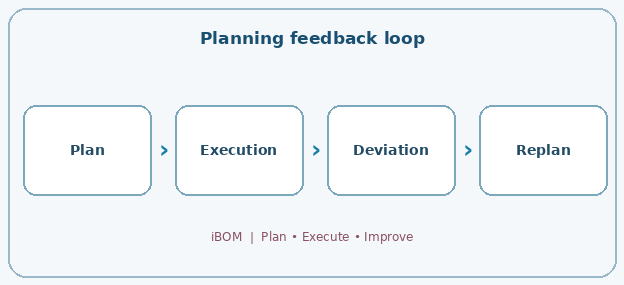
Figure 5. Feedback loop
8. Digitization and a possible iBOM coordination layer
Moving beyond spreadsheets requires common identifiers for orders, products, operations, resources and execution states. Each work order should connect to material requirements, resource reservations, quality results and completion times. Inconsistent identifiers produce reports that look precise but cannot explain deviations.
In a proposed architecture, iBOM could serve as a coordination and decision-workflow layer: receiving approved plans, assigning owners, capturing progress and exceptions, and tracking corrective actions to closure. Specialist ERP, MES and scheduling systems may continue to handle material planning, machine data and detailed optimization. This is an integration proposal requiring product-fit assessment, not a claim that all capabilities already exist.
A practical pilot starts with one production area, clean input definitions and shift-level execution capture. Planned-versus-actual comparisons then reveal which alerts enable earlier intervention. Forecasting and optimization algorithms should be introduced only after the underlying data is dependable, with approval controls retained for consequential schedule changes.
The objective is not to digitize every form. It is to create a closed management loop: delivery commitments become feasible plans, actual conditions are captured promptly, deviations receive accountable responses and lessons improve the next planning cycle. Once that loop works, AI has a credible foundation for recommending better decisions under competing constraints.
Conclusion
Production planning is not the act of filling machine calendars; it is the discipline of determining which commitments can be delivered with finite resources. When demand is translated into operations, constraints are identified and materials and labor are synchronized, managers can make transparent delivery decisions. Digital systems and AI create lasting value only when they reinforce accountable decision-making.
Conceptual references
- APICS / ASCM — principles of production and inventory management; master production scheduling and material requirements planning.
- Eliyahu M. Goldratt and Jeff Cox — The Goal (Theory of Constraints), conceptual background.
- ISO 9001:2015 — process approach, operational control and improvement.
- The Commoditization of Construction Execution
- Why Future Construction Companies Need an Operating System
- Execution Data — The Missing Layer in Enterprise Management
- AI in Construction Project Management: From Manual Reporting to Intelligent Decision Support (The end)
- Digital Transformation Is a Workflow Problem, Not a Technology Problem