
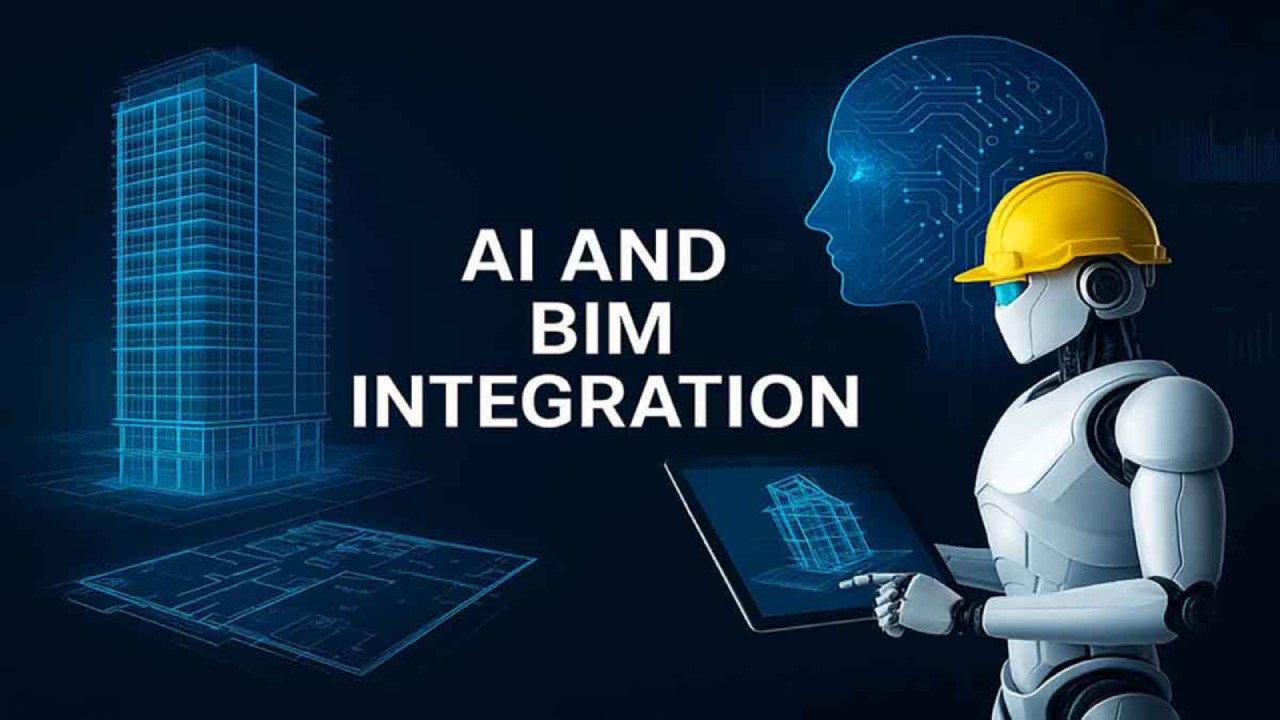
From AI Chatbot to AI Decision Assistant

When people hear about AI, they often think of chatbots.
But for construction companies, a generic chatbot is not enough.
A chatbot that only answers general questions does not create much business value if it cannot understand actual company data.
What construction companies need is an AI Decision Assistant.
This means an AI assistant that can:
- Connect with project data
- Understand schedule, BOQ, cost, subcontractors, documents, and execution context
- Analyze actual project status
- Detect risks
- Suggest actions
- Support executive decision-making
This is the next stage of AI in construction project management.
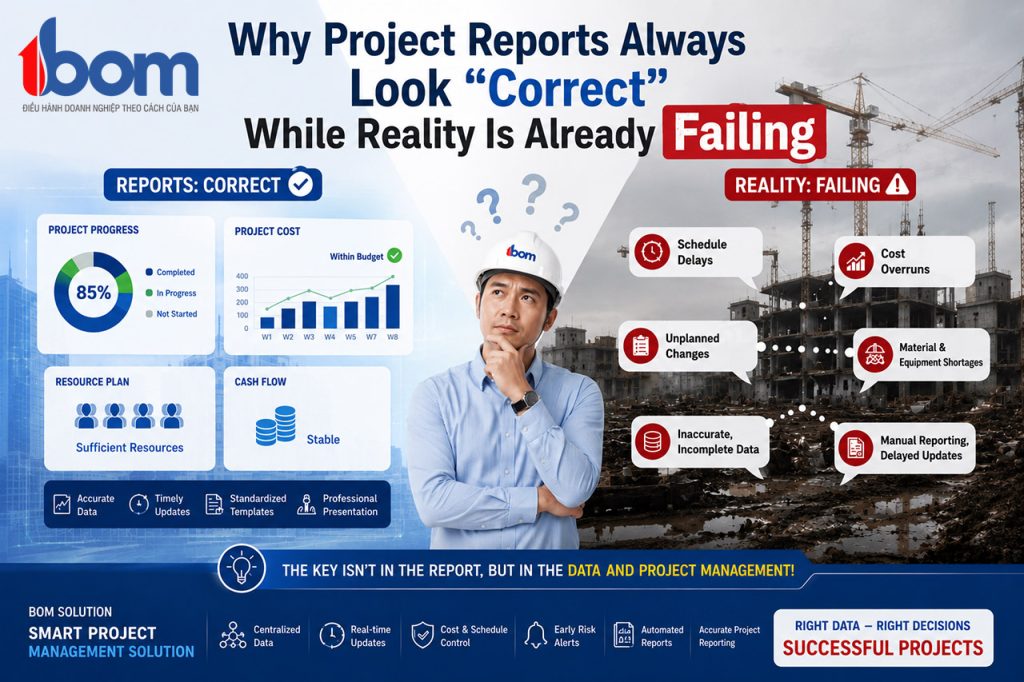
Execution Infrastructure — The Missing Foundation of Modern Enterprise Execution
iBot – AI Decision Assistant in the IBOM Ecosystem
In the IBOM ecosystem, iBot is positioned as an AI Decision Assistant for construction companies.
iBot is not designed to be only a simple chatbot.
It is designed to help companies use execution data inside IBOM, including:
- Schedule
- BOQ
- Quantity
- Cost
- Subcontractors
- Project documents
- Field tasks
- Site diaries
- Mobile data
- Executive dashboards
The goal of iBot is to help companies not only “view data” but also “ask data” and “understand data.”
For example, executives may ask:
- “Which project is most delayed?”
- “Which work package is at risk of cost overrun?”
- “Which subcontractor is affecting project progress?”
- “Which items should be handled this week?”
- “Are there any significant BOQ deviations?”
- “Which project requires executive intervention?”
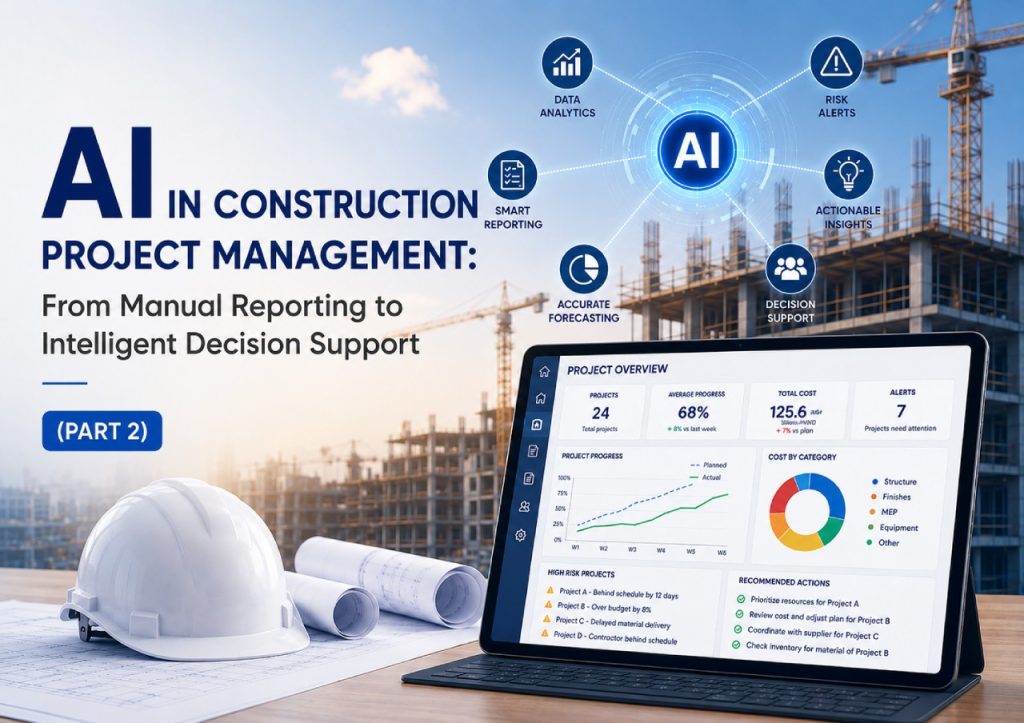
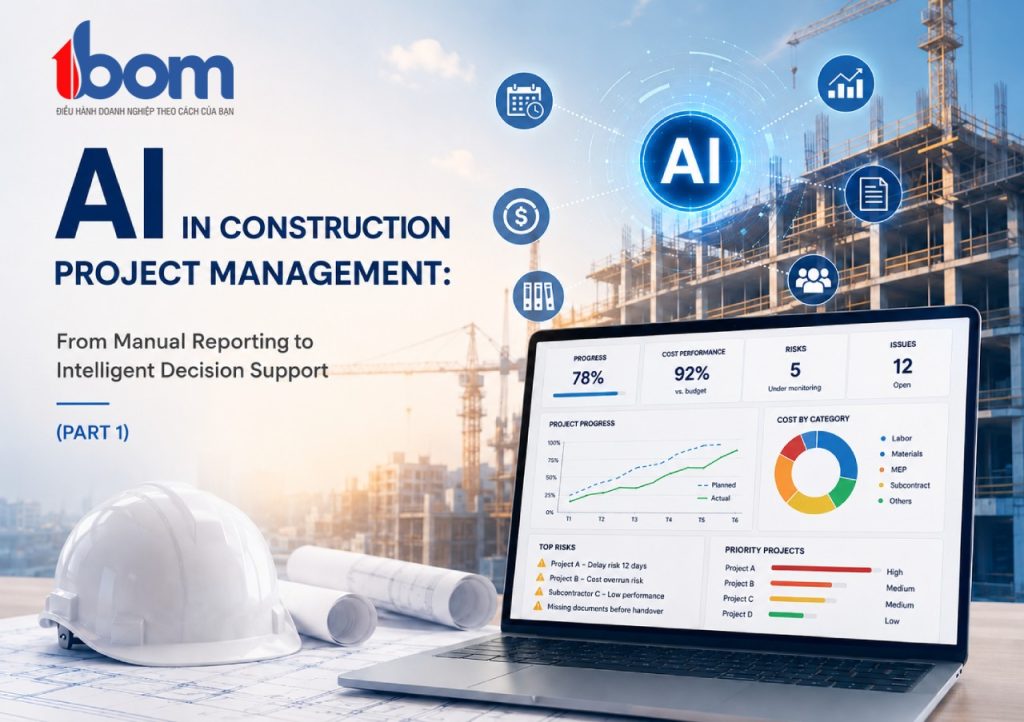
iBot becomes an intelligent layer above execution data, helping users retrieve, analyze, and act faster.
Why iBot Fits Construction Companies

Construction companies have specific data characteristics.
Project data is large, fragmented, constantly changing, and deeply connected to site execution.
An AI assistant for construction must understand industry-specific concepts such as:
- Project
- Work package
- BOQ
- Quantity
- Acceptance
- Subcontractor
- Schedule
- Variation
- Cost
- Project documents
- EPC project
If AI does not understand this context, the output will be too generic.
iBot has an advantage because it is designed within the IBOM ecosystem, a platform for construction project, site, and EPC management.
This allows iBot to work closer to real execution data instead of only providing general knowledge.
AI & Power: Whoever Controls the Algorithm Controls the Advantage
AI in EPC Project Management

For EPC companies, AI can create even greater value because the EPC model includes three tightly connected layers:
- Engineering
- Procurement
- Construction
If engineering is delayed, procurement may be delayed.
If procurement is delayed, construction may be delayed.
If construction is delayed, commissioning and handover may be affected.
AI can support EPC companies by:
- Monitoring dependencies between engineering, procurement, and construction
- Detecting packages at risk
- Warning when materials may affect site progress
- Analyzing cost overrun risks
- Tracking subcontractors and vendors
- Supporting executive dashboards for EPC projects
This is why AI is not only a technology trend. It can become an important project governance capability for EPC companies.
AI in Construction Schedule Management
Schedule is one of the areas where AI can create very clear value.
A strong AI-enabled system can analyze:
- Planned schedule
- Actual progress
- Completion percentage by work item
- Delayed tasks
- Task dependencies
- Related subcontractors
- Delay causes
- Impact on milestones
From there, AI can help answer:
- Where is the delay?
- How serious is it?
- Does it affect handover milestones?
- Which work package should be prioritized?
- Which subcontractor needs immediate attention?
For companies managing multiple projects, AI can classify risk levels across projects so executives are not overwhelmed by too much information.
AI in Construction Cost Management
Cost is one of the most sensitive indicators in construction projects.
AI can help monitor:
- Planned cost
- Actual cost
- Variations
- Cost by work package
- Cost by subcontractor
- Cost by phase
- Project cash flow
- Plan versus actual deviation
More importantly, AI can detect abnormal trends.
For example:
- A work package is only 40% complete but has already consumed 70% of its budget
- A subcontractor has continuously increasing variation claims
- A project cash flow deviates from plan
- A cost category is growing faster than actual progress
These alerts help companies protect project profitability.
AI in BOQ Management
BOQ is one of the most suitable data layers for AI.
When BOQ is connected with schedule, quantity, acceptance, and cost, AI can support:
- BOQ deviation analysis
- Variation detection
- Abnormal accepted quantity checks
- Planned versus actual quantity comparison
- Quantity trend monitoring
- Review suggestions for high-risk items
This is especially important for general contractors and EPC companies, where small quantity deviations can have large financial impacts.
AI in Subcontractor Management
Subcontractors directly affect project schedule and quality.
AI can help evaluate subcontractor performance based on objective data:
- On-time completion rate
- Completed quantity
- Number of issues
- Acceptance pass rate
- Delay frequency
- Variation cost ratio
- Impact on other work packages
With enough data, companies can build a more transparent subcontractor performance evaluation system.
Benefits of AI in Construction Project Management
Applying AI correctly can bring many benefits.
1. Faster Decision-Making
AI reduces the time needed to search, consolidate, and analyze project data.
Executives can access insights faster instead of waiting for manual reports.
2. Earlier Risk Detection
AI can continuously monitor data and alert teams to abnormal signals before they become serious problems.
3. Less Manual Reporting
AI can help generate reports, summarize data, and highlight key issues, reducing manual reporting workload.
4. Better Transparency
When data is centralized and analyzed by the system, teams can work from a single source of truth.
5. Stronger Multi-Project Governance
For companies managing many projects, AI helps executives identify which projects need attention first.
6. Better Digital Transformation
AI cannot be separated from digital transformation.
To use AI effectively, companies must digitize data, standardize processes, and build a centralized project management platform.
In this sense, AI can accelerate the move from manual management to data-driven construction management.
Risks of Applying AI in Construction
AI has strong potential, but companies should also be realistic.
1. Bad Data Leads to Bad AI
If input data is incomplete, outdated, or inaccurate, AI analysis will not be reliable.
2. AI Should Not Make Final Decisions Alone
AI should support decisions, not replace executives, project managers, QS teams, finance teams, or legal decision-makers.
3. Data Permission is Critical
Project data may include sensitive information about cost, contracts, vendors, claims, and legal matters.
AI implementation must include proper access control.
4. Operational Habits Must Change
If site teams do not update data, departments do not use the system, and executives still rely only on manual reports, AI will not create meaningful value.
How Construction Companies Should Start with AI
Companies should not start with an overly complex AI project.
A practical roadmap is better.
Step 1: Standardize Project Data
Start with the most important data:
- Projects
- Work packages
- Schedule
- BOQ
- Quantity
- Cost
- Subcontractors
- Documents
- Tasks
Step 2: Centralize Data on One Platform
Move project data away from fragmented files and into a centralized project management platform.
Step 3: Build Executive Dashboards
Dashboards help management understand project status and provide the foundation for deeper AI analysis.
Step 4: Apply AI to Specific Business Questions
Do not implement AI in a generic way.
Start with questions that matter:
- Which project is delayed?
- Which work package is over budget?
- Which subcontractor is underperforming?
- Which BOQ item has deviation?
- Which documents are missing?
- Which tasks need immediate attention?
Step 5: Integrate AI into Management Workflows
AI creates value when it is used in real operations:
- Weekly meetings
- Executive reporting
- Progress tracking
- Cost control
- Subcontractor management
- Acceptance management
- Risk monitoring
The Future of AI in Construction Project Management
In the future, AI in construction will go beyond simple Q&A.
It may support:
- Schedule delay prediction
- Cost overrun prediction
- Project risk analysis
- Resource allocation suggestions
- Subcontractor performance analysis
- Project document summarization
- Contract review support
- Executive report generation
- Mobile field data analysis
- Integration between BIM, BOQ, schedule, and cost
Companies that prepare their data foundation today will have a major advantage as AI becomes more deeply integrated into construction management.
Conclusion
AI in construction project management is no longer a distant concept.
However, the real value of AI is not simply having a chatbot or a new technology feature.
The real value lies in helping construction companies use project data better, detect risks earlier, and make decisions faster.
For the construction industry, where schedule, cost, BOQ, subcontractors, and documents constantly change, AI can become a new management capability.
But AI only works well when companies have a strong data foundation.
Therefore, the right approach is not to rush into AI blindly. The right approach is to build a centralized project management platform, standardize execution data, and gradually apply AI to workflows that create real business value.
In this direction, IBOM and iBot – AI Decision Assistant aim to help construction companies move from manual management to data-driven execution management, where leaders can not only view reports, but also ask data, understand data, and make faster decisions.
Đỗ Hữu Binh
CEO, ISOFT
This article is part of a professional series analyzing construction project management and cost control strategies.
© 2026 Đỗ Hữu Binh. All rights reserved.
Any citation or reuse of this content must clearly state the source and author.
- Construction Leadership Truth #2
- The Biggest Blind Spot in Construction Management That 90% of Companies Never See
- How Modern Construction Teams Build Systematic Control Over Quantities, Costs, and Changes — Without Adding Complexity
- The Hidden Cost of Construction Projects: It’s Not What You Think
- Construction Leadership Truth #1