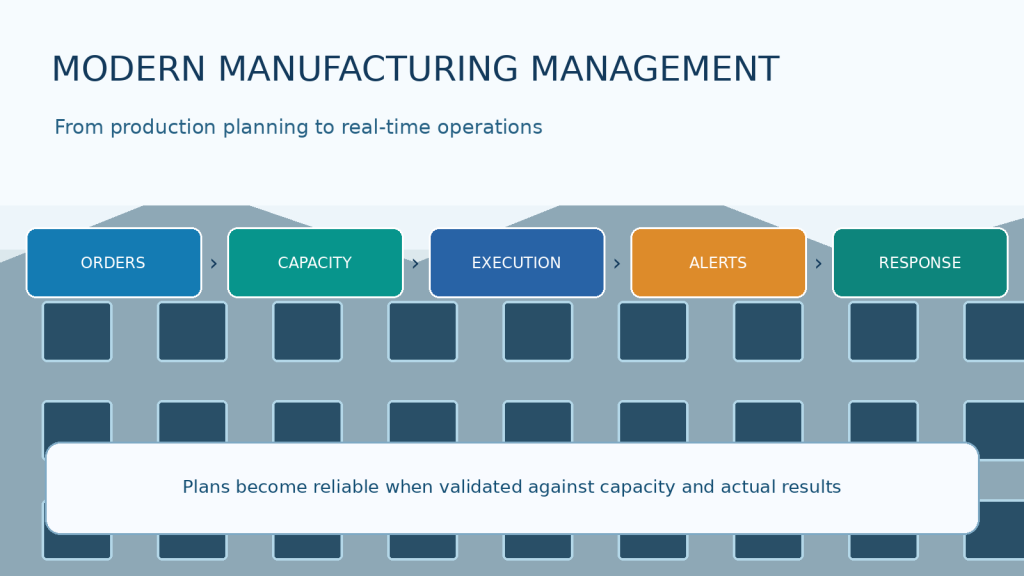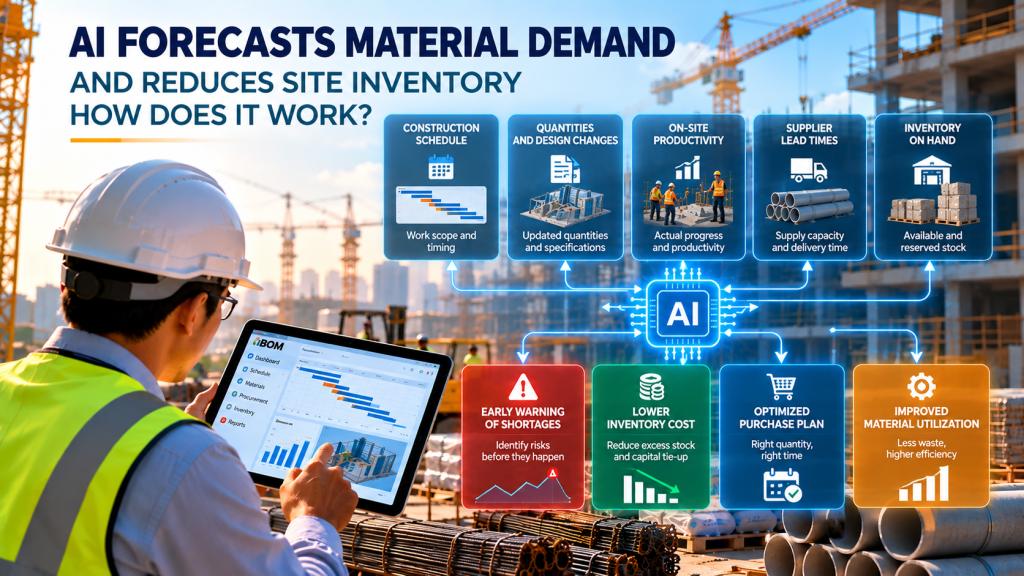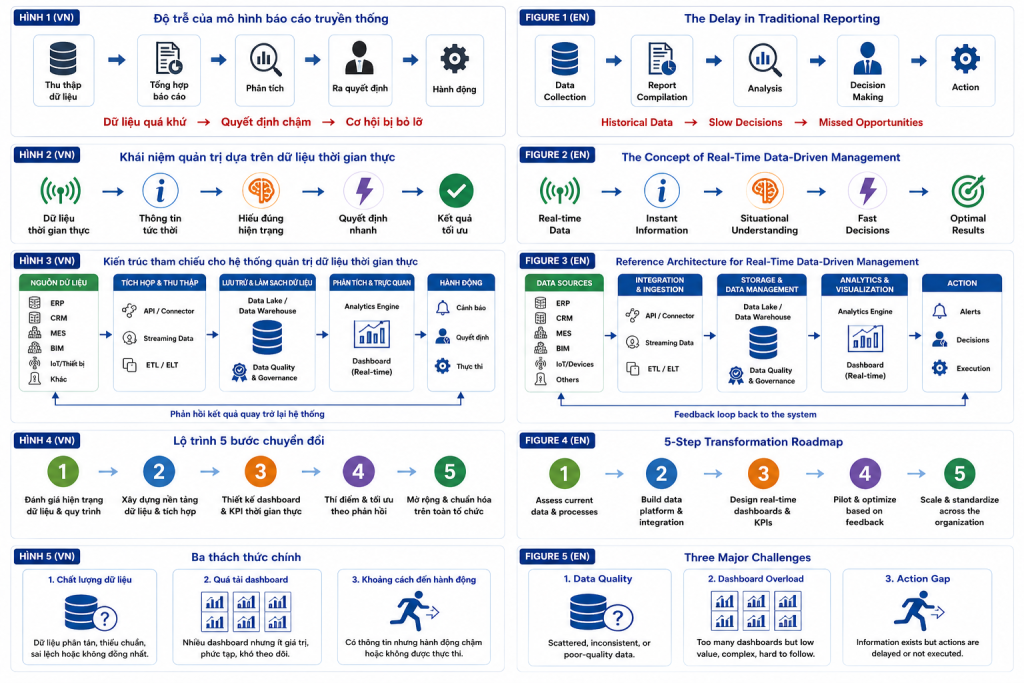

1. From collecting factory data to making better decisions
A factory can retain millions of records from orders, equipment, warehouses and production reports yet still depend on fragmented judgement. Historical records explain what happened; operational leadership must determine what is likely to happen next and where intervention will matter. Artificial intelligence can help bridge that gap, provided its output is tied to real operational decisions.
AI should not be confused with a more sophisticated dashboard or an autonomous instruction engine. Production decisions must respect finite capacity, setup times, material readiness, customer commitments and quality constraints. A useful system therefore combines prediction with feasible options, accountable approval and measurement of what happened after the decision.
2. Why optimizing individual machines can harm the whole factory
The preceding article described a factory in which upstream output rises while customer orders are delivered late. If machining runs at maximum speed but surface treatment cannot absorb the output, work-in-process accumulates between stages. Local utilization improves while end-to-end throughput and lead time deteriorate.
The problem is systemic rather than a failure of one machine. AI can reveal relationships among workload, queues, setup times and due dates, but the optimization objective must represent the entire production flow. On-time delivery, lead time, work-in-process and total cost matter more than maximizing a single machine’s output. A mathematically efficient local solution may be a poor business decision.
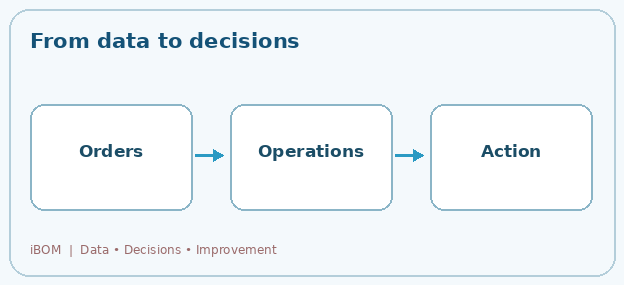
Figure 1. Data and decisions
3. Operational data must represent actual shop-floor states
Useful AI inputs go beyond daily production totals. Orders should connect to bills of materials, process routes, operations, equipment, start and finish timestamps, accepted quantities, scrap and downtime causes. Nominal machine capacity must be distinguished from actual availability after maintenance, changeovers, shift calendars and staffing limitations.
The harder issue is often data fragmentation. Enterprise systems, manufacturing execution systems, machine signals and supervisors’ spreadsheets may describe the same event differently. Inconsistent product codes, units, timestamps and process identifiers can lead a model to learn false relationships. Reliable master data and clear ownership of each source should precede advanced modeling.
4. Demand forecasting is not production forecasting
Demand forecasting estimates what customers may need and when. Production forecasting must also account for the factory’s ability to meet that demand. A high-volume requirement should not automatically enter the schedule if critical materials are unavailable or a constrained operation has no spare capacity. AI can incorporate order history, seasonality and customer signals to generate alternative demand scenarios.
Confirmed orders and statistical forecasts should remain distinct. Low average forecast error may conceal poor predictions for low-volume, high-value products. Prediction ranges and product-level uncertainty allow planners to decide on safety stock, reserve capacity and procurement timing without treating a model output as a guaranteed commitment.
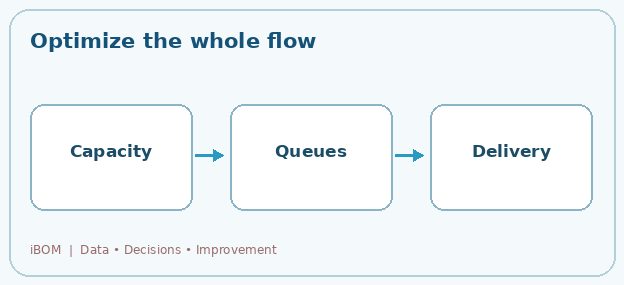
Figure 2. Flow optimization
5. Turning forecasts into feasible production plans
A feasible plan specifies what to produce, on which resources and by when. Machine-learning models may estimate actual processing times, while optimization methods sequence jobs under machine, tooling, material, labor and routing constraints. Prediction and optimization are complementary disciplines rather than interchangeable labels.
A highly optimized schedule will fail if its processing-time assumptions are unrealistic. Conversely, accurate time predictions do not automatically yield a good schedule when setups and precedence constraints are ignored. Plans should therefore be checked for feasibility before release, then compared with execution after every shift to improve both estimates and scheduling rules.
6. Dynamic scheduling without constant disruption
Equipment failures, material holds and urgent customer changes can invalidate a weekly plan. Dynamic scheduling uses current conditions to evaluate feasible alternatives, estimate their effects on connected orders and recommend how capacity should be reassigned.
Continuous rescheduling can itself become a source of waste. If every new signal changes the schedule, teams repeatedly prepare equipment, lose stability and stop trusting the system. Effective implementation needs decision thresholds, frozen planning windows and approval rules for changes affecting delivery promises, quality or safe operations.
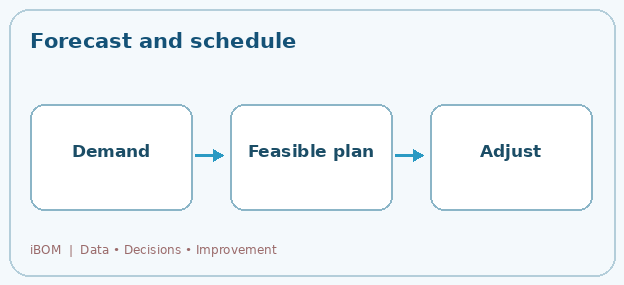
Figure 3. Forecasting and scheduling
7. Predictive maintenance under real operating conditions
Predictive maintenance is more than connecting sensors and waiting for a failure alert. Vibration, temperature, current and cycle counts become meaningful only when interpreted alongside equipment type, load regime, maintenance history and specific failure modes. The same temperature rise can be normal under one operating condition and abnormal under another.
The aim is not to predict every fault at any cost. False alerts may cause unnecessary shutdowns, while missed failures can create severe losses. Plants should prioritize critical equipment, validate alerts with maintenance specialists and connect interventions to spare parts, production schedules and alternate capacity.
8. Quality analytics and root-cause investigation
Quality evidence includes dimensional measurements, process parameters, product images and nonconformance records. AI can detect unusual combinations of conditions, highlight recurring defects and direct inspectors toward higher-risk output. Computer vision may identify defined surface defects when lighting, camera position and labeling criteria are controlled.
Correlation must not be mistaken for causation. A higher night-shift defect rate does not establish a staffing problem without considering materials, equipment state and product mix. AI should help engineers narrow hypotheses for testing; it cannot replace technical verification, authorized acceptance or safety-critical process controls.
9. Materials, work-in-process and working capital
Raw-material stock buffers supply uncertainty, but excess inventory ties up capital. Work-in-process can be even more revealing because it exposes mismatches in capacity across stages. AI can estimate consumption, queue times and shortage risk against the current production plan, informing procurement, transfers and sequencing.
Inventory reduction is valuable only if it does not increase line stoppages and late deliveries. Inventory turnover must be interpreted alongside order service levels, waiting time and shortage costs. Working-capital improvement should follow from a more coordinated production system, not from indiscriminate stock reduction targets.
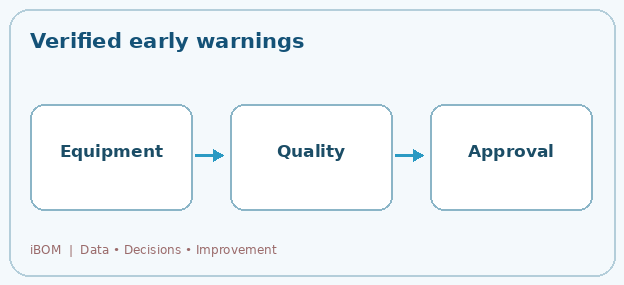
Figure 4. Verified alerts
10. Illustrative case: higher output, later deliveries
Consider a factory with machining, surface treatment and assembly. In one week, machining produces 1,200 parts against a plan of 1,000, while surface treatment finishes only 760 because of lengthy color changeovers and an unexpected equipment outage. Work-in-process rises, but assembly lacks the specific part variants needed to complete due orders. This is a hypothetical scenario, not measured factory performance.
Maximizing machining output would continue feeding the constraint. A better decision-support system would identify growing queues, analyze the product mix required for due orders, propose grouping compatible surface-treatment jobs and reserve capacity for the most time-sensitive commitments. Planners must still weigh setup costs, quality requirements and effects on other customers. Success is measured in delivery reliability and reduced waiting, not the number of parts forecast.
11. Evaluate AI by decision outcomes, not model accuracy alone
Forecast error, defect-detection rates and computing time matter, but they do not establish business value. A highly accurate late-delivery prediction made after intervention is no longer possible has little preventive value. A less precise warning that arrives early enough to reallocate capacity may be far more useful.
Pilots should compare AI-assisted decisions with existing planning under comparable conditions, tracking on-time delivery, order lead time, work-in-process, setup cost and adherence to recommendations. Forecasts must be evaluated using only information available at the prediction date. Model drift should be monitored as product mix, equipment and operating practices change.
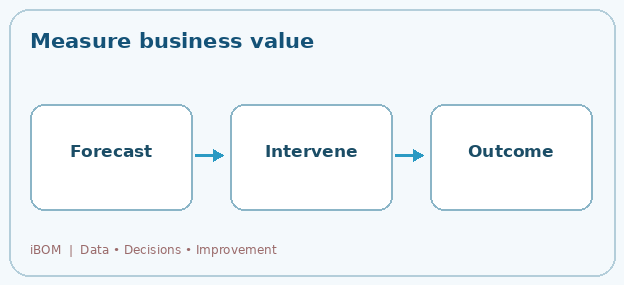
Figure 5. Measuring value
12. An implementation pathway and a possible role for iBOM
The first priority is a dependable operational data flow connecting orders, operations, tasks, progress, resources and exceptions. A potential iBOM architecture could use work structures and task coordination as an orchestration layer connected to existing enterprise and manufacturing execution systems. This is a proposed solution direction, not a claim that iBOM already contains all specialized manufacturing capabilities.
Once records are reliable, a plant can pilot delay warnings and completion-time forecasts on one constrained production line. Scenario-based scheduling and measured intervention outcomes should come next, followed by selective expansion into maintenance or quality. Throughout, authorized personnel must retain control over production commitments, machine parameters and quality acceptance. Sustainable AI value emerges when recommendations become part of a measurable, continuously improved management process.
Conclusion
AI does not create an autonomous factory simply by deploying a forecasting model. Value emerges when trustworthy data informs feasible options, decisions remain governed and outcomes are measured. Manufacturers should start with a constraint that materially affects delivery, cost or quality, then progressively build evidence-based operational capabilities.
Professional references and conceptual foundations
- ISO 22400-2:2014 — Automation systems and integration — Key performance indicators for manufacturing operations management.
- ISO 23247-1:2021 — Automation systems and integration — Digital twin framework for manufacturing.
- NIST AI Risk Management Framework (AI RMF 1.0), 2023 — governance, measurement and management of AI risks.
- ISO 9001:2015 — Quality management systems — Requirements.
- Why Do Growing Enterprises Need Standardized Management Processes?
- Construction Project Management in 2026: Profit Erosion Is a Structural Problem, Not an Operational Accident
- Construction Leadership Truth #3
- Construction Quality Management: From Standards to Acceptance and Defect Resolution
- When Does a Construction Project Actually Start Falling Behind?