
You Don’t Have a Data Problem. You Have a Data Structure Problem.

Many construction companies believe they have a data problem.
They say:
“We don’t have enough data.”
“We don’t have visibility.”
“We don’t have accurate reports.”
So they try to fix it by:
- Collecting more data
- Asking for more reports
- Adding more spreadsheets
But after all that effort, nothing really changes.
Visibility is still limited.
Decisions are still delayed.
Problems still repeat.
Because the real issue is not data.
It is structure.
1. Construction Companies Are Not Short of Data

In reality, construction companies generate massive amounts of data every day.
- Progress updates from sites
- Cost tracking reports
- Procurement records
- Contractor communications
- Financial data
The problem is not availability.
The problem is that this data exists in:
- Different formats
- Different systems
- Different levels of detail
Without structure, data becomes noise.
2. When Data Is Not Structured, It Cannot Be Managed

Unstructured data creates three critical limitations:
No comparability
Projects cannot be compared consistently.
No pattern detection
Recurring issues remain invisible.
No system-level insight
Leadership cannot see how the organization performs as a whole.
As a result, data remains operational—not strategic.
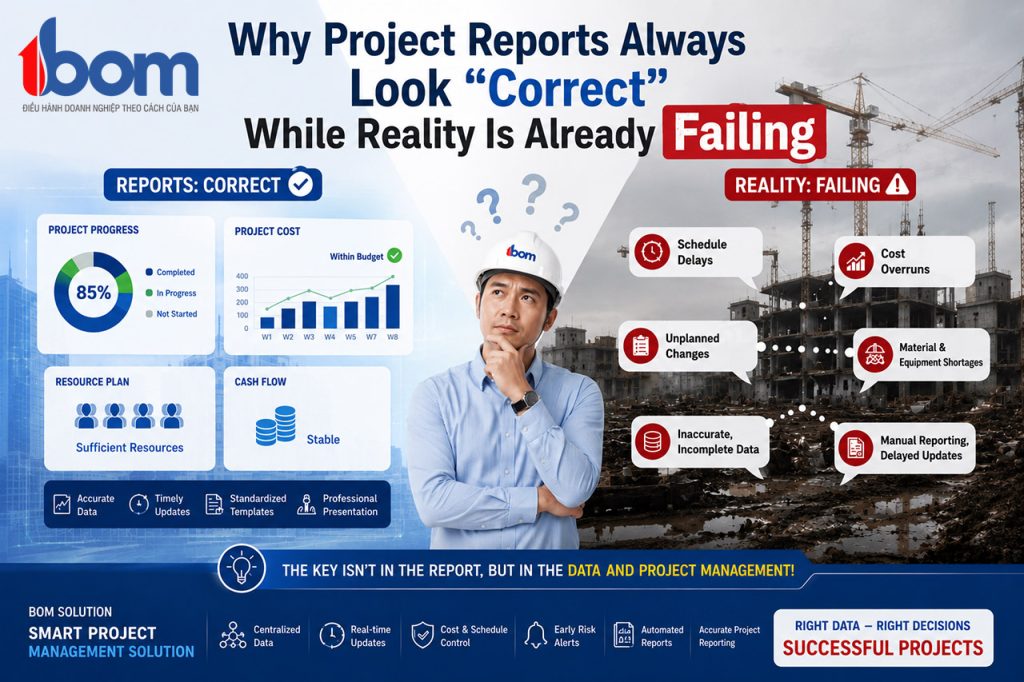
3. The Illusion of Reporting

Many companies rely heavily on reporting.
Weekly reports.
Monthly summaries.
Executive dashboards.
But reporting is not the same as structure.
Reports:
- Simplify reality
- Compress information
- Hide underlying patterns
By the time insights appear in reports, it is often too late.
The system has already produced the outcome.
4. What Data Structure Really Means
A structured data system in construction requires:
Standardization
All projects follow the same data model.
Integration
Data flows across cost, schedule, and operations.
Continuity
Data moves in real time, not just in reporting cycles.
With structure:
- Data becomes comparable
- Patterns become visible
- Decisions become proactive
5. Why Structure Is the Foundation of Control
Without structured data:
Control is impossible.
Because control requires:
- Visibility across projects
- Early detection of risks
- Understanding of system behavior
Data structure is what connects operations to leadership.
It is the foundation of project governance.
6. From Data Collection to Data Systems
To move forward, construction companies must shift from:
Collecting data → Designing data systems
This means:
- Defining consistent data frameworks
- Connecting all project data sources
- Building real-time visibility layers
Platforms like IBOM enable this transformation by structuring project data into a unified system.
7. The Leadership Question That Matters
The real question is not:
“How do we collect more data?”
But:
“How do we structure data so it becomes a system for decision-making?”
Because in construction:
Companies don’t fail because they lack data.
They fail because their data cannot be used.
Đỗ Hữu Binh
CEO, ISOFT
This article is part of a professional series analyzing construction project management and cost control strategies.
© 2026 Đỗ Hữu Binh. All rights reserved.
Any citation or reuse of this content must clearly state the source and author.