
Building on Article “Contractor and Subcontractor Management: Quantities, Schedule, Quality and Payment“, this article examines contractor risk forecasting and a practical iBOM deployment architecture for general contractors and subcontractors.
1. Contractor risk emerges before a milestone is missed
A subcontractor rarely becomes a project risk only on the day a handover milestone slips. Early signals may include inconsistent crew mobilization, falling output per shift, unresolved material approvals, an expanding backlog of inspection requests or recurring payment-document corrections. None of these observations necessarily indicates failure on its own. Together, however, they may reveal constraints in delivery capacity, coordination or financial resilience.
The general contractor is exposed to more than the delayed package itself. Mechanical and electrical work can block ceilings; unaccepted work can delay testing and handover. Risk therefore needs to be evaluated through the dependencies between packages rather than through a standalone score assigned to each company. AI becomes useful when it connects fragmented operational evidence and helps managers decide which emerging problems deserve investigation first.
2. Define the outcome before predicting risk
“Contractor risk” is not a single measurable event. Failure to meet a milestone, inability to sustain production, recurring nonconformities, inadequate resource mobilization and payment-document bottlenecks have different causes and consequences. Combining them into an opaque number may produce an attractive dashboard without identifying a practical response.
A useful prediction specifies an event, a time horizon and the affected scope. “Risk of failing to hand over level 12 within the next 21 days” is actionable in a way that “high-risk subcontractor” is not. Each alert should be associated with a package, location, planned milestone, expected impact and accountable manager. Only then can the organization test whether the prediction was timely and accurate.
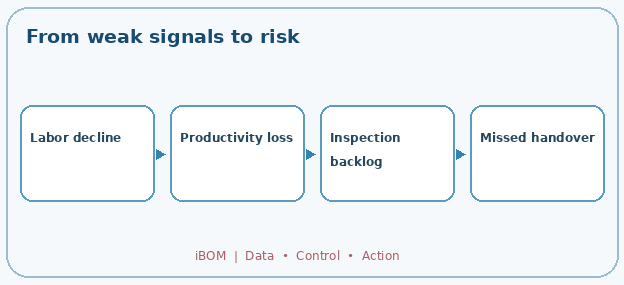
Figure 1. From weak signals to risk
3. Operational history matters more than a static profile
Prequalification information, comparable-project experience and financial standing are important during selection, but they cannot replace continuous observation of performance on the current project. Even an experienced contractor can struggle with restricted access, changed drawings, unfamiliar crews or simultaneous commitments elsewhere.
The operating record should connect assigned work, actual and accepted quantities, mobilized labor, productivity, approved materials, equipment availability, nonconformities, safety observations and contractual documentation. Records must preserve their original timestamps and the schedule revision that applied when the information was known. Using month-end outcomes to predict an event earlier in the same month introduces future information into training and produces misleading performance claims.
4. Separate reported progress, accepted work and payable value
A subcontractor may report 65 percent physical completion while only 52 percent has passed acceptance. This difference is not proof of poor performance: testing, document preparation or inspection scheduling may explain part of it. Nevertheless, a widening gap on activities that constrain the critical path deserves immediate attention.
The same distinction applies to requested payment, certified payment and cash actually disbursed. An AI system must retain these as different business states and link them to contract conditions, acceptance evidence and approved changes. If they are collapsed into a generic “completed” field, a sophisticated model will still learn from operationally incorrect data. Sound data definitions are therefore a prerequisite for meaningful risk analytics.
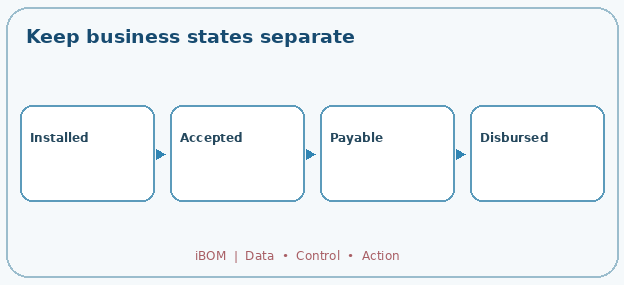
Figure 2. Keep business states separate
5. How AI combines weak signals into an early warning
Implementation can begin with transparent management rules: persistent labor shortfalls, declining productivity over consecutive periods, excessive inspection backlogs or successor activities blocked by incomplete handovers. Such rules are explainable and immediately useful, although they may miss interactions between multiple weak signals.
With sufficient reliable history, machine-learning models can estimate the likelihood of a defined milestone or output shortfall over a specific horizon. Predictions should be accompanied by interpretable contributing factors, such as declining mobilization, poor first-pass inspection performance or prolonged technical-query resolution. Statistical association does not establish responsibility. Managers must distinguish subcontractor-controlled problems from late access, design changes or other constraints imposed by upstream parties.
6. Risk propagates across package interfaces
A three-day delay may be inconsequential when float is available, yet severe when it blocks several successor trades. Contractor risk assessment must therefore reflect activity dependencies, interface conditions and the real availability of workable areas. An alert concerning one subcontractor should be interpreted alongside the integrated schedule, handover constraints and remaining contingency.
Consider an MEP contractor unable to complete pressure testing, preventing the ceiling team from closing an area. Aggregate completion percentages might still appear satisfactory, but dependency-aware analysis exposes the impact on downstream milestones. AI can help prioritize these bottlenecks; decisions about resequencing must remain with engineers and construction leaders who can assess technical, safety and contractual implications.
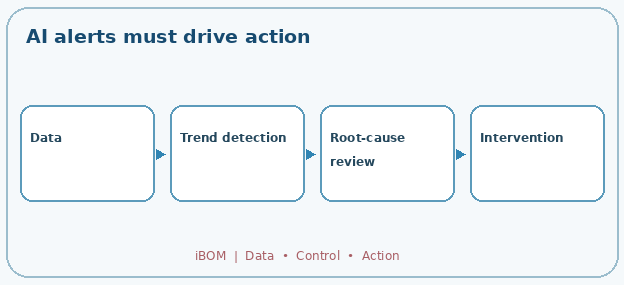
Figure 3. AI alerts must drive action
7. Evaluate warnings by lead time and decision value
Accuracy alone is insufficient. Where serious failures are uncommon, a model that always predicts “no risk” can achieve a high accuracy rate while missing every event that matters. Evaluation should consider missed events, false alarms, probability calibration, differences across package types and—crucially—the time available to intervene.
A forecast made two days before a missed milestone may be accurate but operationally useless. A less certain warning three weeks ahead may allow the team to mobilize additional resources or resolve procurement constraints. Management should explicitly balance the cost of investigating false alerts against the consequences of missed risks. Performance must also be tested across project phases and contexts rather than assumed to transfer unchanged.
8. Illustrative case: an MEP subcontractor under pressure
Imagine a high-rise MEP package scheduled to hand over levels 10–14 in six weeks. At the end of week three, reported progress continues to increase and no major milestone has yet been missed. Yet actual crew deployment is approximately 18 percent below plan, installation productivity has fallen for two reporting periods, inspection requests are accumulating and some delivered equipment lacks final technical approval. All figures in this scenario are illustrative; they are not validated model results.
An analytics system could flag the risk of a late level-12 handover and surface the contributing signals. The general contractor should not immediately infer subcontractor incompetence. Investigation may reveal that late access and revised drawings explain some of the productivity decline, while insufficient specialist crews explain the remainder. A responsible response would coordinate access, reinforce the critical crew, secure inspection slots and track weekly recovery evidence. The benefit is an earlier, more focused management conversation.
9. Turn a forecast into accountable intervention
An alert creates value only when it becomes an assigned action with a deadline and verifiable closure criteria. A productivity warning calls for examination of access, labor, equipment and methods; a quality warning requires attention to defect type, recurrence and inspection coverage; a payment warning requires separation of missing documentation from disputed valuation or delayed disbursement.
Risk scores should never automatically trigger withheld payment, penalties or exclusion. Such decisions require contract-based evidence, due process and authorized approval. Subcontractors should be able to review relevant records, correct inaccurate entries and explain external constraints. Without that feedback mechanism, AI may amplify information asymmetry rather than improve collaboration.
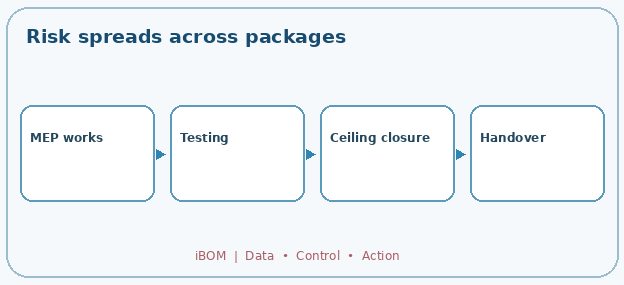
Figure 4. Risk spreads across packages
10. A proposed iBOM operating model for general contractors and subcontractors
As a solution architecture, iBOM could provide a shared operating-data environment in which each subcontract package is connected to contract scope, work breakdown, site locations, handover milestones and accountable parties. Subcontractors would submit workforce records, installed quantities, constraints and inspection requests; authorized general-contractor personnel would verify actual progress, acceptance and blocked interfaces. Role-based access would preserve each participant’s contractual scope while giving the general contractor an integrated project view.
This is a proposed implementation model, not a claim that every capability is currently available in the deployed iBOM product. An initial capability and integration assessment is necessary. The first release should emphasize consistent data and transparent rule-based alerts, which can already improve coordination. Predictive machine learning should follow only when the historical records and outcome labels are sufficiently reliable to justify it.
11. A staged deployment from one pilot to portfolio-wide warning
Start with a live project and a small number of closely dependent packages, such as MEP and finishes. The general contractor and subcontractors should agree on the operational meaning of installed, accepted and payable quantities, unresolved constraints, mobilized resources and handover eligibility. Site teams then capture records as work occurs; authorized staff validate them, while the system retains timestamps and revision history.
After several operating cycles, introduce package-level dashboards and transparent alert rules, measuring the time between detection and resolution. Next, audit historical completeness, define measurable outcomes, split training and validation data chronologically and test any predictive model on projects excluded from training. AI should enter as an explainable recommendation rather than an autonomous decision-maker. Scaling should depend on fewer missed handovers, faster constraint resolution and reduced rework—not on the volume of alerts generated.
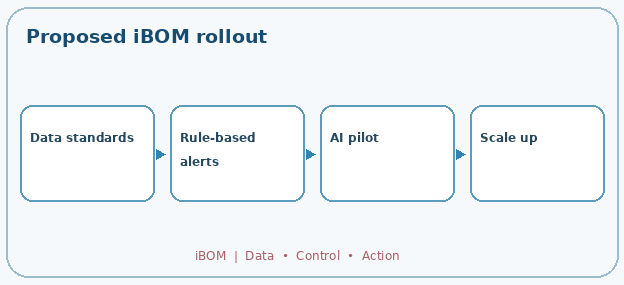
Figure 5. Proposed iBOM rollout
12. Data governance, fairness and accountable use
Subcontractor records may contain commercially sensitive rates, payment terms, personnel information and unresolved disputes. Access controls, purpose limitations, audit trails and agreed retention policies are essential in a multi-company environment. Data from one project should not automatically become a universal judgment about a firm’s capability.
Models require monitoring as project types, reporting practices and site conditions change. A subcontractor inspected more intensively may accumulate more defect records without delivering worse actual quality; another may inherit exceptionally difficult work areas. Context and inspection coverage must therefore be considered before comparing performance. Explainability, challenge mechanisms, model review and the ability to suspend unreliable scores are not optional extras. They are necessary conditions for responsible risk management.
Conclusion
AI should not reduce subcontractors to opaque scores. Properly implemented, it helps general contractors see risks where schedule, quality, resources and contract administration intersect, creating time for coordinated intervention. For iBOM, the primary opportunity is to establish reliable, traceable operating data before building predictive models. Success should be measured by dependable handovers, less rework and greater transparency between general contractors and subcontractors.
Professional references and conceptual foundations
- ISO 31000:2018 – Risk management — Guidelines.
- ISO 9001:2015 – Quality management systems — Requirements.
- NIST AI Risk Management Framework (AI RMF 1.0), 2023.
- Project Management Institute – project risk and schedule management principles.
- Why Great Construction Companies Don’t Depend on Great People
- Construction Project Management: From the Master Plan to Execution Control on Site
- Why Construction Companies Will Compete on Decision Speed, Not Execution Speed
- Scaling Project Control Across Multiple Construction Projects – Without Losing Flexibility
- Most CEOs Don’t Have an Execution Problem — They Have an Accountability Problem