
Construction delay rarely begins on the day an activity is reported late. It usually develops through a chain of earlier signals: slower approvals, unresolved constraints, declining productivity, unstable resources, late procurement and repeated schedule movement. AI can add value by combining these signals and estimating emerging risk before the final variance becomes visible.
The purpose is not to replace planners or project managers. It is to increase early-warning time and convert fragmented project data into prioritized, explainable signals that managers can act on.
1. Delay is a lagging outcome of earlier conditions
Traditional schedule reporting is dominated by lagging indicators. By the time a planned start or finish date is missed, the causes may have been developing for weeks.
AI can estimate the probability and potential impact of delay from combinations of weak signals. The useful output is therefore not only a predicted completion date, but also risk probability, likely drivers and remaining intervention time.
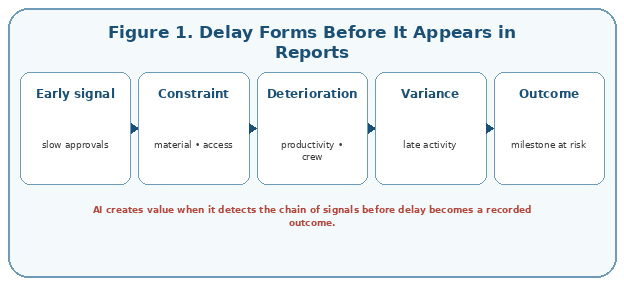
Figure 1. Delay usually develops through a chain of signals before it becomes a reported schedule variance.
2. Prediction requires more than the schedule file
The baseline and schedule network provide milestones, dependencies, float and update history. They describe how the project is intended to operate, but they do not fully describe execution reality.
A practical prediction layer also needs field progress, productivity, design approvals, RFIs, procurement status, material delivery, labor, equipment, access constraints, change events and relevant external context. The decisive capability is the linkage among these objects and schedule activities.
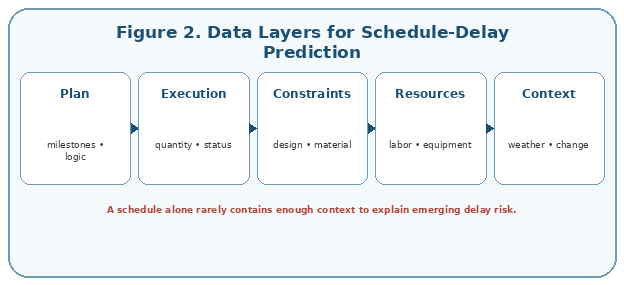
Figure 2. Delay prediction requires schedule data plus execution, constraints, resources and context.
3. AI learns patterns through management features
Machine-learning models learn recurring relationships between observed conditions and later outcomes. Raw events therefore need to be transformed into meaningful features such as approval-cycle trends, float consumption, late-start frequency, labor variance, delivery slippage and unresolved-constraint density.
Interpretability matters. A slightly less accurate model that explains the main risk drivers may create more management value than an opaque model with a higher benchmark score.
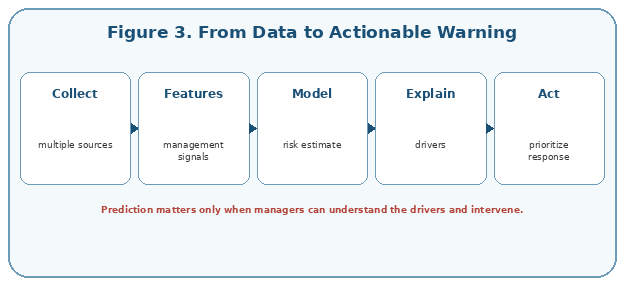
Figure 3. Prediction creates value only when risk is explainable and connected to action.
4. Delay prediction should operate at multiple levels
Executives may need project-level completion risk; project teams need package-level risk; planners need activity-level start or finish risk; field teams need constraint-level warnings.
Useful systems combine probability, impact and explanation, and refresh those outputs as new information arrives. A warning is not a fixed conclusion; it should respond to corrective actions and new evidence.
5. AI complements critical-path and probabilistic schedule methods
Critical Path Method (CPM), float analysis, baseline variance and Monte Carlo simulation remain foundational. AI adds a data-driven layer that can recognize multivariate execution patterns that traditional schedule logic alone may not capture.
The strongest architecture therefore combines schedule logic, probabilistic reasoning, execution data and professional judgment rather than positioning AI as a replacement for scheduling software or experts.
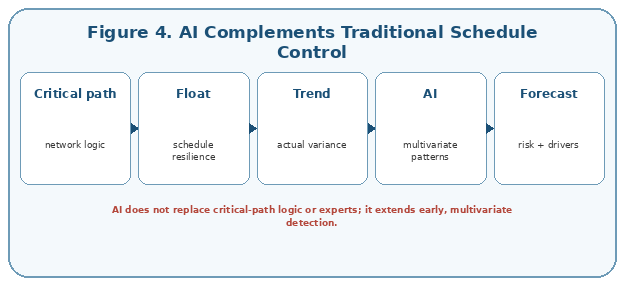
Figure 4. AI extends rather than replaces critical-path logic, probabilistic methods and expert judgment.
6. The real challenge is converting warning into action
A prediction engine can still fail operationally if it produces too many alerts without priorities, owners or response deadlines. Risk should be ranked by probability, impact, milestone proximity, propagation potential and remaining response time.
Warnings should become actions: accelerate an approval, secure an alternative supplier, resequence work, investigate productivity or escalate a decision. Outcomes should then be fed back into the system.
7. Data quality is usually harder than model selection
Historical data is often inconsistent across projects. Coding structures, status definitions, update frequencies and delay-cause taxonomies may differ. Enterprises need a minimum common data model and must preserve change history, not only the latest state.
Training also needs to avoid future-data leakage and monitor model drift when project types, contractors, methods or processes change.
8. Model quality should be measured in management terms
Overall accuracy can be misleading when delay cases are relatively rare. Recall, false-alert rate, probability calibration and lead time are more informative.
Business measures matter even more: average warning lead time, percentage of alerts that trigger action, risks removed before milestone impact, avoided delay days and user trust.
9. Explainability and governance must be designed in
Users should be able to see the source data, update time, confidence level and major drivers behind a warning. Decisions and outcomes should be traceable for learning and governance.
AI should not autonomously change contractual baselines or commit major resources solely on a prediction. High-impact actions should remain under appropriate human approval.
10. A practical implementation roadmap
Start with one narrow management question, standardize the necessary data, build a historical dataset and run a pilot in parallel with the current process. Then integrate useful warnings into the weekly management cadence.
Only after the foundation is stable should the organization expand toward BIM, document intelligence, imagery, sensors and broader predictive models.
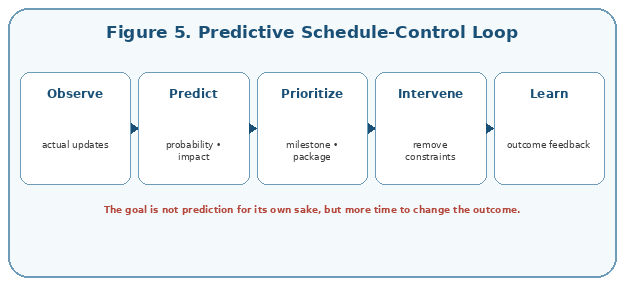
Figure 5. Predictive control is a closed loop from observation to intervention and learning.
11. Example: early warning before a commissioning milestone
A mechanical and electrical package may still be on schedule while approval time is rising, critical equipment delivery remains uncertain, labor is below plan and predecessor float is being consumed. A model can combine those signals and show that milestone risk has materially increased even before a formal delay appears.
Management can then accelerate approvals, secure alternatives, add crews or resequence work. The value is not the prediction itself; it is the additional time created for intervention.
Conclusion
AI can support construction-delay prediction when it is built on a disciplined project-control and data foundation. Delay is the result of interacting constraints and execution conditions, and AI is useful because it can observe many of those signals simultaneously.
Success should be measured less by model sophistication than by whether the project sees risk earlier, understands the drivers and acts before the delay becomes irreversible.
References
- Gao, Y. et al. (2026), Artificial Intelligence in Construction Project Management: A Systematic Literature Review of Cost, Time, and Safety Management, Buildings.
- BIM and AI Integration for Dynamic Schedule Management: A Practical Framework and Case Study (2025), Buildings.
- AI-Driven Decision Support System for Proactive Risk Management in Construction Projects (2026), Intelligent Infrastructure and Construction.
- Project Management Institute (PMI), schedule, critical path, risk and project-control resources.
- Oracle Construction and Engineering, Construction and Artificial Intelligence: Driving Better Outcomes with Data.