
ERP discussions often begin with modules: finance, procurement, inventory, sales, manufacturing or HR. That view is useful but incomplete. The deeper purpose of ERP is to place activities that span many functions into a shared structure of data, processes and controls, so that a transaction initiated in one area is reflected consistently wherever its consequences matter.
ERP therefore contributes more than document digitization or reduced data entry. It establishes a common operating layer: shared definitions of resources, consistent transaction records, explicit handoffs and traceability from management outcomes back to the activities that produced them. This is why ERP commonly serves as a transactional core and as a foundation for analytics and AI.
1. What is ERP, and why can “resource planning” be misleading?
ERP stands for Enterprise Resource Planning. Modern definitions describe it as an integrated software system for managing core processes such as finance, procurement, supply chain, manufacturing, sales and HR on shared data. Oracle emphasizes process integration and data flow across functions, while SAP describes integrated applications that share a common database and provide a single source of truth.
The phrase resource planning can sound narrower than the actual scope. ERP covers planning, transaction creation, approval, execution, recording, reconciliation and reporting. A material request can become a purchase order, a goods receipt, an inventory update and ultimately a financial liability. ERP value emerges when these are connected states of one business flow rather than independent records.
ERP is therefore more than extended accounting. Accounting records financial consequences; ERP connects those consequences to operational causes. Managers can trace a cost back to a purchase, material, project, cost center or activity, turning transaction data into management evidence.
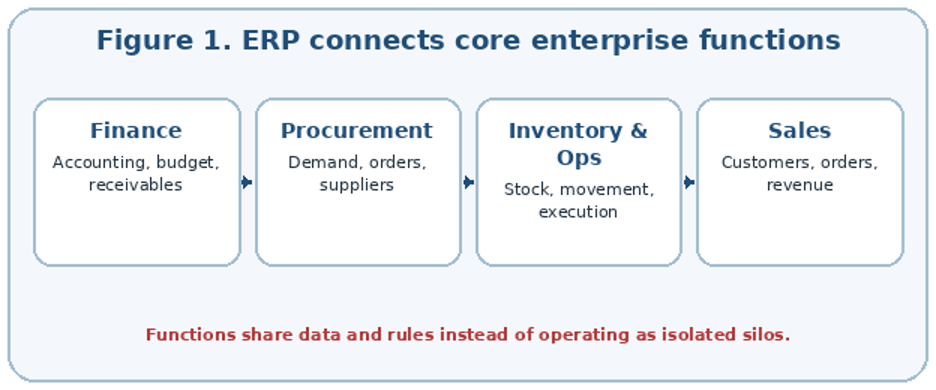
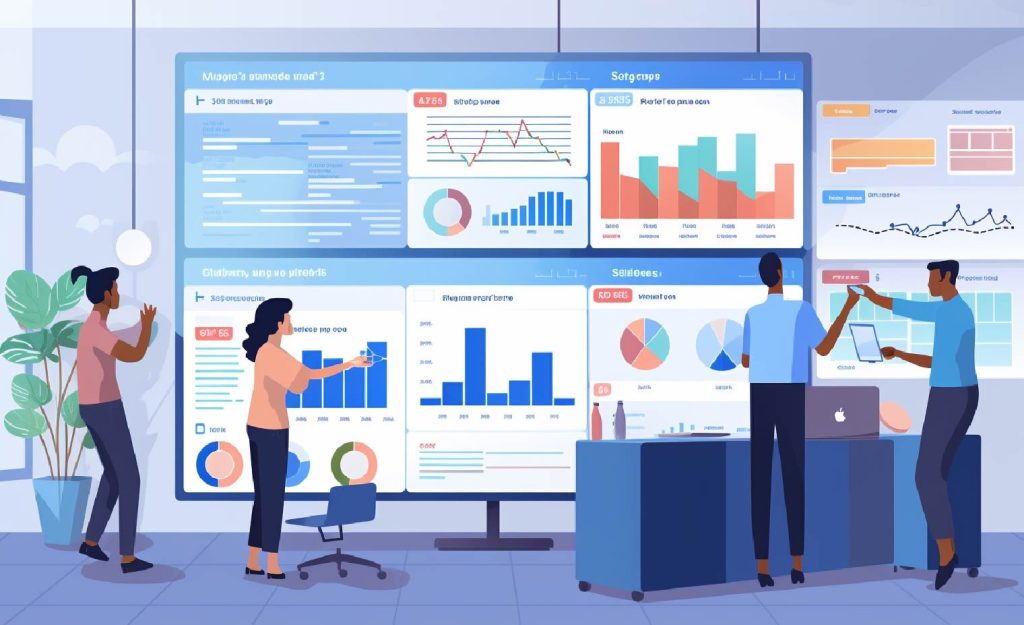
Figure 1. ERP connects core enterprise functions.
2. ERP addresses fragmentation, not merely a shortage of software
Organizations often have many tools before ERP: accounting packages, procurement spreadsheets, warehouse apps, sales systems and specialist platforms. The problem is that each can create its own version of truth. Suppliers may have duplicate codes, the same item may use different names, and inventory or order status may differ across functions.
This fragmentation creates hidden coordination costs: re-entry, reconciliation, phone calls, confirmation and correction. As the enterprise grows, the number of cross-functional handoffs rises and every unstandardized handoff becomes a potential delay or error point.
ERP addresses this through common master data and integrated transaction flows. A purchase order can retain who requested it, its business purpose, budget impact, receipt status and payable consequence. The enterprise spends less effort translating data between functions and gains stronger end-to-end control.
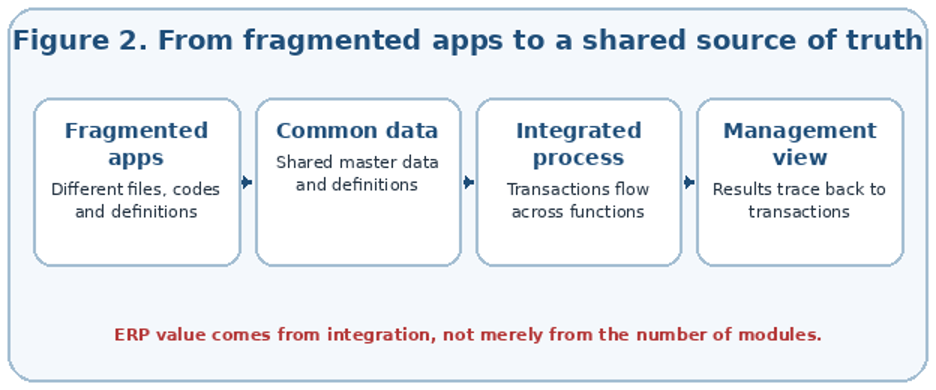
Figure 2. From fragmented apps to a shared source of truth.
3. How ERP works: shared data and cross-functional processes
ERP modules should not be viewed as isolated applications. They use related business objects and shared definitions. Customers, materials, organizational units and projects need consistent identifiers so that transactions across sales, inventory and finance can be connected into one business narrative.
Consider procurement: a user raises demand, approval rules are applied, purchasing issues an order, inventory records receipt, the business confirms quantity or quality, and finance recognizes the obligation. In disconnected systems, people bridge these steps manually. In ERP, document relationships and state transitions are designed into the process.
ERP is consequently often treated as a system of record for core transactions. It does not have to contain every enterprise dataset; rather, important transactions have an authoritative record with status, actor, time, permissions and history. That traceability supports audit, reconciliation and management analysis.
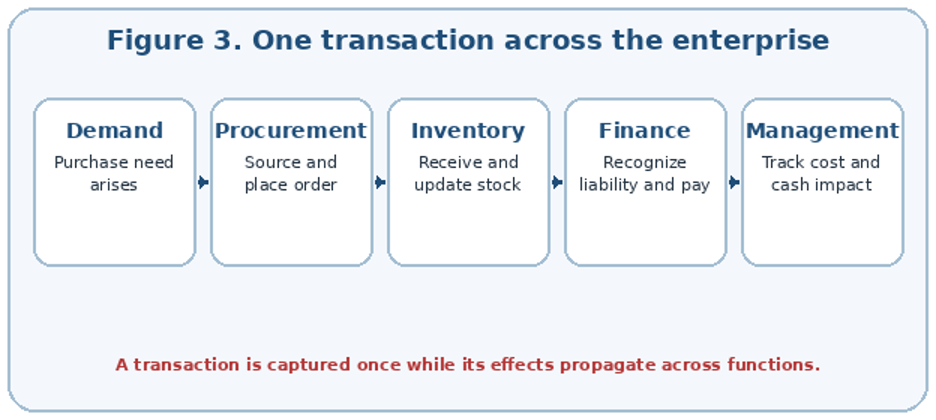
Figure 3. One transaction across the enterprise.
4. The role of ERP in modern enterprise management
First, ERP creates operating discipline by embedding approved rules, required information and controls into repeatable workflows. This is not about making the organization rigid; it is about making agreed management principles executable.
Second, ERP connects operations with finance. Costs, revenue, inventory, receivables, payables and resource commitments can arise directly from business transactions, allowing managers to see financial implications while operations are unfolding rather than only at period end.
Third, ERP creates traceability. A management metric is more useful when it can be traced to source transactions: which items drove inventory growth, which purchase package drove project cost, or which contracts created overdue receivables.
Fourth, ERP supports cross-functional coordination by making handoffs explicit: who initiates, approves and executes; which conditions permit state changes; and which exceptions require intervention. This extends the process-standardization logic discussed in Article #03 into system-enforced execution.
5. ERP is not the entire digital architecture
A common mistake is expecting ERP to replace every other system. Modern enterprises often need specialist platforms such as CRM, MES, BIM, IoT, project management and asset applications. SAP notes that modern ERP must connect and synchronize with other applications and data sources to create a unified view.
The architectural question is therefore not whether everything belongs in ERP, but which transactions and data should be governed by the ERP core, which require specialist systems, and where integration boundaries should sit. MES may manage minute-by-minute shop-floor execution while ERP retains enterprise plans, inventory and financial consequences. BIM may manage technical models while ERP manages contracts, procurement, costs and assets.
Well-designed boundaries keep ERP strong as a transactional core without turning it into an oversized system that tries to do everything. Integration and enterprise data platforms connect specialist systems with ERP, while BI and AI use contextualized data for analysis and prediction.
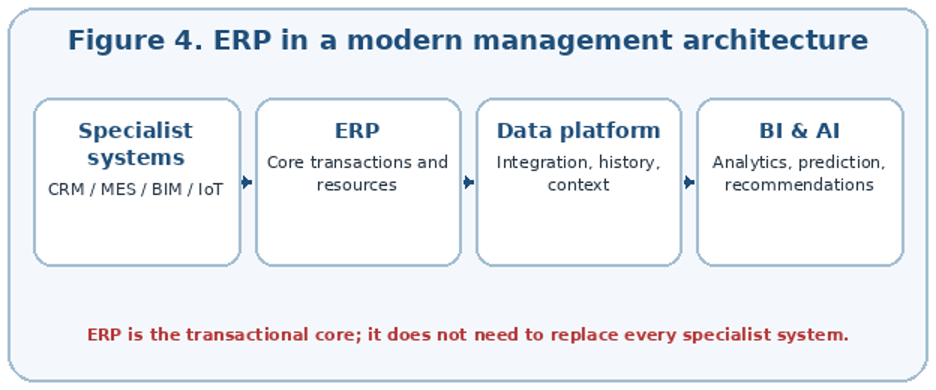
Figure 4. ERP in a modern management architecture.
6. Why do ERP programs often underdeliver?
ERP failure is rarely only a software problem. Organizations often digitize weak processes as they are. If responsibilities are unclear, master data is poor, controls are ceremonial and exceptions are undefined, ERP can make complexity systematic rather than eliminate it.
Another problem is treating ERP as an IT project. ERP changes how functions work, who approves, how performance is measured and sometimes how authority is distributed. Process owners and business leaders therefore need to own design decisions. SAP implementation guidance similarly stresses that software selection is only the beginning and that preparation and change management matter throughout implementation.
Data migration is another major risk. Moving duplicate codes and unreliable balances into a new platform produces faster but not more trustworthy reporting. Excessive customization also creates long-term cost by reproducing legacy habits and making upgrades harder.
Success should therefore be measured beyond go-live: cycle time, data consistency, off-system work, reconciliation effort, closing speed and management visibility should all improve.
7. A management-led ERP implementation roadmap
A sound roadmap starts with management problems rather than feature lists. Identify bottlenecks that create cost or risk—uncontrolled procurement, inaccurate inventory, weak project-cost visibility, disconnected sales and receivables, or manual reporting—and attach measurable outcomes to each.
Next standardize processes and data. Define process ownership, standard flows, permitted exceptions, shared master data and data-quality accountability. Only then should the organization configure ERP, design integrations and migrate data. Technology should serve an intentionally designed operating model rather than accidentally define it.
After go-live, operating data reveals where users bypass the system, which steps create bottlenecks, which rules generate excessive exceptions and which metrics fail to reflect reality. ERP is therefore not a project with an absolute endpoint; it is an operating capability that must evolve with the enterprise.
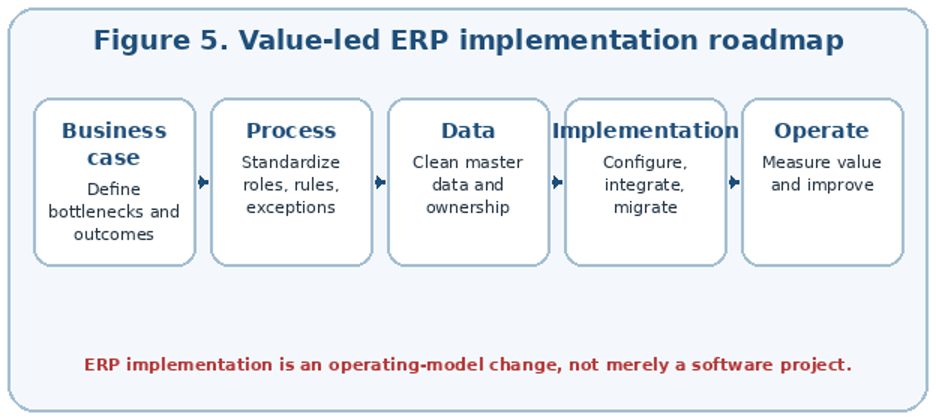
Figure 5. Value-led ERP implementation roadmap.
8. ERP as a foundation for intelligent management
The first articles in this series discussed real-time data and AI-assisted decisions. ERP sits between those themes. AI needs structured, contextual enterprise data, and many of the most important signals are generated by ERP transactions: orders, procurement, inventory, costs, receivables, plans and resources.
Traditional ERP mainly answers what has been recorded and what the current state is. Combined with a data platform, analytics and AI, enterprises can move toward predicting what may happen, identifying exceptions and recommending action. But intelligent models cannot sustainably compensate for duplicate master data, missing transactions or uncontrolled processes.
ERP is therefore not the destination of digital transformation. It is part of the management infrastructure that moves an enterprise from fragmented records to controlled, connected processes and data. The next article will examine how ERP itself changes in the AI era—from a system of record toward a platform that increasingly supports sensing, prediction and decision-making.
Conclusion
ERP matters not because it bundles many functions into one product, but because it connects data, process, accountability and financial consequences. When implemented well, a transaction no longer belongs only to the department that created it; it becomes part of an enterprise flow that can be tracked, controlled and traced.
That value appears only when ERP is treated as an operating-model transformation. Process standardization, data governance, role design and integration architecture must accompany technology selection. With that foundation, ERP can become a reliable core on which real-time data, analytics and AI create management value.
References
- SAP (updated 26 January 2026), What is ERP? The Essential Guide – https://www.sap.com/sea/products/erp/what-is-erp.html
- Oracle, What Is ERP? – https://www.oracle.com/asean/erp/what-is-erp/
- Oracle, What Are the Benefits of an ERP? – https://www.oracle.com/erp/what-is-erp/erp-benefits/
- SAP (updated 26 January 2026), ERP Implementation Best Practices and Pitfalls to Avoid – https://www.sap.com/uk/products/erp/what-is-erp/erp-implementation-best-practices.html
- SAP (23 June 2026), ERP Automation at Scale: A Playbook for AI-Enabled Operations – https://www.sap.com/blogs/erp-automation-at-scale
- Construction Project Management: From the Master Plan to Execution Control on Site
- Scaling Project Control Across Multiple Construction Projects – Without Losing Flexibility
- In the AI Era, Management Power Lies in Execution Data
- A Day in the Life of a Construction Site Manager: What Do They Really Do?
- Why Construction Companies Cannot Scale