
When an enterprise is small, many operating problems can be solved through direct communication. Managers know who holds a document, why a case is delayed and which customer needs attention. Experience and personal coordination can compensate for the absence of formal process design.
Growth changes the structure of work. More employees, projects, locations and approval levels create more handoffs and dependencies. The issue is no longer whether individual employees are capable, but whether the organization has a common operating method that lets many people coordinate without continuously asking for clarification or escalating routine issues.
Process standardization is therefore not an administrative exercise. It is the mechanism that converts personal know-how into an operating system that can be repeated, controlled, measured and improved.
1. Growth exposes the limits of experience-based management
In an early-stage organization, many procedures exist as tacit knowledge. Experienced employees know which information matters, whom to call and how to handle exceptions. At low volume, informal communication can compensate for unclear process design, so the organization may appear to operate well without formal standards.
As transaction volume grows, person-dependence turns into structural delay. A leave of absence can stop a workflow; two units can apply different criteria to the same case; routine questions are escalated because employees are uncertain about authority. Management overhead often grows faster than business volume because the number of handoffs and dependencies expands.
A common symptom is that senior managers become increasingly involved in routine operating decisions. What initially feels like careful control becomes a bottleneck. The enterprise has added employees but still operates with the coordination logic of a much smaller company.
Standardization moves repeatable knowledge from individuals into the operating system. Routine decisions become explicit rules and states, while judgment-intensive points remain visible. This allows expert knowledge to improve the performance of the organization rather than only the performance of the expert.
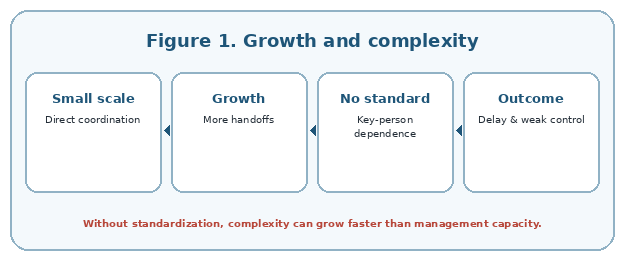
Figure 1. As scale increases, informal coordination creates more waiting points and person-dependence.
2. What does process standardization actually standardize?
Standardization is often mistaken for documentation. Documents are only a representation. Real standardization occurs when the organization agrees on how work starts, what information is required, who is accountable, how work moves, where controls apply and what constitutes completion.
Inputs are the first layer. Inconsistent inputs create rework downstream. Roles are the second: naming a department is not enough; the process should distinguish accountability, approval, consultation and information responsibilities. The third layer is status and transition logic, which makes it possible to see whether a case is awaiting information, approval, an external party or actual execution.
Controls must also be explicit. Approval thresholds, segregation of duties, compliance requirements and required evidence should be embedded at the right point rather than added as generic bureaucracy around every transaction.
Finally, a mature process standard includes exception design. It defines when deviation is legitimate, who can authorize it and how the reason is recorded. Repeated exceptions can then become evidence for process improvement rather than remaining invisible workarounds.
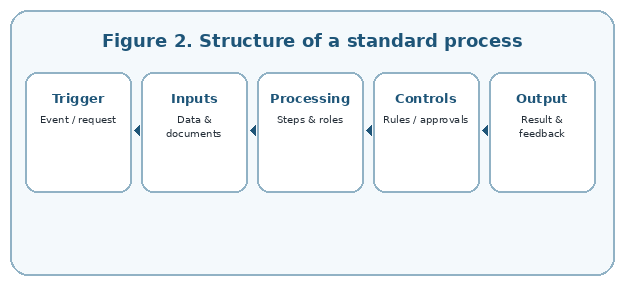
Figure 2. A standardized process clarifies inputs, steps, roles, controls and outputs.
3. Standardization lets the enterprise scale without scaling chaos
Opening new projects, branches or business units should not create a new version of the company each time. Shared processes provide a common operating backbone so expansion does not fragment purchasing, contracting, approvals and reporting into incompatible local practices.
Standard work shortens onboarding and increases workforce substitutability. Employees can move between projects more easily because they do not need to relearn the basic logic of each transaction. Managers can monitor status and exceptions instead of reconstructing the situation through individual conversations.
The greatest gains often occur at cross-functional handoffs. End-to-end processes such as order-to-cash or procure-to-pay can remain slow even when each department optimizes its own tasks. Standardization should therefore focus on the flow of value across departments, not only on local procedures.
Every important end-to-end process also needs an owner accountable for overall performance. Documentation without ownership creates a process on paper; ownership plus metrics creates process governance and continuous improvement.
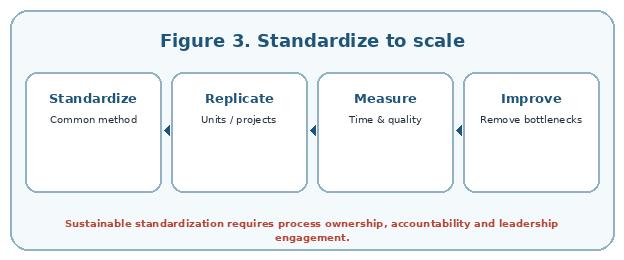
Figure 3. Standardization enables growth without proportionally increasing operating complexity.
4. Standardization does not eliminate flexibility
Poorly designed standards can become bureaucracy, but rigidity is not an inherent feature of standardization. The objective is to standardize what must be consistent while preserving professional judgment where context genuinely matters.
A useful design separates non-negotiable controls, the normal operating path and managed exceptions. Non-negotiable elements may include regulatory requirements, approval limits or master-data rules. The normal path should cover most transactions efficiently. Exceptions should be routed to people with the appropriate authority rather than forced through an unsuitable standard path.
For example, procurement can standardize request data, budget checks and approval rights while still supporting emergency purchasing when operations are at risk. The emergency path should record why it was used and by whom, preventing a legitimate exception mechanism from becoming a permanent shortcut.
Well-designed standardization therefore creates controlled flexibility. It removes repetitive debate about routine work and reserves human judgment for situations where it creates the most value.
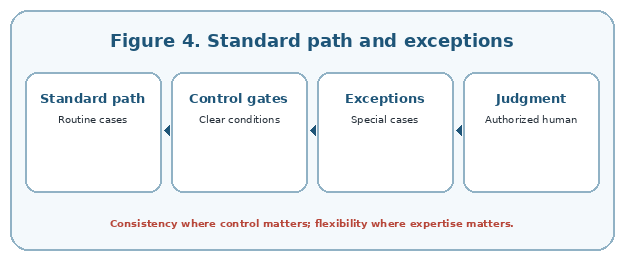
Figure 4. Standardize what must be consistent and deliberately design how exceptions are handled.
5. Standard processes create operational data and measurability
Unstandardized work usually records final outcomes but not how those outcomes were produced. Managers may know that an invoice was paid, yet not know how long it waited for validation, where it was returned or why it missed the target date.
Once steps, statuses, owners and timestamps are consistent, every case creates an operational trace. Enterprises can measure cycle time, waiting time, first-time-right rates, rework, SLA compliance and exception frequency. This is execution data rather than merely end-of-period reporting data.
Operational traces also support root-cause analysis. If payment lead time is excessive, the enterprise can determine whether the delay originates in missing documents, acceptance confirmation or approval capacity. Improvement can then focus on the actual constraint rather than on general assumptions.
This directly connects process standardization to data-driven management. Real-time data is useful only when events are captured consistently and with context. Standard processes provide the structure that makes operational data comparable, traceable and actionable.
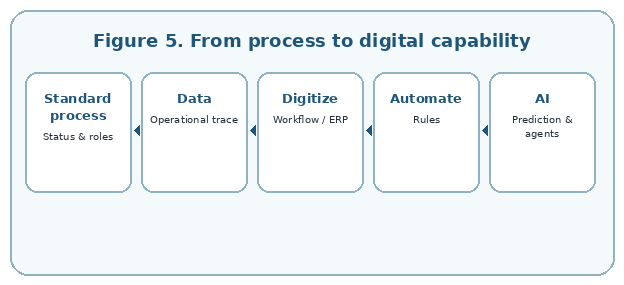
Figure 5. Standard processes create operational data for measurement, digitization, automation and AI.
6. Standardization is a prerequisite for digitization, automation and AI
Software can accelerate a process, but it cannot decide what the enterprise intends the process to be. Digitizing an unclear workflow often produces digital confusion: users still call each other for status, decisions occur outside the system and data is entered only after the fact.
Effective digitization requires explicit inputs, roles, statuses and permissions. Automation requires even clearer conditions so a system can act without asking for interpretation at every step. If approval limits, budget rules or master data are inconsistent, automation simply makes errors occur faster.
AI can handle less structured work, but it still needs process context. A model may identify unusual contract language, yet the enterprise must define which risks require escalation, who owns the decision and what the next action should be. An AI agent may prepare a requisition, but authority to release a purchase order must remain connected to approved limits and controls.
Standardization is therefore not an old-fashioned phase before digital transformation. It is the management layer that allows digital systems, automation and AI to operate deeply without losing control.
7. A practical standardization roadmap without added bureaucracy
Do not begin by documenting hundreds of procedures. Prioritize high-frequency, cross-functional processes that are visibly slow, risky or dependent on individual knowledge. Procurement, payments, contracts, change management and issue resolution are typical starting points.
First observe the process that actually runs, not the process described in policy. Follow real cases end to end and capture waiting points, loops, offline work and recurring clarifications. Then design a target process that removes unnecessary steps while clarifying data, roles, statuses and controls.
Pilot the design in a scope small enough to learn. Exceptions during the pilot are valuable evidence: some indicate missing rules, some reveal over-rigid design and others show genuine non-compliance. The process should be adjusted before broad rollout.
Finally, assign ownership and a small set of meaningful measures. Standardization becomes useful when it is continuously improved with evidence rather than periodically rewritten as an administrative document.
Conclusion
As enterprises grow, management becomes less about the capability of individual employees and more about the quality of the coordination system that connects their work. When operations depend on memory, relationships and constant intervention by key people, growth makes control progressively harder.
Process standardization converts good practice into repeatable operating capability. Its purpose is not rigidity: effective standards define the common path, preserve controlled flexibility for exceptions, create measurable operational data and assign clear ownership.
This is also a direct foundation for automation and AI. Technology can participate deeply in operations only when data, authority, conditions and expected outcomes are sufficiently explicit. Standardization is therefore not the destination; it is management infrastructure for scalable and increasingly intelligent operations.
References
- APQC, Process Management and Process Framework guidance.
- ISO 9001:2015, Quality Management Systems – process approach and documented information.
- Association of Business Process Management Professionals (ABPMP), BPM Common Body of Knowledge.
- IBM, Business Process Management and workflow automation resources.
- Construction Leadership Truth #2
- AI & Power: Whoever Controls the Algorithm Controls the Advantage
- Execution Data — The Missing Layer in Enterprise Management
- Construction Project Management: From the Master Plan to Execution Control on Site
- Execution Infrastructure — The Missing Foundation of Modern Enterprise Execution